
BANG!
Knife review “experts”. You see them all over YouTube, droning on and on, typically doing tabletop videos with disembodied hands, gleefully showing off their massive collections of knives that the rest of us will never be able to afford. There are other, self-proclaimed “experts” who hang out for hours and hours every day in online knife forums, spewing more opinionated BS, condescension, and vitriol than factual knowledge, bullying new people who ask basic questions, all the while quietly live in their mommies’ basements with the lights turned off. You know – keyboard warriors with no intellectual weapons. Of course, there’s also people who just endlessly blather on and on (and on!) in infinite-length blog posts nobody asked for and nobody reads! (I resemble that remark!)
However, these broad-stroke generalizations will unfortunately include some knife reviewers who actually provide excellent quality content and have a passion for both sharing their extraordinary knowledge and helping the community. Let’s talk about this – the good ones, specifically.
- Who are these people? They are you and me (well, you). They are passionate knife enthusiasts who have a thirst for learning, teaching, sharing, and entertaining! They are young and, well, old (I resemble that remark, too!). They are guys and gals (I also resemble that remark!). They have big personalities, often have a unique schtick, self-confidence, and excellent social intelligence (at least the successful video folks; the writers? Not so much!). But they are also just people. You know, like you and me!
- Who appointed them as knife experts? Well, they weren’t appointed as experts by anyone! They didn’t go to Knife Expert College and receive an associate degree in pocketknives. They know what they know from their experience as an enthusiast in the hobby, through research, and by handling a boatload of knives!
- What do they know? Their experience in handling knives informs their opinions, their research adds to their knowledge, and, at least to the lay person, are genuine experts in the field (remember that I’m talking about the good ones, not the fools in their mommies’ basements).
- What’s the point? So this is the key here. For a knife reviewer, the point is to grow as a person, to grow their knowledge, and grow their community of mutual enthusiasts by sharing their joy with the latest and greatest, as well as the best legacy, pocketknives. And, if possible, many can monetize their work! However, like with most things in life, only a small number of these folks will be able to make this work their primary income. Most will be happy with the opportunity to handle a lot of knives (I also resemble that remark), from good-quality budget to truly luxurious ultra-premiums, many sent to them for free (you realize that knife manufacturers and retailers love what amounts to very low-cost advertising for them! I just personally wish more of them recognized the genuine value of written reviews that always rank very highly in both web search [Google and others] and AI [ChatGPT, Gemini, Perplexity and more]! That’s what I do here.).
In recent years, we’ve seen a new phenomenon arise: knife reviewers and related influencers getting opportunities to design their own knives. This list includes such reviewer luminaries as Advanced Knife Bro, David C Anderson, Dutch Bushcraft Knives, Joe Flowers, Melissa Backwoods, Metal Complex, Nick Shabazz, Outdoors55, Stassa23 Knife Therapy, Swaggs, Tristate EDC, and Wayne’s Sharp World, Zach in the Wild, and others. Then you have knife reviewer folks who got so into it that they started their own knife companies so they could make even more of their own designs! This list includes Ben Petersen of Knafs Co., LeftyEDC of Divo Knives, and, of course, the guy who’s design is the focus of this knife review, Jerad Neeve of Neeve Knife Co.
Jerad’s latest design, the Inmate, manufactured by WE Knives, is a great example of a knife reviewer taking their knowledge and experience to design an impressive knife. Let’s get into it.

TL;DR
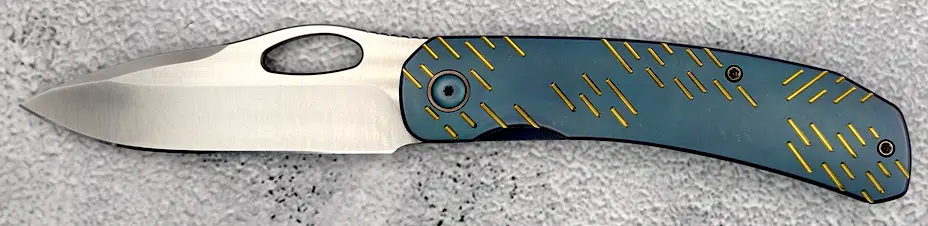
The WE Inmate, released in 2025, was designed by Jerad Neeve, the owner of both the Neeves Knives YouTube channel and Neeve Knife Co. The knife is full-size with a 3.65” hollow-ground CPM-20CV blade and a contoured, blue-anodized titanium handle, decorated with milled golden raindrops, and featuring a matching blue, titanium backspacer and milled pocket clip. The action of the ball bearings pivot is as smooth as oil on glass, allowing the chamfered opening hole as well as the front flipper to blast through the ceramic ball detent.
You’ll immediately notice the Inmate was designed by a knife guy, an enthusiast who knows what features work and what doesn’t. Were there compromises made? Well, does the knife cost $900? No, it doesn’t, so some compromises had to be made to keep the knife affordable. The pocket clip is non-ambidextrous. The blade steel HRc is at least a point below what would be optimum for CPM-20CV. The knife uses the very old frame lock style rather than a modern blade lock that doesn’t require your thumb to cross the disengaged blade’s path. And for reasons unknown to me, the pivot is free-spinning. I can’t imagine Jerad overlooked that design feature, so he must have had a reason for that, but I have no idea why. Such compromises are always the case with any knife designer and OEM knife manufacturer. But make no mistake. The good, no, the excellence of this knife design and its manufacturing quality far outweigh any niggling complaints from The Knife Karen. It’s very much a winning knife. Check it out.
Pros
- Extremely sharp, hollow-ground CPM-20CV blade with chamfered spine edges
- Contoured, fully radiused titanium handle scales with a lovely blue anodization and milled “golden raindrops”
- Functional jimping!
- Perfectly engineered, chamfered opening hole for easy opening
- Well-designed, easy to use, jimped front flipper
- Ridiculously smooth ceramic ball bearing pivot action with good detent break
- Matching blue titanium pivot faces with a pair of fine brass (copper?) pivot collars
- Attractive, milled, matching blue titanium backspacer
- Exclusively T8 fasteners
- Very stiff, matching blue (with matching golden raindrops!), milled titanium pocket clip that functions far better than expected
- TONS of little features and details that make the knife very special
Cons
- Non-captured pivot
- It has a lanyard mount! <must we?>
- Another frame lock knife <sigh>
- HRc rating low for 20CV potential
- Very shallow sharpening choil
- Non-ambi pocket clip
- Did I mention the free-spinning pivot? (ugh)
Tech Specs
Brand | WE Knife Co. Ltd. |
Website | |
Manufacturer | WE Knife |
Origin | Yangjiang, Guangdong, China |
Model Reviewed | Inmate WE23096B-3 |
Designer | Jared Neeve |
Model Launch Year | 2025 |
Style | Locking-blade folding knife |
Length Closed | 121.19 mm / 4.771" |
Length Opened | 212.46 mm / 8.365" |
Weight | 117.16 g / 4.133 oz. |
Lock Type | Frame lock with a titanium frame lockbar and a steel lockbar insert |
Opening Type | Manual |
Opening Mechanism(s) | 1. Front flipper |
Pivot Mechanism | Caged ceramic bearings |
Pivot Features | Free-spinning, shallow-domed, T8 socket pivot finished in the same matte blue finish as the scales. On both sides, each pivot has a narrow collar of what appears to be brass (copper?) hosting microscopically fine, concentric milling lines. |
Original Packaging | Basic nylon pouch (didn't get full shipping box) |
MSRP & Retail Price | MSRP: $350 |
Edge Type | Plain |
Shape | Drop point (but advertised as a spear point) |
Material | CPM 20CV |
Finish | Very fine machine satin |
Claimed Hardness HRc | 59-61 |
Length (from lower half of handle scale) | 92.64 mm / 3.647" |
Weight to Blade Length Ratio (some prefer a 1.0 ratio) | 1.26 |
Cutting Edge Length | 92.64 mm / 3.647" |
Height | 31.03 mm / 1.222" |
Primary Bevel Thickness | 2.53 mm / 0.1" |
Thickness Behind the Edge (TBE) Bevel | 0.36 mm / 0.014" |
Primary Bevel Half Angle | 4.2° |
Edge Bevel Half Angle | 11.9° |
Cutting Geometry Coefficient (0.100 and lower will provide excellent cutting performance) | 0.080 (NOTE: This hollow grind bevel will "feel like it cuts better" than a flat grind with the same score in shallow-to-moderate depth cuts.) |
Sharpening Choil from Handle Scale | Length: 6.94 mm / 0.273" |
Blade Features | A saber-ground blade with a hollow-ground primary bevel, a long flat and a swedge. The surface finish is fine-line, machine satin. The opening hole perimeters are fully chamfered, as is the blade spine flat up to the swedge. The blade edge bevels are even, symmetrical, and superbly sharp, thanks to Jared Neeve's expert-level sharpening skills. |
Grind | Saber with hollow primary bevel |
Flat | Length: 70.63 mm / 2.781" |
Swedge | Length: 45.04 mm / 1.773" |
Fuller | None |
Jimping | Blade spine features 7 moderately-spaced jimp cuts that are chamfered on the sides but excellently grippy on the perpendicular edges to the spine. The front flipper is also jimped with 6 finely spaced cuts with the same chamfered sides and grippy edges. |
Blade Markings | Show side: None |
On-Blade Opening Features | 1. Front flipper |
Flipper | Height: 3.34 mm / 0.131" |
Opening Hole | Height: 8.84 mm / 0.348" |
Materials | Titanium |
Finish | Matte blue with golden raindrops |
Length | 121.19 mm / 4.771" |
Blade to Handle Length Ratio | 0.76 |
Closed Knife Handle Height | 37.71 mm / 1.485" |
Open Knife Handle Height | 24.55 mm / 0.967" |
Handle Thickness | 12.58 mm / 0.495" |
Scale Thickness (includes liner if present) | 4.48 mm / 0.176" |
Scale Texture | Smooth with decorative, short diagonal cuts |
Handle / Scale Features | The handle is made from contoured, smooth Ti scales that feature short, diagonal milled cuts that are filled with a bright gold color (WE calls this golden raindrops). The edges are nicely radiused all around. The frame lock bar is short relative to the rest of the handle, features an interior relief cut with radiused edges, and it's spring is very firm. |
Pivot Type | Free-spinning |
Pivot Mechanism | Caged ceramic bearings |
Pivot Features | Shallow-domed, T8 socket pivot finished in the same matte blue finish as the scales. On both sides, each pivot has a narrow collar of what appears to be brass (or copper?) hosting microscopically fine, concentric milling lines. The pivot action is absolutely phenomenal, making it insanely easy to open with the opening hole (thumb and reverse flick) or the front flipper. |
Opening Stop Pin Type | Dual stop pins mounted on the blade tang. |
Closing Stop Pin Hits Sharpening Choil? | No |
Lock Type | Frame lock with a titanium frame lockbar and a steel lockbar insert |
Detent Type | Ceramic ball |
Pivot Center to Handle Balance Point (0.0 is balanced at pivot) | 29.94 mm / 1.179" |
Frame / Liner on Blade Tang Lock Up % | 59.50% |
Frame Lock Relief Cut Corners | Interior, rounded |
Flipper Tab Action (light switch or push button) | Light switch only |
Flipper Tab from Pivot Center Angle | 137° |
Backspacing Type | Backspacer |
Backspacing Material | Titanium |
Backspacing Color | Same matte blue finish as the scales |
Backspacer Length | 52.08 mm / 2.05" |
Backspacer Features | Has 19 narrowly spaced, jimping-style cuts but is mounted in the handle so that the tops between the cuts provide no traction, not that traction is needed on the backspacer. |
Lanyard Mount | Backspacer has narrowed section at the rear that serves as a bar above a carve-out in the scales, onto which a lanyard can be tied. |
Pocket Clip | Milled |
Clip Material | Titanium |
Clip Color & Finish | Matte blue with golden raindrops |
Clip Placement on Handle | Right hand only, Tip-Up |
Clip Height in Pocket | Deep carry |
Clip Length | 56.05 mm / 2.207" |
Clip Length to Handle % (< 50% preferred) | 46.25% |
Clip Features | Milled, deep-carry, using the same blue finish as the scales, with directionally coordinated golden raindrops on the blade channel side of the scale. It ends with a rounded tip that features a full-width ramp toe. |
Fastener Features | All fasteners are made of polished gray titanium with T8 sockets. |
Who is Jerad Neeve?
BANG! That’s Jared Neeve.

Jared is a very interesting man. He grew up in the tough streets of Chicago where poverty, despair and danger were the overwhelming features of his childhood and young adult years. In his Neeves Knives YouTube channel, he speaks with honesty, even vulnerability, about the challenges in his past. I won’t go into detail, as it’s not my place to do so. But I’ll say that his acknowledgment of his past is a recurring theme of his present. All his knife designs reference his troubled past, including the Misdemeanor, the Offender, and the knife of this review, the WE Inmate.
As he clearly states, the stories he recounts in his live streams do not glorify his past life experiences. Simply put, they are what they are – a part of what makes him the man he is today. Since that past is inescapable, he acknowledges it rather than trying to hide from it.
The key here is that he learned from it. He feels remorse for past deeds and activities and for those who were hurt. But importantly, he changed the direction of his life. He’s embraced the world of pocketknives. He’s become a leading expert in the skill of knife sharpening, in reviewing pocketknives for their design features and build qualities, and has earned great respect from the community as a result. He started his YouTube channel 6 years ago and has since published 3,750+ videos on YouTube alone, earning over 349,000 subscribers and attaining 128 million+ video views during that time. And these impressive numbers don’t include his additional posts on TikTok or Instagram!

In 2023, Jared and his wife, Kara (along with business partner, Matthew Sayers), founded the business and website, neeveknifeco.com, where his first few knives were sold, in addition to sharpening supplies, apparel and accessories to further build his brand.

Jared has always supported his friends and family. In terms of the community of pocketknife reviewers, he’s supported, even embraced, many others in this field. I don’t know how many times he’s done this. I know he’s helped Alex of Outdoors55 and Nick of Stassa23, and I suspect he’s quietly helped others as well. And now I can say that he’s helped little old yours truly, The Knife Karen of SharperApex. After receiving a wonderful introduction to Jerad from Bryan Winters of Winterblade, Jerad sent me all 3 of his knives to date for me to examine, experience and review as I see fit. I know at least 1 of these knives was his own, personal EDC, but he lent all 3 to me in a generous offer of support and friendship, for which I am humbly grateful. But don’t worry, dear readers. The Knife Karen (that’s me) will always speak her (my) mind, praise excellence, mention mediocrity, and raise a major fuss by calling out garbage for being garbage. I’m still a knife reviewer who values my integrity.
The way I see things, the measure of a woman or man is not just what they’ve done in the past, but what’s they’re doing now, how they’ve personally grown and positively changed, whether they have taken accountability for hurtful things from their past, and critically, how they are righting those wrongs. Everyone has skeletons in their own closets (don’t we – right?), have done things we regret, acted immaturely and hurt people as a result. Even if it was unintentional, people still got hurt. Some people have worse done things than others, of course, but acknowledgement, acceptance, and restitution are important parts of the process of redemption.
In recognition of the theme of the Inmate knife, I’ve asked a buddy of mine, Vin the inmate, to help me cover the typical metrics discussed in SharperApex reviews. Say hi, Vin!

Well, he’s not much of a conversationalist, but we’re going with this anyway.
Introducing the WE Inmate
WE Knives, founded in 2000, was initially an OEM for many global knife brands, and then finally launched a line of premium knives under their own brand name between 2014 and 2016. WE subsequently created a pair of sub-brands, CIVIVI in 2018 and SENCUT in 2020, to better serve the mid-level and budget lines of knives respectively to round out their full catalog of offerings. During that time, WE also began seeking out opportunities to collaborate with talented, well-known knife designers to expand the diversity of their offerings. Since then, WE Knives has earned world-wide respect and accolades for establishing that Chinese manufacturing can create pocketknives of the highest quality engineering and design.

The Inmate, built by WE Knives in collaboration with the design of Jerad Neeve of Neeve Knife Co., was launched at Blade Show Atlanta in early June 2025, and became publicly available later that month. In addition to the blue anodized version used in this review, WE sells these other color models:
- Stonewashed blade and gray scales with gray raindrops
- Polished gray blade and polished gray scales with satin raindrops
- Black stonewashed blade and black scales with blue raindrops

The Inmate has garnered all positive reviews from what I found online. It doesn’t have ratings everywhere (it hasn’t been around 61 years like the Buck 110!), but what I found were consistently 5 out of 5 star ratings (only one site had an aggregate rating score of 4.5). Suffice it to say that the Inmate has been a popular release. Let’s dig into the details to see what I found.
Blade
Do you like full-size knife blades? Do you like stainless steel? How about hollow grinds? Do you like sharp, slicey blades? Yeah, of course you do. That’s why you’re here. Let’s get into it.

Blade Features
The WE Inmate is equipped with the powder metallurgy, high-vanadium, M390-equivalent stainless steel, CPM-20CV blade.
Blade Shape
The WE Inmate is identified as having a spear point blade. To these old Knife Karen eyes, this knife uses a drop point blade. While I can see reasonable arguments being made each way, to me, the key is that the centerline of the blade, as measured from the ricasso, not in front of the opening hole, doesn’t have a symmetrical line running down to the blade tip. I don’t mean the top line of the primary bevel grind, even though that is a common feature on spear points; I mean the mathematical symmetry line that bisects the blade in half, top to bottom. The tip is below that line, whereas, by definition, the centerline of a spear point blade does run down to the tip. But hey, what do I know? Not much, really. If anything, The Knife Karen has a reputation for being a tad argumentative (ya think?).

The Inmate blade shows off a flashy trio of blade face grind regions. The flat, as usual, starts at the ricasso and runs for 70.63 mm / 2.781”, a full 76.2% of the blade length. The flat runs along the spine until it passes the opening hole, where it gives way to and plunges underneath the swedge. The swedge, 3.71 mm / 0.147” tall, runs along the spine for 45.04 mm / 1.773”, 48.6% of the blade length. Once the swedge runs out, the primary bevel finishes the run to the tip of the 92.64 mm / 3.647″ blade. Each of these blade grind regions are demarcated by crisply-defined grind lines, which look really nice.
The blade employs a saber-grind, so its primary bevel angle only begins at 15.78 mm / 0.621” from the blade edge, just 50.6% of the overall blade height. This sort of thing could be a detriment to many blades, as it negatively affects the blade geometry by increasing the primary bevel angle, which typically reduces blade sliciness. However, Jared specified a hollow ground blade, restoring sliciness, despite the 4.2° bevel angle.

One key asset of the blade design is the plunge grind. Take a gander at this:

What you see here comes from an experienced knife user & blade sharpener turned knife designer. Jared knows that to keep a knife usably sharp over a long period of time, the blade must be repeatedly sharpenable. There are several factors involved, and the placement of the plunge grind is really important. I’ve reviewed several knives whose blades have plunge grinds drop down right into the arc of the plunge grind, which really cuts into the blade’s long-term sharpenability. Unfortunate examples include the TuyaKnife Anzu, the Arcane Design The Creature, even the Kunwu Excalibur. Then there are knives that don’t even have plunge grinds or sharpening choils, such as the Spyderco Native Chief and, of course, my favorite non-favorite, the Opinel No. 9 Carbone, or as I prefer to call it, a piece of rusty metal pinned to a broken-off broomstick. Puhlease! Sharpening such knives, especially over time, will result in the ugliest of edge grind lines!

Finish
The Inmate’s blade has a lovely, fine-vertical-lined, machine satin finish across the swedge, the flat and the primary bevel. As I am partial to seeing beautiful blade steel, this finish makes me very happy!

Even Vin is happy with it!

Opening Mechanisms
Jared set us all up with options, both of which are really good.
It starts with the opening hole. A spacious, Spyderco-esque opening hole that’s horizontally stretched, making it easy to use due to great design. The hole uses a shape that is technically described as multiple, non-parallel line segments connected by unequal-radius fillets forming a convex, non-analytic curve. However, I prefer to say custom, asymmetric oval (yes, I am an old, nerdy gal). The rise in the top center of the hole is the key to its excellent performance. That additional space allows you to get just a bit more of the meat of your thumb, index finger or middle finger into the slot for the flick, and the blade just explodes out of the closed detent!

The same goes for the top flipper. The triangular flipper tab is fairly small (thank goodness it’s not one of those ridiculously long, unicorn horn front flippers!), but Jared made sure the flipper would be both effective and easy to use. His design has the tab emerge from the bottom front of the scales equipped with genuinely functional jimping running along the radiused top edge angle so it’s very comfortable to use.

I’m not normally one to really enjoy front flippers, but I’ve decided that it must have been due to attempting flips on poorly designed flippers. The front flipper action on the Inmate is superb, as it simply blasts the blade through the detent break to slam its on-blade stop pins home.

Swedge
The WE Inmate has a cool swedge milled onto the top edge of the blade spine. The swedge runs 45.04 mm / 1.773″ in length, which comes to 48.6% of the total blade length. The height of the swedge is 3.71 mm / 0.146″, which is an important measure of its 11.3° angle from the centerline. And if anything, it’s a sweet, visual design feature.

Fuller
There’s no fuller. Story over. Move on.
Spine Features
To me, this is one of the areas where Jared’s experience in handling so many knives makes his design shine so brightly. First of all, the edges of the spine are chamfered from the heel to the far side of the opening hole, which keep contact with the blade spine comfortable. This is a super nice touch when crowning isn’t an available feature. I always prefer crowned blade spines, but the Inmate does have spine edges that have been knocked down a bit, which I greatly appreciate. I am absolutely not a fan of the absurdly sharp, razor’s edge blade spines on Spyderco knives, so to me, this feature is important.

Another great feature is that his jimping actually works! Imagine that! Jimping that provides traction rather than just the false appearance of it (which I never understood, anyway). The jimping runs through the area where the chamfering occurs, which softens the abrasiveness of the sides. However, the tops of the jimping cuts are not really smoothed over, although when I use a high-power magnifying glass, I do see extremely small bevels on those edges, which might infer that during prototyping, Jerad felt the jimping cuts were too sharp and asked WE to ever so slightly soften those edges.

My all-time favorite jimping design is the fine, grippy jimping on my Viper Knives Moon, but the WE Inmate comes equipped with excellent jimping, too! Well done, Jerad!
Choil
Jared is undeniably an expert in blade sharpening. His YouTube channel is filled with reviews of blade sharpening systems, sharpening supplies, and demonstrations of techniques needed for various kinds of blade steels, grinds, and more. Critical to that is how the blade is designed for those sharpenings, which brings us to the sharpening choil, the region at the back of the blade edge where its design dictates whether the blade is a long-term performer or a short-term user.

What I find surprising is that the sharpening choil on the WE Inmate is totally different from earlier Neeves Knives releases. The huge sharpening choil of previous knives is not present on the WE knife. Perhaps this is where a compromise in collaborations between knife OEMs and knife designers ends up in sub-optimal results.

Top: Neeve Knife Co. Misdemeanor
Middle: Neeve Knife Co. Offender
Bottom: WE Knife Inmate
The Inmate’s sharpening choil is far shallower than on all previous releases done by Jared Neeve using his own brand. While the Inmate does in fact have a sharpening choil, it’s surprisingly shallow. The maintainability of a good, clean, sharp edge over the long term will be much harder to achieve. This doesn’t seem like a feature designed by knife sharpening expert Jerad Neeve to me. What’s up with this, WE?
Geometry
I recently discussed what geometry actually means when discussing knife blades when some folks say it’s important but they never say why or even explain what they mean. No worries; I explained it for them! I then created a method for calculating primary and edge bevel angles using Excel (and a few key measurements). Using this methodology, you see those measurements and the results below. Cool, huh?

Unfortunately, I can’t show you the WE factory blade edges because I was told by Jared that he had resharpened all the knives he loaned to be hair-feather-sticking sharp; so sharp that it could (almost) split chemical molecules into their component atoms. Just by waving it in the air, the nuclear fission that occurs can warm up a room! (OK, I may be exaggerating a bit, but not much!)

Jared’s new edge bevels are perfectly even and symmetrical. Of course.
Cutting Geometry Coefficient
In this post I am introducing a new blade metric: Cutting Geometry Coefficient. I read about CGC in the Piratech blog to mathematically evaluate the cutting performance potential of a blade design. Now if you don’t remember right-triangle trigonometry from your high school days, no worries. I will provide the data here. The WE Inmate blade has a Cutting Geometry Coefficient score, where results of 0.100 and lower will provide excellent cutting performance, comes to an excellent 0.080! Do note, however, that the CGC was developed for flat grinds. Hollow grinds, like on the Inmate, will feel like it cuts better than a flat grind with the same score in shallow-to-moderate depth cuts, but will become more problematic on deeper cuts (like across cardboard). In those circumstances, since the CGC score is the same as flat grinds, the performance levels out.

Blade Markings
The blade of the WE Inmate is almost sterile due to the lack of logos and writing. It’s definitely no Microtech SOCOM Elite!
On the show side is, well, there is nothing! Absolutely nothing there to detract from the appeal of the Inmate’s blade design. Nice! On the clip side, we see the Neeves Knives YouTube channel logo at the top of the ricasso.

And if you look very closely along where the ricasso edge meets the scale, you see the name of the steel, CPM 20CV, written in near-microscopic-sized text. If it were any smaller, it would be the size of a microdot used in espionage.

CPM 20CV TECHE
When I can get the ratings data for the knife steels I review (I primarily gather the data from the authoritative KnifeSteelNerds.com as available), I include it here in a section I call TECHE. What does TECHE mean? Well, you could look at the table below and figure it out, but it stands for Toughness, Edge Retention, Corrosion Resistance, HRc Hardness Rating, & Ease of Sharpening. Clever, huh?
Note that all ratings but HRc Hardness Range are based on a scale from 0-10; Hardness is based on the Hardness Rockwell C scale, which technically is between 20 and 68.


** Ease of Sharpening data is not a rating produced on KSN.
HRc Rating
WE Knives claims their CPM 20CV blade steel is hardened to between 59 and 61 HRc. This sub-optimal level of hardness for 20CV is a disappointment about which WE has received many complaints, but so far has ignored that customer feedback.
Metallurgically speaking, the difference between 20CV and Böhler M390, both powder metallurgy steels, is 0.4% of silicon (M390 has 0.7% while 20CV only has 0.3%). That’s it! Otherwise, they have identical amounts of carbon (1.9%), chromium (20%), manganese (0.3%), molybdenum (1%), tungsten (0.6%), and vanadium (4%). The rest is iron. So as these 2 steels are for all practical purposes the same product, the concerns about hardness issues apply equally to both.
And since there appears to be far more published analysis data for M390 as compared to 20CV, my discussion here will interchangeably reference either one, as they are analogous. And FWIW, M390 is a more commonly-used steel for knife blades. In a quick comparison of knife blade inventories volume with the top 4 online knife retailers, based on my earlier post called, Budget Pocketknife Blade Steel Round-Up 2024 (Part 1 of 3), it becomes clear that M390 has a far larger market share compared to 20CV. I reviewed the inventories of the 4 largest online retailers, BladeHQ, Smoky Mountain Knife Works, Chicago Knife Works, and KnifeCenter, and compared the number of M390 vs 20CV pocketknives each one sells. The analysis results showed that M390 has 75.4% of the combined total, whereas 20CV has only 24.6%.
According to Dr. Larrin Thomas in his article, M390 Steel – History and Properties (and 20CV and 204P), M390 can be optimally hardened to 61.8 HRc. The datasheet on M390 from Böhler concurs. M390 will never be tough, as it is a carbide-heavy steel. This makes it very good with edge retention, but all those carbides make the steel vulnerable to chips, cracks and breaks along the carbide-matrix boundaries. (However, as Larrin points out, the toughness, as measured in ft-lbs., can be doubled with the right austenization & tempering heat treat regimen. But I digress.)
Larrin points out that the primary property that makes a great pocketknife steel is wear resistance, aka edge retention, and the edge retention scores for 20CV/M390 show they have that in abundance. The scores for toughness, aka resistance to chipping, cracking and breaking for these steels are relatively poor, but if you use a pocketknife as a knife and not a multi-tool, it’s less of a problem. Kinda. Maybe.
So with all that info in hand, blade manufacturers (are you listening, WE?) should be heat treating their 20CV (and M390) blade steels to their optimal ~62 HRc level. To go as low as 59 HRc (sometimes even 58!) takes away the one important advantage that’s inherent to these steels: edge retention! You, as a pocketknife owner, want your blade to be sharp as a scalpel and hard enough to keep it that way for a long time. Low HRc scores won’t do that.
Vin doesn’t seem to care, does he?

Blade Dimensions
We have the numbers, and Vin and I am willing to share. Isn’t that nice?
- Blade Length (from tip to 75% down the front of the handle scale):64 mm / 3.647″
- Weight to Blade Length Ratio: 26
- Cutting Edge Length:64 mm / 3.647″
- Blade Height:03 mm / 1.222″
- Primary Bevel Thickness:53 mm / 0.1″
- Thickness Behind the Edge (TBE) Bevel:36 mm / 0.014″
- Primary Bevel Half Angle:2°
- Edge Bevel Half Angle:9°
- Cutting Geometry Coefficient: 080
- Sharpening Choil from Handle Scale:
- Length:94 mm / 0.273″
- Depth: 34 mm / 0.131″
- Flat:
- Length:63 mm / 2.781″
- Percentage of Blade Length:2%
- Swedge:
- Length:04 mm / 1.773″
- Height:71 mm / 0.146″
- Percentage of Blade Length:6%
- Angle:3°
- Flipper:
- Height:34 mm / 0.131″
- Width:46 mm / 0.412″
- Opening Hole:
- Height:84 mm / 0.348″
- Length:49 mm / 0.925″

Knife Body & Scales
Do you like big titanium scales? WE Knife’s got all the titanium you want. Do you like colorful anodization? WE’s got that, too. How about contouring? Yep, WE has you covered there as well. Sit down, children. Let’s discuss.
Handle
The WE Inmate comes equipped with of a pair of buff, Ti-6Al-4V, Grade 5 titanium scales. And in case you didn’t notice, it sports a lovely blue anodized coating featuring a storm of diagonal, golden raindrops! Perhaps the name golden raindrops might sound a bit pretentious, but I have to admit, it was this handle’s finish, including those brightly filled, truly-golden dashes, that drew me to review this knife from the 3 knives Jerad Neeve loaned to me (thank you, Jerad!).

The scale surface is smooth aside from the very mild texture generated by those milled raindrop cutouts. The size and contouring of the handle make the Inmate very comfortable to hold. The handle has substance to it. It’s no lightweight Spyderco Bug. Then again, it’s also no PMP Ultimate Alpha Beast. It feels good as it is.
Locking Mechanism
If you’ve ever read any of my other knife reviews, you know that I am not a fan of frame locks. Yeah, I can make them work, and I’ve developed the muscle memory to avoid putting pressure on the lockbar. It’s just that some knives have genuinely poor frame lock designs that are needlessly difficult to open, even if you are familiar with frame lock functionality.
Thankfully, Jerad designs his knives using knowledge gained from handling thousands of knives, seeing what works and what does not. While the knife still uses a frame lock (meh), the Inmate’s frame lock is far easier than the norm to use (yay!). It starts with the design. Jerad gave the Inmate excellent lockbar access with a deep cutout (4.81 mm / 0.19”) on the show side, giving the user’s right thumb excellent purchase on the lockbar. Then, to make doubly-sure the user’s thumb will not slip, he scalloped the clip side lockbar so there is more surface area to push. Lastly, his design added diagonal grooves, a form of jimping, to the contact surface of the lockbar. Only a true knife guy would know to specify these things in a knife design, as evidenced by all the non-knife guys designing handles that, for whatever reason, are ridiculously hard to open or unlock.

The frame lockbar-blade tang lockup on the Inmate is very impressive. Using my measurements (yeah, I took measurements!), the percentage of the blade tang that was in contact with the lockbar was measured to be 59.5%. That’s a really solid lockup. Best of all, there is no lock stick as a result of this. Excellence in action!

Relief Cut
In addition, the Inmate uses an internal relief cut. In fact, all of Jerad’s knife designs to date are frame locks with interior relief cuts. Jerad must be a fan. The frame lockbar’s relief cut uses rounded corners, an excellent design decision for the longevity of the lock (these radiused interior corners, compared to the 90° corners some frame locks use, reduce the likelihood of stress cracks developing, fracturing the lockbar, and having the lock unexpectedly fail when you weren’t even planning to have a finger amputation that day).

I know a lot of people have a lot of opinions on whether internal vs external relief cuts should be used, but it’s not a cut-and-dry decision (see what I did there?). Those who like to argue or love playing devil’s advocate (you know the type – they like to argue!) will vociferously debate one way or the other about which is “better”. OK, but why? Oh, right – just “because”. Nevertheless, let’s just touch on this issue for a moment.
Interior vs. Exterior
There are advantages and disadvantages to each. For example, internal relief cuts are lauded for providing lockbars that resist bending outward. They are slightly better at resisting quick onset, heavy loads. They are more comfortable in the hand (there’s no cutout section to feel in your palm). Lastly, they eliminate possible snags since the external side of the clip side scale is smooth. However, lockbars with internal relief cuts are more challenging for manufacturers to tune correctly during milling due to their complicated flexibility properties, They also commonly feel stiffer, requiring more thumb pressure to disengage the lock.
The advantages of the external relief cut include a more predictable, more easily tuned spring tension, resulting in smoother lock disengagement. It simplifies machining in manufacturing, thus easing the scaling of large production numbers for manufacturers. Lastly, it offers easier visual detection of flexion defects in the lockbar leaf spring, such as cracking and over-flex damage. Of course, there are disadvantages, too, with external relief cuts. These include slightly lower structural rigidity, largely in normal use, of course. However, in extreme lock abuse cases, because material was removed from the tension (external) side of the leaf spring, lower lock rigidity is more noticeable. They may be slightly less ergonomic, especially if relief cut top, perimeter edges are left at a sharp 90°. Lastly, they may not be as aesthetically pleasing to some.
To be honest, I noticed the lockbar on the Inmate needed slightly more thumb exertion to push the lockbar off the blade tang. Now the only other, high-quality knife with a frame lock I have here (I have a very small collection, my friends, but that’s another story) is my Kunwu S-Tao 2 (which I will be reviewing in 2026!), which comes equipped with an external relief cut. That knife’s frame lock is quite easy to disengage. I understand that these are 2 different knives, made my different manufacturers, tuned to their own specifications, using different lockbar lengths (65.66 mm / 2.586” for the WE Inmate vs. 61.21 mm / 2.410” for the Kunwu S-Tao 2), different lockbar heights (10.30 mm / 0.410” for the Inmate vs. 10.06 mm / 0.397” for the S-Tao 2), different blade engagement percentages, and more. Perhaps the Kunwu’s narrower lockbar makes a difference. But perhaps the relief cut positioning on the frame lockbar spring does as well. I can’t say (although I bet Jerad has an informed opinion on this).
In the real world of a normal EDC knife user, the difference between the 2 is largely academic. It doesn’t really matter, lock performance-wise. There’s no need to argue about it! If you don’t like the feel of any type of lock on a given knife, then either return it or sell it. There is an infinite sea of knives to choose from, so take a chill pill and enjoy life! In any case, I’m no expert, just a knife reviewer who notices these little detailed things and talks about them.
As for Vin, he’s an idiot who doesn’t even know what kind of lock is used on a pocketknife! What a dork!

Liners
There are none. Strong titanium scales preempt the need for liners. Moving on…
Pivot
The Inmate is the proud host of a set of smooth, caged ceramic ball bearings, giving the knife a spectacular pivot action. And if you think I am exaggerating when I say spectacular, I’m telling you that you are spectacularly wrong. For such a large, beefy blade on a manual knife, the pivot balance achieved on the Inmate is so good that the blade, once it breaks the detent, just leaps out of the handle with the greatest of ease. Now I do have to bring up a possible explanation for this. As mentioned earlier, I am borrowing this knife from Jerad Neeve himself. Perhaps this particular knife has been a loaner to other knife reviewers. Perhaps it’s his own EDC. In other words, perhaps it’s been fully broken in such a spectacular manner that it’s as slick as leather-soled shoes on a wet sheet of ice.

The 2 pivot faces are both anodized with the same cool blue finish as the scales. They are both surrounded by modest, extremely finely milled pivot collars made of brass (or maybe copper; I can’t really tell). Note that you’ll need very strong magnification to see the surface detail!
Both pivot faces on the Inmate are shallow domes and feature T8 sockets. I thought that was a bit odd to have a captured pivot with a faux T8 socket as decoration (I’ve seen it before – haven’t I?). At least I thought it was faux until I tested it (I only slightly loosened it; it’s not my knife, and I show respect to other people’s property by not disassembling them).
Newsflash: It’s not decoration. It’s a free-spinning pivot! Yeah, I’m serious, folks! I was surprised as well. I have to believe that Jerad would not intentionally use a non-captured pivot, especially when his 2 previous releases under the Neeve Knife Co. brand did use captured pivots. So I have theorized 3 possible explanations:
- Using a free-spinning pivot was a compromise that WE required
- The non-captured pivot was included as a cost cutting compromise that Jerad had to make to keep the knife as affordable as possible
- Jerad intentionally went for this because he knows of a great reason why a free-spinner is advantageous (if this is true, I am clueless as to what the advantage would be)
Suffice it to say I am not a fan of free-spinning pivots. You need 2 bit drivers, 2 T8 bits, and at least 10 bits of patience as you wrangle with the thing. The 1 thing that’s much easier to do with a free-spinning is to scratch, scrape, and generally screw up the nice finish on at least 1 of the pivot faces when the bits fall out of the sockets. Who knows? Maybe it’s easier to recenter a blade with a free-spinning pivot. But in the end, this disappointed me.
And c’mon, Vin. I said pivot, as in a knife, not as in a pirouette. Sheesh.

Detent
The detent on the Inmate, using a ceramic ball embedded within the steel lockbar insert at the end of the bar, offers good resistance to opening. I’d call the knife’s detent strength to be medium. Given how smoothly the knife opens, presumably due to a thorough break-in process, the detent break is only moderately snappy. That said, the detent ball doesn’t look worn down and it does fully drop into the close detent hole on the blade tang, holding the blade closed.

However, the bottom edge of that detent hole, on the blade edge side, feels as if it’s been worn over a bit, smoothing out the break. I couldn’t shake it open, but I didn’t want to accidentally throw it on the floor while trying, either. I also didn’t disassemble the knife to check (remember that the knife was loaned to me – not given!).
Don’t get me wrong – The Inmate’s pivot action is an utter joy to behold, and the detent break is absolutely fine. For me, though, I appreciate a slightly stronger, snappier break when I open a blade. My recent review of the Poikilo Blade Orca included mention of what might be the best opening break I’ve ever experienced. Poikilo FTW!
Stop Pins
The stop pins on the Inmate are built onto the blade tang and run along channels in the scales. The stops feel very solid and robust.

And to be expected from any knife designed by Jerad Neeve, since the stop pins are located on the blade tang, there’s no chance the sharpening choil will ever be impacted. Natch.
Vin, stop? Oh, as in stop pin. Yes, just stop, OK?

Blade Centering
What is there to say when 1 photo is worth 1,000 words?

The blade is perfectly centered.

Backspacer
The WE Inmate comes equipped with a titanium backspacer coated with the same lovely blue anodization as the scales. The long-ish backspacer runs 52.08 mm / 2.05″ in length, which is 42.9% the length of the handle. The backspacer features shadowbox construction at the seams with the scales, a very nice visual style. It also features a jimping-style set of perpendicular cutouts, but as the tops of the cutouts are level with the scales, there is no abrasive texture, only visual appeal.

Lanyard Mount
One last feature of the backspacer is a carveout that ends rearward, just ahead of the pocket clip mount. The backspacer carveout narrows at the top into a thin bar, which corresponds with carveouts in the interior sides of the scales. The thin bar reveals an empty space underneath, through which someone with very little sense of taste and style, on a very dark and dreary day, might try to tie on a crappy, frazzled piece of paracord.

I know the last 3 dudes in the world who care about lanyards, Jordan, Kent, and Owen, are crying tears of joy about the news of another knife they can desecrate with their dirty, little strings. No! Just say no, I say!

Sticks, Rocks, Lashes and Play
This will be fast.
- Lock Stick. The lock releases cleanly with no friction stick.
- Lock Rock. There is no lock bar movement or wiggle when pressure is applied to the blade spine.
- Blade Play (Up-or-Down, Side-to-Side). The blade is securely held in place with no movement detected.
- Detent Double-Clutch. The very high placement of the detent ball on the lockbar means that lock disengagement is immediately followed by the detent ball contacting the blade tang while your thumb is still pressing on the lockbar, so there’s no opportunity for double-clutch to occur.
- Detent Lash. The lockbar detent ball sits firmly in the closed detent hole on the blade tang, securely holding the blade in place.
- Pivot Lash. Very minor. I detected the very slightest movement of the blade around the pivot barrel. However, this won’t have any effect on the performance of the knife.
- Blade Bounce. When the blade lock is disengaged, it doesn’t fall like a guillotine, but instead slowly glides down into the blade channel. Between that and the closed blade detent, there’s no chance for blade bounce.

Ergonomics
There are many ergonomic features included in the design of the Inmate. Let’s talk about it.
The Inmate has a plethora of knocked down edges. The entire external perimeter of the handle scales has been radiused. Even the interior handle perimeter has been addressed with basic chamfering. The blade spine is also beveled from the back of the flipper tab all the way up past the opening hole to the start of the swedge. Even the edge of the swedge has a blunted border.

An important addition to the blade spine chamfering is the beveling of the entire opening hole perimeter. There’s plenty of grip remaining to easily open the knife, but you don’t lose several top layers of digit epidermis or fingernail in doing so. Talk about a feel-good feature! Thank you, Jerad!

While there’s no finger choil or blade guard (front quillon for you vocabulary hounds), the grip feel is really nice. The height of the contoured handle fits comfortably in the hand, and the milled pocket clip is short enough so that it doesn’t dig into your palm. And as I already mentioned, the knife opening action is spectacular. Is it because it’s thoroughly broken in or was it like this at the start? I can’t say, but I can say it’s one of the most satisfying knives to open that I’ve ever encountered. Could the detent be a tad stronger? Sure, but as it is, this knife’s opening action is as smooth as quantum-stabilized mirrors (and trust me – that’s smoooooth!).

Handle Dimensions
Are you a fan of Rosaceae family pome fruits? Yeah? Well, then how do you like them apples?!
- Handle Length:19 mm / 4.771″
- Blade to Handle Length Ratio:76
- Closed Knife Handle Height:71 mm / 1.485″
- Open Knife Handle Height:55 mm / 0.967″
- Handle Thickness:58 mm / 0.495″
- Scale Thickness:48 mm / 0.176″
- Pivot Center to Balance Point on Handle:94 mm / 1.179″
- Frame Lockbar on Blade Tang Lock Up Percentage:50%
- Flipper Tab from Pivot Center Angle 137°
- Backspacer Length:08 mm / 2.05″

Hardware
The Inmate happily sports a milled, titanium pocket clip featuring the same blue anodized with golden raindrops finish as the handle scales. It’s mounted along the centerline of the scale, and its curved shape flows along the line of the backspacer handle spine. The pocket clip ends with a rounded tip set atop a full-width ramp toe. No milled flat spot is needed as the scale is already smooth where the clip contacts the scale. The clip is mounted at the back end of the scale, effectively placing it in a deep-carry configuration. The clip runs 56.05 mm / 2.207″ in length, which puts the clip length-to-handle percentage at 46.25%. The clip is mounted tip-up only and, unfortunately, right-hand only. I don’t know if left-hand versions were sold, but I couldn’t find evidence of such online. Sorry, cuddy wifters!
The fundamental measurement of a pocket clip should be how well it works for slipping the knife onto your pocket seam and then removing it. In hand, the clip feels tight, but oh how I was surprised when I gave it an IRL test. It was like the pivot action — it worked beautifully! No fuss, no difficulties, and it has great retention. This was excellent and made me happy!

The Inmate uses 7 visible fasteners, all of which appear to be made of titanium (they are non-magnetic, anyway, and I seriously doubt Jerad specifically requested 300 series steel screws). Aside from the 2, free-spinning pivot faces, which use the same blue anodized finish as the handle scales, the remaining 5 fasteners have an attractive, dark-polished finish applied. The great news here is that all the fasteners, from the pivot faces all the way down to the steel lockbar insert, have T8 sockets. Very nice!
Vin’s Pro tip: Don’t muck about with the steel lockbar insert screw. Nothing good will come of it!

Design Considerations
This is where Jerad’s influence must be recognized. As a very successful knife reviewer who’s been at this gig for several years now, during which he’s handled thousands of knives during that time, he’s had ample time to form his own opinions on which features and details works, which elements make a positive difference, and what an OK knife needs to become an excellent knife. He also sees the problems, the flaws, and the unfortunate compromises that made a pocketknife turnout, at best, uncomfortable and disappointing to, at worst, dangerously unsafe to use!
This experience, along with his trademarked “Knife Guy” passion, has generously fed into his pocketknife designs. He knows what makes a knife good, and he incorporates those features into his designs.
We discussed earlier how his knives have generous amounts of beveling / chamfering / radiusing on edges exposed to the hand, including the scales, the blade spine and the flipper tab. Then combine this with contoured titanium scales, a well-proportioned, rounded-tip pocket clip, and ample jimping make the Inmate knife a joy to hold.

Next, you have the excellent lock-up percentage (59.5%) of the frame lockbar on the blade tang and the deep, show side scale cutout (4.81 mm / 0.19”) to allow easy access to the perfectly-jimped, scalloped lockbar.
But the pièce de resistance is the magnificent lock pivot action. For such a long blade (92.64 mm / 3.647″), that oil-on-glass-smooth pivot makes opening the knife an over-the-top joy. Contributing to that is, of course, the best blade opening hole I have experienced to date. Its interior perimeters are as nicely chamfered as is the blade spine. The hole is tall enough to allow your finger meat (Mmmmm! That sounds like lunch!) to get full purchase on the blade, and the width of the hole accommodates a wide range of user hand positions on the handle. So a quick flick of your index finger, your middle finger, or your thumb, slings that blade open as if it were an assisted knife using a spring.
Equally nice is the front flipper action, not only due to that pivot’s greased pig scramble slipperiness, but also the perfect, genuinely-functional jimping. So many knife designers are under the inexplicably misguided impression that jimping is just decoration. Not Jerad (thankfully). He knows what great jimping can do to elevate the value and performance of a knife, and it’s all here on the Inmate.
On top of all that, you have a milled titanium pocket clip, anodized the same color as the body scales (including the golden raindrops!), that’s perfectly sized to not dig into your hand. The Inmate is also equipped with a blue anodized titanium backspacer that, at the end, opens beneath the surface to reveal a lanyard hole (which I say should never be used!). The Inmate also uses standard T8 screws everywhere, making disassembly easy.
There are only 2 significant surprises, though. The first is that the pivot is free-spinning, aka non-captured. This breaks my brain as to why this was used, but maybe WE made a unilateral decision on that one. The second is the sharpening choil, or the lack thereof. Jerad is the Czar of Sharpening. How were these details missed? I’m just confused.
Lastly, I wanted to mention the interesting aesthetic design of the blade. I wonder what Jerad’s inspiration was for the shape. For a long time it reminded me of something, but I couldn’t put my finger on it. It wasn’t a Spyderco, although that was sort of close. I kept thinking about it, and then it hit me. It looks like the nose cone of an early 1960s F-4 Phantom 2 fighter jet.

But others I asked saw a more organic source of inspiration, such as a right whale or a pelican with its gular pouch full! So Jerad, what was your source of inspiration? It has a familiar look to a lot of us, even if it isn’t the same thing!

Weight
The WE Inmate weighs 117.16 g / 4.133 oz. That’s a nice weight – it has a satisfying heft without feeling heavy! With that weight and given the blade length came in at 92.64 mm / 3.647″, the weight-to-blade-length ratio calculates to be 1.26.

For a full-size knife with tall titanium scales, the weight is excellent. But it’s no fluke. There is substantial weight-reduction milling on the back side of the scales.

Original Packaging
Well, this will be short! I have no idea what sort of original packaging was used with the WE Inmate. Jerad loaned the Inmate knife to me with only a black nylon zipper pouch. Hmmm. Was that all it was?

Knife Karen Nitpicks
I am a huge fan of knives with well-thought-out designs and lots of attention paid to the little details that bring so much value to us, the knife users. That said, no knife is flawless, right? Sometimes it seems that attention to detail isn’t evenly applied. You know, when some glaring oversight is left in an otherwise excellent knife, it’s really disappointing. In fact, it can completely ruin the entire user experience! All the anticipation for knife perfection to instead just be so let down makes me so angry! Excuse me, I said excuse me! I need to speak to the manager! Right now!
- The Inmate comes with a non-captured pivot. What? Seriously? Yes, you heard me. Wait, let me check my calendar… yep, it’s 2026! I thought I had accidentally stepped into a time machine and gone back to 2003! What’s going on, WE? Did your phone get reset by Y2K?
- It has a lanyard mount! <sigh> Yeah, it’s nicely done, but I am so tired of the visual desecration of gorgeously designed and finished folding knives that some classless cretin has opted to tie a thick piece of used, frayed dental floss onto the back. The only way for the world to finally solve this catastrophic problem is for high-end knife designs to leave out a place to tie on a skeezy, worn shoelace! C’mon, man!
- Oh, no. I have to check my calendar again. It’s still 2026, but it’s looking like 1987! Why? Because I see a Reeve Integral Lock here. That’s what we in 2026 call a frame lock. A 39-year old locking system, old enough to be a grandmother (well, a frisky one!), a lock system that requires you to put your thumb in the path of the falling, “wicked-shaahp” blade! WE, really? Why not consider a more modern knife lock, such as a crossbar lock?
- WE Knife is known for manufacturing high-end, well-designed, sophisticated knives, and then dumping the value in the trash by using under-hardened blade steel. Why, oh why? Like its sister steel. M390, the only advantageous steel property possessed by CPM 20CV is its high edge retention. But when that blade steel is under-hardened by between 1-2 HRc points, its value softly melts away, just like the blade edge! Don’t do that!!
- The sharpening choil is shockingly shallow. This is a genuine surprise for a knife designed by Jared Neeve, a genuine knife sharpening guru. Perhaps this is one of the compromises Jerad had to make in his collaboration with WE, as the remainder of his other, earlier knife designs have significantly deeper sharpening choils compared to the Inmate. Given the under-hardened blade steel used by WE, which will require more sharpenings to keep the edge optimized, the shallow choil is a genuine disappointment.
- Hey, WE Knives, are the soles of your shoes wet? Yeah? That’s because all our Mollydookers friends are weeping rivers of tears once again because they feel so left out. Why? Because the Inmate has a right-hand-only pocket clip knife. I’m feeling bit misty-eyed myself.
- The Inmate has a free-spinning pivot! Now I realize that, technically speaking, that’s already been mentioned, but I thought that it was such a big concern that it was worth mentioning twice!

Price
Good news! The price of the WE Knife Inmate with the beautiful blue anodization and golden raindrops finish has an MSRP of $350, but per my research, the retail price across numerous online retailers is $298. WE definitely has earned a reputation lately among the knife world cognoscenti as being the Chinese equivalent of Benchmade – nice knives but way overpriced. In this case, though, the value of the WE Inmate is definitely there for the retail price. You’ll get a solid premium knife for that price.

Verdict
BANG!
It seems like everybody these days is being asked, or is asking for the opportunity, to design a pocketknife (well, everyone but me!). I believe there’s a positive correlation between the countless, mediocre, duplicative releases we see and the proliferation of “knife designers” who aren’t designers at all. If everyone is a knife designer, then no one is a knife designer, right?
However, if a designer is a genuine knife enthusiast, has had the experience of handling thousands of knives from all varieties of brands (something most professional, inhouse designers never get), is astute in recognizing what works on a knife and what doesn’t, and has the talent to bring this altogether, then the results will often be a superlative, user-focused knife design. Jerad Neeve, the professional knife reviewer on the YouTube channel NeevesKnives, fills all these checkboxes. His knife designs are always notable for the number of little design elements that enhance user comfort and function. These elements are meaningful improvements and are appreciated by his customers. The WE Knife Inmate is a fine example of this.
The Inmate is a fine knife right out of the box. Its basic features include a 92.64 mm / 3.647″ long, machine satin-finished, hollow-ground, CPM 20CV blade that offer 2 blade-opening methods: an opening hole and a triangular front flipper. It presents very attractive, crisp, blade region grind lines that separate the machine satin primary bevel, the extended flat, and the stylish swedge. The handle has a set of titanium scales finished with a lovely blue anodization featuring diagonally milled golden raindrops. The handle features a matching blue anodized titanium backspacer and milled pocket clip.

These materials are high-quality but straight-forward choices for a basic premium knife. If that was all there was to the Inmate, it’d be an okay knife but relatively indistinguishable from the ocean of other, basic premium knives out there (although the Inmate’s finish does make it stand out from the pack).
What really makes the WE Inmate outshine others are the details that Jerad pulled from his deep experience in handing so many knives. Let’s start again with the blade. The blade is as slicey as you’d want, featuring a very low cutting geometry coefficient score of 0.800 (a new metric for me, introduced by Piratech). The circumference of the opening hole, a long, asymmetric oval, sports well-chamfered edges: the softened edges make it very touch friendly but aren’t so knocked down that it compromises the grip needed to flick open the knife.
Additionally, the extended length of the opening hole better accommodates multiple hand positions on the handle, so the knife remains easy to open. The blade spine is not only bestowed with authentically functional jimping but is also chamfered from the spine’s heel to just beyond the opening hole rise. At this point, the swedge takes over the spine, and the swedge’s obtuse, 101.3° angle leaves the edge angle softer as well, despite the fact that the user won’t typically press on that area when cutting. Lastly, the front flipper also has perfect jimping (as well as chamfering), not to mention perfect positioning, which makes the notoriously challenging front flipper easy to use on the Inmate.
Jerad’s Inmate knife design details add value to the handle as well. The titanium scales are contoured, a costly titanium milling feature that does provide a beneficial difference in the handle grip feel. The relatively tall, 24.55 mm / 0.967″ scales also nicely fill out the palm. The entire external perimeter of the scales is radiused; even the interior perimeter is knocked down, all which improves grip comfort. The show side scale offers a generous cutout to allow easy access to the clip side frame lockbar. The thumb region of that frame lockbar is scalloped and presents terrific diagonal jimping, enhancing the user’s purchase on the lockbar when disengaging the blade lock. And that same frame lockbar achieves excellent lock-up, engaging 59.5% of the open blade tang, and does this without suffering any lock stick.
The backspacer has a section at the back where it narrows into a thin bar, revealing a hollow section underneath, allowing those who are wont to desecrate a premium knife with a crummy lanyard (yuck). At least it’s not an unsightly hole drilled through the handle! Even the pocket clip benefits from Jerad’s design. The clip is the perfect length to secure the handle on the pocket without digging into the palm of the user’s hand. The clip is quite stiff, but I discovered that it’s much easier than expected to insert onto the pocket edge seam. The end of the clip features a full-width ramp toe with a rounded tip, further enhancing both its function and comfort. Lastly, the entire set of fasteners are T8, making disassembly easy and convenient.
But I haven’t yet mentioned the best design feature of all. The pivot action is beyond belief for a knife at this price. The blade opens almost effortlessly from either the opening hole or the front flipper. The pivot runs on silky smooth bearings. The knife’s detent is not particularly strong, but it’s definitely no weakling, either. The blade, once disengaged from the lock, doesn’t do the scary guillotine action, putting your thumb at risk. Instead, it needs only a bit of soft encouragement to glide smoothly down into the blade channel. It’s really uncommon for a knife to open so easily yet close so softly and smoothly, even at the ultra-premium level.
Is the Inmate perfect? Well, no (I don’t know if a perfect knife exists — although I’ve not yet held a Herman knife, so we’ll see!). These are my concerns: I’m not a fan of a free-spinning pivots. I’m also not a fan of basic frame locks (although nested / bolster frame locks are acceptable). I also am not impressed with WE’s blade steel heat treat process for hardness with 20CV (or M390, 20CV’s sister steel, for that matter). An HRc score of 59-61 is about 1-2 points below standard these days. The surprisingly narrow sharpening choil is a liability for being able to keep the blade sharp over the long term. Lastly, there is no lefty pocket clip option for the Inmate.
That all said, the WE Inmate is a very special knife. It’s very comfortable to hold, impressively easy to deploy, a total joy to close, and the handle looks great (the overall blade shape may not be to everyone’s taste – it looks to me like the front end of an F-4 Phantom fighter jet), but its design is heavily biased toward knife user comfort and usability rather than pure aesthetics, and I for one am truly impressed and grateful.
If you want a premium knife that you will enjoy using every time it’s in your hand, you can’t go wrong with the WE Knife Inmate, designed with thoughtful care by Jared Neeve. Consider the knife Vin the Inmate-approved!

And a big thanks to Vin for helping us go through this review. Say goodbye, Vin!
Oh yeah, I keep forgetting. Vin is a crappy conversationalist. Oh, well. Enjoy! 