

Back when I was a young kid, we had knives around, but things were much more basic. I remember we used hammerstones and elk antler billets for flintknapping chunks of obsidian into sharp flakes. They were glassy smooth and insanely sharp, but they had no toughness at all. Those blades would chip almost immediately if you weren’t cutting soft stuff like Smilodon steaks. At least the corrosion resistance was outstanding!
Those early blades didn’t even have a handle. You just gripped the blade and hoped for the best (and boy, were we eager for Band-Aids to be invented!). Eventually some smarty pants with only 3 fingers left put the blade into the end of a short stick and the blood flow of users, well, it slowed down a bit. Then someone wanted something fancier, so they replaced the stick with a chunk of bone. That was sweet!
I had a friend from a cave down the street, a Neanderthal dude named Smuh, who was really into inventing stuff. He was the first one I ever saw with an Opinel. Interestingly, the Opinel hasn’t changed at all since then. Too bad, actually.

If you think about it, it’s interesting to see the progression of knife technology over time:
- 600-500 BCE. People (at least a few) actually had friction folder knives back then (one was found in Austria!). However, it didn’t have the Virobloc ring like Opinels do, so it was even more primitive. Sadly, its blade was made from crappy wrought iron, which is literally so soft that its hardness can’t be measured on the HRc scale. Experts believe the user likely threw the dang thing away out of frustration and disgust.
- 100-300 CE. The Romans mass-produced folding knives which used blades made from either bronze (which totally sucked due to its 20-35 HRc) or, later on, carburized, very low carbon, case-hardened iron (a primitive form of steel), which was also utter crap for edge retention (the outer surface of the blade material, exposed to charcoal while manufactured, could possibly achieve an HRc as high as 55-62, but the core blade material was soft, hot garbage, with an HRc score lower than 0!). However, these knives did come with a spoon and a toothpick, so that was cool. Victorinox still makes these knives today.
- 700-1000 CE. The Vikings (not the Minnesota variety) developed swiveling friction folders using iron blades and carved bone handles. Curiously, the ancient artifacts dug up, having been buried for 1,200 years, are still a nicer knife than today’s Opinels.
- 1400s. The pen knife was invented for trimming the tips of feather writing quills, the pens of their day, as sharp quills were needed to help keep their writing more legible. As it turned out, it wasn’t just smooshed quill tips that made their chicken scratches indecipherable. Penmanship wouldn’t be invented until a long time afterward.
- Late 1700s. The first spring-launched switchblade was developed in Italy. It wasn’t long afterward that teenage street gangs with greasy DA haircuts began crouching over while waving these knives in front of them in a slightly menacing but mostly preposterous ritual.
- Mid-1890s. Joseph Opinel had an idea. Unlike his father and grandfather before him, who handmade iron tools, he wanted to try using modern (for the time) manufacturing techniques to build a better knife at a lower cost for local farmers. He invented a line of carbon steel knives he named, well, Opinel (“Joseph” might have equally good name in retrospect). He popped that rust-prone, thin steel blade into a slot cut into the end of a cutoff broom stick that he called a haft, and drilled a hole across the top of the haft for inserting an axle to hold the blade in the wood. It was received well at the time as “cutting edge” (the pun didn’t escape anyone). But unlike young Joe, older Joe and his descendants all chose to abandon the pursuit of modernization, forbade their products from moving into the 20th century by using ever-improving knife blade materials and design (they did eventually add XC90 stainless steel, but we’ll say that this is not impressive blade steel either). The Opinel now stands as the most visible anachronism of the pocketknife community.
- 1945-1950s. WW2 veterans from Europe brought home fancy Italian stilettos of both types, side openers and OTFs. As expected, the American public became smitten with these beautiful knives, so domestic knifemakers quickly jumped in and made totally crappy clones to sell. Dammit!
- 1964. The Buck 110 Hunter was the first modern back lock knife, popularizing locking folding knives. It was (and still is) a long knife equipped with a high carbon 420 blade, a tough but low edge-retention, stainless steel mounted in a handle made from pinned wood scaled on a brass frame with brass bolsters. The Buck 110 was and still is a two-handed knife (blame that back lock), and because brass is heavier than steel, the damn thing weighs around 17 pounds. It comes with a black leather belt loop pouch because Buck didn’t invent the pocket clip, and it needed your belt to support the weight.
- 1980. The modern liner lock, meaning it was a 1-hand opener and closer mechanism (unlike the original invented in 1906), was trademarked in Michael Walker. It was a separate piece of spring steel mounted to the interior of the blade channel’s clip side scale that, when the rotating blade tang reached a flat milled section there, sprung into that spot to secure the blade from rotating. The new liner lock also added a hard stop pin and a detent ball, replacing a backspring. Sadly, some knife makers, despite having had 45 years to work on this technology, still can’t figure out how to avoid lock stick! Arrgh!
- 1987. Chris Reeve of CRK released the Sebenza with a new blade lock: the Reeve Integral Lock (aka the frame lock). The frame lock was similar to the Walker liner lock, except the side wall of the, well, frame, serves as the leaf spring to move onto the blade tang flat. Since that time, almost 40 years ago, we still have to deal with knife designs that are near impossible to open because the user’s fingers are forced into a position that inadvertently presses onto the frame spring, adding so much friction onto the blade that it can’t move. Nice – not! In addition, the Sebenza was also the knife to popularize titanium knife handle scales. Before that, titanium was famously used as the skin material of the Mach 3.3+ SR-71 Blackbird, so it made sense to use it for knife scales. That said, I’ll take titanium any day of the week! Interestingly, in 1991, Reeve was the main driver in the development CPM-S30V, a steel specifically developed for knife blades. He was also involved in 2009 with the development of its upgrade knife blade steel, CPM-S35VN.
- 1994. Spyderco was the first company to use a powder metallurgy steel in a production pocketknife. They used CPM-S60V, a stainless steel that had decent edge retention (7/10) but fairly poor toughness (3.5/10). It had a reputation for being both brittle and quite difficult to sharpen, so its hardness was typically limited to as low as 56 HRc. That sucks. Most people decided to be patient and wait 13 years for the invention of CPM-S90V, a much better S60V.
- 1997. Two New England custom knifemakers, Jason Williams and Bill McHenry, invented, and a year later, patented, the crossbar locking system. They conspired with the owner of a local knife shop, Cove Cutlery, to let them know when the founder of Benchmade, Les deAsis, who occasionally visited the shop when he was in town, so they could casually and coincidently drop-in and say hello. When the day came, they gave deAsis a demo of their prototype lock, and despite its dependence on crappy omega springs, Benchmade then threw an undisclosed sum of money at them to buy the patent. Benchmade branded it the AXIS Lock. In 2016, the patent expired, and crossbar locks began to appear everywhere, despite continuing to use those crappy omega springs.
- 1997 (again). Custom knifemaker and designer, Ernest Emerson, unintentionally invented the Emerson Wave. Developed for military knives as a defensive blade catcher (you know, in case a soldier meets with a Jet or a Shark), folks realized that when drawing a Wave-equipped knife from a pocket, the blade catcher snagged the edge of the pocket seam and automatically deployed. Future versions featured upgraded pocket-shredding capabilities. And yet switchblades remain illegal… SMH
- 2000. Sal Glesser, the founder of Spyderco, invented the strong, 1-hand-operated Compression Lock because, why not? It was patented in 2003, which expired in 2021. That’s great news, as now you don’t have to buy a fugly knife that looks like a 1-eyed, sharp spined, bird-beaked blade and cheap, flat scales held together with a cheap, Home Depot screw as a pivot, to get this excellent locking system.
- Early 2000s. Pocketknife pivot systems began moving away from traditional, friction-based pivot pins and brass (sometimes even steel) washers, replacing those with ball bearings in high-end, custom knives to get ever-smoother knife pivot action. Soon afterward came mass acceptance of guillotine-like, blade drop action, despite the correlated boost in sales of Band-Aids.
- 2021. Dr. Larrin Thomas, a professional metallurgist, invented CPM-MagnaCut, another steel specifically designed for use in pocketknife blades, and it revolutionized the industry. Before MagnaCut, blade steels considered to be highly desirable, might have good ratings in 1, sometimes even 2, of the 3 properties of steel: toughness (resistance to chipping, cracking and breaking), edge retention (resistance to wear), and stainlessness (resistance to corrosion, aka rust). MagnaCut, while not the best rated in any of these properties, had above average to excellent ratings in all 3 properties, making it the most balanced, high-performance steel on the market. It also can get very hard (up to 65 HRc), enhancing its edge retention, and yet is not considered to be more than moderately difficult to sharpen. Larrin for President!
- 2026. One word: MagnaMax.
The reason I mention all this is because throughout time, knives have gotten better and better. Knifemakers learned from the past and from each other. Steels got better, handle materials became much finer, pivot became so much nicer, and blade locks evolved to be both more reliable and easier to use.
In my eyes, in terms of production knives, there are utter crap knifemakers (way too many), good knifemakers (luckily a growing number), excellent knifemakers (way too few!), and then there are only a few world class production knifemakers. These are the elites in the industry, whose prodigious designs, engineering, material choices, and exquisite craftsmanship give their knives a genuine panache, a certain je ne sais quoi that is often hard to pinpoint but is most clearly there.
I have been very fortunate to experience knives from one of these elite knifemakers – Poikilo Blade. I saved and saved (and saved) my pennies and finally bought one of the last new Poikilo Orca knives on the market (yeah, that was me – sorry I bought your knife, mister). I wrote about the joy of that experience in a previous review, and Andy Wang, the co-founder of PKB, asked if I’d like to try another. I jumped at the chance so he loaned me a new Midtech edition (fancy pants!) of the Poikilo Tuna (I am a fan of natural, organic curves – what can I say?). I promised that I’d be honest; I’d have both positive and negative things to say, and I’d say them with honesty. He still sent the knife!
I am gleefully pleased to share with you my experience in handling the Poikilo Tuna – Midtech edition. Let’s go!
TL;DR
The Poikilo (pronounced poi-KEE-lo) Blade Tuna is another showpiece knife. It’s a chonky chunk of beautifully designed, modified tanto blade made of exclusive Böhler M398 blade steel inserted into a set of beefy, DLC-coated titanium scales. The Midtech edition upgrades the Standard version by adding a stunning hand-rubbed satin on the blade, along with generous amounts of Zircu-TI used in both the backspacer and the pocket clip.
It’s a genuine beast with a hefty, weighted feel in hand, although not overly so. It’s neither too big (200.64 mm / 7.899” opened) nor too heavy (151.26 g / 5.336 oz.), and you instantly know you have something special in your pocket (if you can ever get it out of your hand!). The knife design, being tallest in the pivot area and then slowly tapering toward the ends, is reminiscent of, at least to me, the Atlantic bluefin tuna, the biggest tuna in the world. Like the smoothness of a bluefin, the PKB Tuna has smooth, contoured, streamlined scales, smooth-topped thumb studs, and wonderful radiused handle edges.
If you think M398 and titanium handle scales are good, check out the Tuna’s strategic use of thick, matte-finished Zircu-Ti in its pocket clip and backspacer. It’s elegant, not gaudy, and really complements the rest of the knife’s understated look (in my opinion).
Is it perfect? Have you ever handled a perfect knife? No, I haven’t, either. I do have things to say about some quirky idiosyncrasies of the PKB Tuna. But the bottom line is this: It’s a Poikilo Blade knife. Their consistency in knife engineering is clear. They build amazing knives. And the PKB Tuna – Midtech edition is no exception. I really like the knife, and I am happy to recommend it for collectors of fine, ultra-premium folding knives.
Pros
- The visual design, reminiscent of the bluefin tuna, is striking and memorable
- Closing blade pivot action is a buttery smooth, wonderfully slow, glide down into the blade channel
- Perfect centered Böhler M398 blade with an exquisite, hand-rubbed satin finish
- Highly functional, blade spine jimping
- Comfy, rounded-tip thumb studs
- Secure, full-face liner lock-up engagement on the blade tang flat
- A pair of gorgeous, beefy black, DLC-coated, smooth, contoured, curvaceous slabs of titanium for scales
- Radiused & beveled scale edges, even knocked down interior edges
- Attractive, customized, captured, black-coated steel pivot faces
- Generous use of gorgeous, matte-finished Zircu-Ti in both the backspacer and milled pocket clip
- Blade spine jimping design is repeated along the backspacer
- Only 2 visible, black-coated steel fasteners with T10 sockets on handle
- Exceptional engineering and parts fitment
Cons
- Blade spine is not crowned, leaving its edges disappointingly sharp
- Out of the box, the liner lock had a disappointing amount of lock stick, although a quick disassembly and some dedicated break-in work resolved it
- Smooth handle scales are slippery
- Liner lockbar is not as accessible as I wish it was, making releasing the blade difficult
- Open blade position detent is rather stiff, contributing to the challenge of releasing the blade lock
- The silvery ring bosses on pivot design have sharp edges, which can abrade your thumb skin
- The otherwise beautiful show side handle is desecrated by the only non-pivot fastener, a backspacer-retaining screw that should be on the clip side
- The pocket clip is very tight and difficult to slip over pocket edge seam
- The weight is more than a bit chonky for a knife of this size
- Backspacer narrows to an exposed bar, revealing an open space underneath that looks suspiciously like a lanyard mount, but no one in their right mind should put a lanyard on this knife!
Tech Specs
Brand | Poikilo Blade |
Website | |
Manufacturer | Poikilo Blade |
Origin | China, but HQ is in Hayward, CA |
Model Reviewed | Tuna Midtech edition |
Designer | Poikilo Blade in-house |
Model Launch Year | 2025 |
Style | Locking-blade folding knife |
Length Closed | 115.57 mm / 4.55” |
Length Opened | 200.64 mm / 7.899” |
Weight | 151.26 g / 5.336 oz. |
Lock Type | Liner lock |
Opening Type | Manual |
Opening Mechanism(s) | Thumb studs |
Pivot Mechanism | Caged ceramic bearings |
Pivot Type | Captured |
Original Packaging | Double-stitched, tri-fold, soft-finished black leather storage pouch with 2 external, Poikilo-branded Velcro patches attached. Inside the suede-lined pouch is a credit-card-sized, carbon fiber plate that’s laser-etched with basic knife information. The knife is rolled up in a (roughly) 8” x 5” black suede sheet. |
MSRP & Retail Price | MSRP: $550 |
Edge Type | Plain |
Shape | Modified American tanto |
Material | Böhler M398 |
Finish | Hand-rubbed satin |
Claimed Hardness HRc | ~62 |
Length (from lower half of handle scale) | 92.22 mm / 3.631” |
Weight to Blade Length Ratio (some prefer a 1.0 ratio) | 1.64 |
Cutting Edge Length | 94.89 mm / 3.736” |
Height | 31.39 mm / 1.236” |
Primary Bevel Thickness | 3.95 mm / 0.156” |
Thickness Behind the Edge (TBE) Bevel | 0.5 mm / 0.02” |
Primary Bevel Half Angle | 5.3° |
Edge Bevel Half Angle | 16.1° |
Cutting Geometry Coefficient (0.100 and lower will provide excellent cutting performance) | 0.101 |
Sharpening Choil from Handle Scale | Length: 8.94 mm / 0.352” |
Blade Features | The high flat grind blade offers a swedge that runs 77.15 mm / 3.037” long, spanning 83.7% of the blade length with a sizable height of 10.15 mm / 0.400” . There's also a flat underneath the swedge that runs 45.91 mm / 1.807” in length, running 49.8% down the blade length. The blade sports a beautiful hand-rubbed satin finish. The thumb studs have a rounded button tip atop a black-coated, gear-like octofoil-shaped base, a design feature repeated in the pivot. |
Grind | High flat grind |
Flat | Length: 45.91 mm / 1.807” |
Swedge | Length: 77.15 mm / 3.037” |
Jimping | The spine offers a 6-cut, widely spaced jimping cuts that are functionally useful due to the tops being left 90° sharp. The jimping starts where the spine meets the scales and ends at the center of the thumb studs. |
Blade Markings | Show side: None |
On-Blade Opening Features | Thumb studs |
Thumb Studs Span | 13.5 mm / 0.531” |
Thumb Stud Height | 4.80 mm / 0.189” |
Thumb Stud in Cutting Path | 11.54 mm / 0.454” |
Weight | 151.26 g / 5.336 oz. |
Weight to Blade Length Ratio (some prefer a 1.0 ratio) | 1.64 |
Materials | Titanium |
Finish | DLC |
Length | 115.57 mm / 4.55” |
Blade to Handle Length Ratio | 0.80 |
Closed Knife Handle Height | 35.34 mm / 1.391” |
Open Knife Handle Height | 24.43 mm / 0.962” |
Handle Thickness | 14.58 mm / 0.574” |
Scale Thickness (includes liner if present) | 5.08 mm / 0.2” |
Scale Texture | Smooth |
Handle / Scale Features | The mildly contoured, black DLC-coated titanium handle scales are very smooth. As an homage to the mighty Tuna for which they are named, they feature a milled scallop swoop that serves as both a thumb stud access relief as well as a design feature reminiscent of the pectoral fins. In addition, the front, pivot end of the handle is tall, meeting the rear height of the blade, looking akin to the beefy, fusiform girth of the bluefin tuna. |
Pivot Type | Captured |
Pivot Mechanism | Caged ceramic bearings |
Pivot Features | Captured, flat, black-coated, gear-like octofoil-shaped pivot featuring a polished steel ring boss design that hides a secret: the outer edge of the wide, T10 fastener aligns with the inside of the polished steel ring. The center of the show-side pivot face features the Poikilo chameleon logo. |
Opening Stop Pin Type | The single stop pin is mounted in the top front of the scales, just ahead and above the pivot. The blade tang is deeply shouldered at the open position and slightly so at the closed position. |
Closing Stop Pin Hits Sharpening Choil? | No |
Lock Type | Liner lock |
Detent Type | Ceramic ball |
Pivot Center to Balance Point on Handle (0.0 is balanced at pivot) | 12.62 mm / 0.497” |
Frame / Liner Lockbar on Blade Tang Lock-up Percentage | 33.30% |
Frame / Liner Lockbar Lock-up Percentage | 100.00% |
Pivot Center to Thumb Stud Distance (higher can mean less leverage for easy, fast opening) | 21.91 mm / 0.863” |
Thumb Stud Angle from Vertical Center when closed | 38 mm / 1.496” |
Thumb Stud Tip to Scale Edge Clearance | 1.4 mm / 0.055” |
Backspacing Type | Backspacer |
Backspacing Material | Zircu-Ti (black titanium Damascus) |
Backspacing Color | Matte-finished with dark blue, black and magenta swirls |
Backspacer Length | 56.35 mm / 2.219” |
Backspacer Features | Matte-finished with 8 very widely spaced jimping cuts and runs from the handle spine up the back height of the back of the handle. |
Lanyard Mount | Backspacer has narrowed section at the rear that serves as a bar above a carve-out in the scales, onto which a lanyard can be tied. |
Pocket Clip | Milled |
Clip Material | Zircu-Ti (black titanium Damascus) |
Clip Color & Finish | Matte-finished with dark blue, black and magenta swirls |
Clip Placement on Handle | Right hand only, Tip-Up |
Clip Height in Pocket | Medium-deep carry |
Clip Length | 61.33 mm / 2.415” |
Clip Length to Handle Percentage (< 50% preferred) | 53.07% |
Clip Features | Milled Zircu-Ti, medium-deep, medium-firm retention. Clip sports a matte finished, level top face that curves with the curve of the knife body, widening as it flows downward. It ends with a blunted, necktie tip that features a full-width ramp toe. |
Fastener Sizes | All external fasteners are T10 |
Fastener Features | There is 1 black-coated (DLC?) T10 fastener on the show side (!) retaining the backspacer. The only fastener on the clip side is the T10 pivot. The pocket clip is fastened from underneath the scale. |
What is a Tuna, Anyway?
For a moment, let’s talk about the Atlantic bluefin tuna, the largest species of tuna in the world. Also known as Thunnus thynnus, these thick, meaty, fusiform-shaped, aggressive predator fish are the epitome of streamlined, hydrodynamic swimmers, capable of speeds of between 70-100 km/h (43-62 mph), making them one of the fastest fish in the ocean. Its propulsion comes almost exclusively from its powerful tail (known as thunniform swimming), driven by its powerfully muscular, rigid body. To further enhance its potential for raw speed, the bluefin can retract its pectoral and dorsal fins into slots on its super-sleek body, and when they need their fins, the bluefin can dynamically control their shapes for fast, agile maneuverability when on the hunt.
The Atlantic bluefin has extremely smooth skin, presenting a dark blue coloring on top and gray underneath with brilliant gold highlights and electric yellow, saw-tooth finlets along both the top and bottom of the vertical centerline on its rear half of its body. Typical adult Atlantic bluefins are 2 to 2.5 m (6.6 to 8.2 ft) long and weigh on average 225 to 250 kg (496 to 551 lbs.).

They commonly dive as deep as 1,000+ m (3,300+ ft) as they hunt for schools of small fish like herring and mackerel, squid, even crustaceans, eating between 3 – 6% of their body weight daily. They must continue to eat because they are endothermic (warm-blooded – they maintain a core body temperature warmer than the water around them, reaching up to 20° C / 68° F), and they need the energy to support their powerful musculature to swim fast and dive deep.
The bluefin has been hunted by humans for well over 1,000 years, but it was only after World War 2 that commercial bluefin tuna fisheries took off. Unfortunately, this unprecedented pressure from severe overfishing has taken a profound toll on bluefin populations, dropping 72-82% between 1969 and 2009. Conservation efforts have stopped the declines, but this mighty fish is still endangered.
What a Tuna is Not
When you ask most people today “what is tuna?”, they seem to have lost the connection between the mesomorphic, colossal apex predator of the sea and their role as food. Rest assured, I can tell you that a tuna is not just:
- A Chicken of the Sea
- A Starkist fish
- A Bumblebee
- A generic canned fish
- Ruby red sushi nigiri

What is a Big Tuna?
So what is a Big Tuna?

• Left: IamaGeek32.org
• Right: AdWeek.com
Well, it’s neither Jim Halpert nor Charlie Tuna. Cmon, man! Be serious! So you want a real, big tuna?

Now this is the genuine Big Tuna! And it’s definitely not your typical bluefin tuna!
This immense fish, the world record for the largest bluefin tuna ever caught, was hooked in Aulds Cove, Nova Scotia, Canada on October 26, 1979, by angler Ken Fraser. He captured this 1,496 lbs., 151” long (that’s 678 kg, 3.84 m, for my 3 international SharperApex fans!) leviathan, which sported a monstrous 99” (2.5 m) girth! Wow! Shockingly, it took Ken less than an hour to bring it in! Sheesh. I’ve taken longer than that to bring in my weekly grocery shopping from my car!
What makes this record all the more amazing is that the behemoth was caught on nothing more than a rod and reel. I was unable to find out exactly what gear he used, but word on the street says he intentionally used an undersized setup to make it more “interesting”.

I’m not saying this is what he used, but if so, I’d find it astonishing that this gear even worked, much less reeled in that 12’+ aquatic hulk. I heard, however, that the bobber nearly exploded when the monster hit the bait!
Introducing the Poikilo Blade Tuna Midtech Edition
Once again, Poikilo Blade casts out its design line and reels in a winner! The knife, whose design boasts a girthy mid-section, is evocative of the sleek, fusiform body shape of the Atlantic bluefin tuna. Sort of. Well, you can kind of see it in the center section around the pivot, right? But the further away you go from the center, toward either the blade tip or handle butt, the knife design deviates further and further from the tapered ends of the bluefin fish. So hmmm…

To be honest, I think the Poikilo Orca knife is more akin to its eponymous inspiration.

What do you think?
Don’t get me wrong. I like the Poikilo Tuna. I adore the hand-rubbed satin finish of its hefty Böhler M398 blade. I swoon over its use of the black, blue and magenta Zircu-Ti elements, such as the glorious pocket clip and backspacer on this beautiful knife. My heart skips a beat over its thicc, DLC-coated, titanium handle scales (but no worries; I’m now taking meds for that).
One unexpected oddity here is that Poikilo opted to classify the Tuna in their EDC knife category. Really? (Yes, really.) Note that they also have a knife category called BIO, which is how the Orca was classified. Being confused, I spoke to Andy Wang, the co-founder of PKB, about this. I told him, to my eyes, the Poikilo Tuna doesn’t grab me as a typical, utilitarian, semi-tactical EDC kind of knife. I really saw it as another of their curve-laden, organic-inspired, BIO series of knives. He admitted that there was a long conversation internally about how to classify the Tuna. Obviously, given the end result, they needed to bring me into these conversations!

Here’s my perspective. The name of the knife is the Tuna, not the Traveler (or any other generic EDC knife name). It has an essence of an organic, powerful titan of the sea, not that of a bottle-opening, stick-whittling, cardboard-slicing, lanyard-hosting daily carry. It’s a BIO knife all day long. But then again, what do I know? The PKB team are the deciders, the visionaries, the designers, the builders, and the experts in their field. I’m just an opinionated, old crank who likes to write (and complain!). So whattaya gonna do?
Blade
Oh yes, that beautiful, beefcake blade. There’s a lot to say, so let’s get talking!

Blade Features
What you have here is a big deal. The Poikilo Tuna features a thick, angular, beautifully-finished blade made from the ultra-premium blade steel, Böhler M398.
Blade Shape
Poikilo designed the Tuna to come equipped with a tanto blade shape. So everyone knows what a tanto blade shape looks like, right? Or do they? It depends on whether the shape is a Japanese tantō or an American tanto. And, as always, there are countless caveats and yabbuts to those designations. But since I have your attention, let’s take a quick look at what defines a blade as a tantō or a tanto. Or different styles of tanto blades. Or whatever.
What is a Tantō?
As with anything worthwhile in life, this is a technically complex topic. It’s easy to get lost in the weeds, as there are countless provisos and stipulations. But if we stay on point (right, me staying on point!), we’ll get through this. Together. Eventually.
In Japanese, the term “tantō”, aka 短刀, simply means “short sword”. Some say it means “short blade”. It’s also interpreted to mean dagger. And occasionally dirk. But you get the point. (Ha! See what I did?)
The tantō blade originated in Japan some 1,200 years ago. The original tantō was a knife that measured up to 1 shaku in length (aka 10 sun, or for you modernist types, 303 mm / 11.93”). It was developed as a basic utility knife to be carried on the belt, where it could also be used as a close-up fighting weapon.
In the 13th century, Japanese swordsmiths moved away from the original blade design that featured a thick, mid-blade ridgeline, known as shinogi-zukuri. Instead, they replaced it with the development of the hira-zukuri blade geometry. This design omitted that central ridge (the shinogi), resulting in a thinner, V-shaped blade with dual, full flat blade bevels. This refined design reduced the weight of the blade, and because of the shallower blade angle geometry, it was a much more efficient cutter. Additionally, since the shallower blade bevel went all the way down to the edge, the Japanese tantō could be made extremely sharp.

As a result of these developments and its history of reliability in action, the tantō knife became so revered for its high-craftsmanship beauty and performance that it was transformed from a fighting tool into a symbol of military strength and political power. This made the tantō knife a staple among the samurai warrior class, who used it for fighting, ornamentation, religious ceremonies, and, when required, seppuku, ritual suicide by self-inflicted disembowelment. And you think you had a tough day at work…
So What is a Tanto?
The design of the western, aka American, tanto was first conceived in the late 1970s by American knifemaker Bob Lum. He blended what he liked about the ancient Japanese tantō with features from western fixed blades. His design harkened back to the older shinogi-zukuri blade design with the center ridgeline, although his design was what he called Hamaguri or clamshell grind, a convex blade grind profile that was also known as an appleseed or Moran grind. This gave his tanto knife blade greater strength with greater penetration ability.
In 1981, Lynn Thompson, the founder of knifemaker Cold Steel, took Lum’s design and refined it further, giving it the now familiar, katana-style, compound grind, pointed angle break, and tip. Note that the striking visual design features of Thompson’s Cold Steel tanto were never used in any traditional Japanese tanto.

• Top: IMA-USA.com
• Bottom: ColdSteel.com
• Middle: and, of course, The Knife Karen!
The top image above shows a genuine example of a Japanese tantō knife, dated to the late 1700s, when they were made with hira-zukuri blade geometry, which had no compound grinds nor any sharp edge angle changes. The bottom image above is the Cold Steel Magnum Tanto II Fixed Blade Knife, displaying its familiar American tanto styling.
The center of the image above is, obviously, the Poikilo Tuna, equipped with what we can only call a modified tanto blade. It’s not a Japanese tantō nor is it a Cold Steel tanto. But it is a gorgeous blade, nevertheless.
And, by the way, I couldn’t help myself. I just had to see who Dirk Dagger would be as a slicey sharp rock star.

Yeah, I am an old, dorky nerd. But it made me laugh!
Grind Lines & Regions
One of the most attention-grabbing features of the PKB Tuna blade are the crisply defined grind regions: the narrow flat, the tall swedge, and the straight-as-an-arrow primary bevel, each one clearly defined by precise, exacting grind lines. Doesn’t that just make you smile?

And in case you didn’t notice, the 40° blade angle between the secondary angle blade edge and the top line of the swedge comes together to an extremely sharp, near-needle-like tip. The other cutting “tip” is the feature of this modified tanto where the angle of the edge abruptly changes. In the case of the Tuna, a quick 26° angle uptick drives the blade edge toward its conclusion without change the changing the bevel grind or the blade finish lines. Very nice visual design.
Finish
To augment the visual appeal of those distinctive grind line regions is the beautiful, horizontal, hand-rubbed satin finish. Given this version of the Poikilo Tuna is their Midtech edition, this special blade finish is part of the special feature handwork upgrades, and I’m loving it!

Note that those very fine satin finish lines on both the flat and the primary bevel flow horizontally, while the fine satin finish lines follow the 5° slope of the swedge. It’s these little visual details that make the designs of Poikilo knives so appealing. Be still my beating heart…
Opening Mechanisms
The Tuna is equipped with thumb studs. Now you know how The Knife Karen loves me some thumb studs… Oh yeah…

In this case, the PKB Tuna thumb studs are handsome, ergonomic, and highly functional (usually these properties are mutually exclusive!).
It starts with the polished, black-coated, half-sphere dome at the end of the studs. As you can see from the images below, the dome is smooth, and rests atop of 2 step levels that build up the height of the stud. Underneath the half-dome is a circular ring with a chamfered edge, and below that is a cool, octagonal gear-like, octofoil-shaped ring with chamfered horizontal and beveled vertical edges. These studs provide a surprisingly good purchase for your thumb, making it easy to flick open the blade.
Adding to that is the perfect stud height as compared to the height of the adjacent, beveled scale. The studs are 4.80 mm / 0.189” proud of the blade flat, which reach just beyond the scale edge. Given that height above the scales, as well as the ample access behind the thumb studs, Poikilo designed the blade opening system on the Tuna to be a genuine pleasure to use.

The one caveat that always needs to be addressed with blade-mounted openers is how much they intrude into the cutting path. I measured that distance on the PKB Tuna to be 11.54 mm / 0.454”. It’s more than I’d wish was, but given how much I like these thumb studs and their opening action, I can live with that.
Swedge
The swedge on the Tuna is a prominent part of the blade design. I already spoke above in the Finish section about the changed angle of the hand-rubbed satin finish in the swedge, so let’s go in for additional details. The swedge is both quite long and unusually high. It runs 77.15 mm / 3.037” in length, a good 83.7% of the entire blade length. As for the height, it rises from the bottom grind line 10.15 mm / 0.4” to the spine. And speaking of the spine, the swedge angles inward by 6.8° in its run up to the spine, which gives the spine edge a slightly less sharp edge of 96.8°. I personally wish it was knocked down more than that, as the spine edge is still scrapy sharp.

Spine Features
The Tuna features real jimping. I mean functional jimping rather than what so many other knives offer these days: decorative, micro-slices along the back of the blade spine that are either too shallow or too smoothed over to offer any useful enhancement to your thumb for improving your grip on your knife. Luckily for us, Poikilo does not do half-way knife design features.
The jimping is widely spaced, which too often compromises the usability of jimping. But in the case of the Tuna, PKB prepared for that. The 6 jimping cuts have a good amount of depth, but the key to success here is the edges of the cut grooves. They are left “sharp”. I don’t mean they will cut you, but they are bitey enough to grip your thumb skin and offer a more secure grip. But wait, there’s more! They are lightly chamfered along the spine edges of those jimping cuts to ensure those edge edges won’t cut you.

If I have one complaint about the jimping, it’s that it ends too early. I prefer jimping that goes further down the blade spine. However, this is not a designer’s mistake. Unlike many other examples of jimping ending too early where the blade spine is clearly capable of hosting more of these crosscuts, the folks at Poikilo stopped the jimping where the swedge begins. There was no room to continue the jimping down the spine. I accept that and am not really disappointed by this.

If I am disappointed by one thing, it’s a missing feature. The blade’s design missed an opportunity to continue the light chamfering done in the jimping area through to the end of the blade. I am not a fan of what I pejoratively call the “Spyderco” spine, where a 90° edge is commonly left absolutely sharp, skin-scrapy and uncomfortable. Admittedly, the slight inward angle of the Tuna’s swedge means that the spine angle is slightly more obtuse than 90°, but the edges are still needlessly sharp.
Personally, I would rather have seen Poikilo apply a beautifully rounded crown to the spine and run that all the way down to the tip. Crowning doesn’t interfere with the usefulness of well-done jimping. An excellent example of how to apply spine crowning while maintaining effective jimping and ensuring even the swedge edge is comfortable is the design of the Viper Knives Moon. I love the design of that knife!
Besides, bluefin tunas are hydrodynamically round piscines. Crowning the spine would have been an appropriate, thematic design decision. Oh well.
Choil
The PKB Tuna includes a modest sharpening choil, spanning 8.94 mm / 0.352” in length and measuring 2.66 mm / 0.105” deep. This primarily matters for those people who actually plan to use this knife rather than keeping this collector’s item safe and sound in a beautiful display rack. And even if a user opts to use the Tuna, the blade steel has excellent edge retention, so sharpening will only be a once-in-a while activity at worst.
Given that, you’ll get a fair number of sharpenings with this knife before the sharpening choil’s edge material is exhausted. Luckily, Poikilo’s primary bevel has a nice, shallow angle, so as you sharpen the knife, the bevel angle won’t immediately widen out, preventing the bevel geometry from drastically changing. You have time.

Fortunately, Poikilo placed the plunge grind of the Tuna at the rear of the sharpening choil, unlike some other knife designs. This detail helps preserve the thinness of the primary bevel for sharpening aficionados. Nice touch, PKB!

Geometry
Many knife reviewers love to talk about the importance of blade “geometry” but then never explain what they mean. It’s as if they actually don’t know and are just parroting what they heard someone else say. True? Who knows. In any case, I recently covered what blade geometry actually means when discussing the performance of knife blades, so I explained it for them! I created a method for calculating primary and edge bevel angles using Excel (and a few key measurements I already had). Using this methodology, you see those measurements and the results below. Cool, huh?

In addition to the collected blade geometry measurement data above, I also include a new score, a metric developed by Piratech, called Cutting Geometry Coefficient. The CGC score provides mathematically calculated insight into a blade’s cutting performance potential based on its bevel angle geometry. If you know me, you already know I am not smart enough to recall my high school trigonometry (heck, I’ve even forgotten my multiplication tables!).
A CGC score of 0.100 and lower is the target. Such as score means the blade is designed to provide excellent cutting performance (assuming it’s sharp!).
Note: The CGC was developed for assessing flat grinds. Hollow grinds with the same score will feel like they cut better than a flat grinds in shallow-to-moderate depth cuts but will become more problematic on deeper cuts (such as across thick cardboard). In those circumstances, since the CGC score is the same as flat grinds, the performance levels out.
Beyond pure, mathematical geometry, the edge bevels must be sharp. And if you ask me, for any knife above the ultra-budget level (where crap workmanship is expected), the edge bevel grinds must be even along the whole edge as well as symmetrically ground on both sides of the blade.
The edge bevels of the Tuna are perfectly ground, evenly done on both sides, and the factory edge was very sharp.

Job well done, Poikilo!
Blade Markings
Poikilo left the blade of the Tuna largely sterile, almost void of any blade markings. The only laser-engraved chicken scratches are on the clip side defining the blade steel (that exquisite M398!).

The blade sterility of the PKB Tuna is rather different from the previous Poikilo knife I reviewed – my beloved Orca. Not that the Orca was a logo-laden NASCAR speedster or the giant billboard of the Microtech SOCOM Elite, but the Tuna doesn’t even have the company logo on the blade (yes, I know, it’s on the pivot face, but I’ll get to that further below!). When I spoke to Andy Wang of PKB about this, he admitted it was a bit of a departure for them and that they are always experimenting with their designs. I have zero complaints about that, and in fact, this is a big part of what I love about Poikilo Blade Knives.
It looks good to me!
Böhler M398 TECHE
When I can get the ratings data for the knife steels I review (I primarily gather the data from the authoritative as available), I include it here in a section I call TECHE. What does TECHE mean? Well, you could look at the table below and figure it out, but it stands for Toughness, Edge Retention, Corrosion Resistance, HRc Hardness Rating, & Ease of Sharpening. Clever, huh?
Note that all ratings but HRc Hardness Range are based on a scale from 0-10; Hardness is based on the Hardness Rockwell C scale, which technically is between 20 and 68.


* HRc Hardness Rating data was gathered from Knife Steel Nerds (KSN), the best source for this data available.
** Ease of Sharpening data is not a rating produced on KSN.
HRc Rating
Since there is nothing new to add here, I will just reuse the text I used for the M398-equipped PKB Orca:
While the Poikilo webpage for the Orca doesn’t list its hardness rating, Andy Wang of Poikilo, in an interview with GearPatrol in October, 2024, stated that their M398 was “expertly heat-treated to approximately 62 HRC.” OK. But Poikilo, you really should include such important info on your website. People care about this stuff!
I hear that some people have complained that ~62 HRc is not where M398 should be. Apparently Poikilo has heard the feedback and has since stated that they will improve their heat treatments to raise their M398 hardness.
That said, the metallurgic properties of M398 already have relatively poor ratings in resisting chipping, cracking & breaking (aka toughness), this at normal hardness ratings. If Poikilo pushes the steel’s HRc ratings higher, toughness levels will drop even further, nudging the blade toward almost eggshell brittle, and who needs that?
I will add this extra bit of information. In the KnifeSteelNerds.com post, M398 Steel Testing – Edge Retention, Toughness, and More, Larrin speaks about the hardenability of M398 being relatively poor.

In the context of the article, we can see that M398 has the capacity, depending upon the heat treatment applied, to get up to almost 64 HRc. The data KSN shows about M398 toughness is a single data point: 3.5 ft-lbs. toughness at 61.5 HRc. And while I can’t find any specific data on how toughness in M398 changes as the steel gets harder, it is reasonable to assume that the toughness will degrade slowly as the HRc scores get higher.
But given the KSN testing shown above did not reveal that M398 became as brittle as a saltine cracker, we can assume that ~64 is an attainable hardness for M398. And as such, for a knife that’s designed to be more of an ultra-premium show piece rather than a hard-use EDC, I’d like to see Poikilo raise the HRc scores of its M398. After all, why not?
Blade Dimensions
I got the numbers. Are you ready?
- Blade Length (from tip to 75% down the front of handle scale):22 mm / 3.631”
- Cutting Edge Length:89 mm / 3.736”
- Blade Height:39 mm / 1.236”
- Primary Bevel Thickness:95 mm / 0.156”
- Blade Thickness Behind the Edge (TBE) Bevel:5 mm / 0.02”
- Primary Bevel Half Angle:3°
- Edge Bevel Half Angle:1°
- Cutting Geometry Coefficient (0.100 and lower will provide excellent cutting performance):101
- Sharpening Choil from Handle Scale
- Length:94 mm / 0.352”
- Depth:66 mm / 0.105”
- Flat
- Length:91 mm / 1.807”
- Percentage of Blade Length:8%
- Swedge
- Length:15 mm / 3.037”
- Percentage of Blade Length:7%
- Height:15 mm / 0.4”
- Angle:0°
- Thumb Studs Span:5 mm / 0.531”
- Thumb Stud Height:8 mm / 0.189”
- Thumb Stud in Cutting Path:54 mm / 0.454”
Size Comparisons
I’ve been getting a lot of requests to show size comparisons to the knife reviewed in my post, despite the fact that I’m already providing so many exact measurements for every element of the knife. But so be it. I hope this visual size comparisons are helpful in determining whether or not this knife is for you.

• Top: Ford Edsal, AudrainAutoMuseum.org
• Middle: Poikilo Blade Tuna Midtech
• Bottom: Tardigrade (water bear), NationalGeographic.com
Knife Body & Scales
The Poikilo Blade Tuna possesses a large, jacked handle body made of thick, robust slabs of DLC-coated titanium.

If you like knives with a bit of brawny beef, the PKB Tuna is designed to satisfyingly fill your hand with enough heft to remind you that the chonky chunk of steel and titanium is strong, powerful, ready to go, and always looking gorgeous.

Handle
The handle of the Tuna is a lovely shade of black (my crappy photos make it look more like a dark silver, but rest assured, it’s a truly handsome matte black made from a genuine DLC coating on its titanium scales). The scales, mimicking the slick skin of the burly bluefin tuna, are wonderfully contoured and quite smooth, if perhaps to a fault. The handle surface doesn’t give me much to help hold onto the knife. This might be a bit of form over function here, but let’s be honest. The PKB Tuna is not likely to be anyone’s work knife. Not that it’s not designed well enough to work hard; it’s just more designed to be an aesthetic and tactile joy rather than a dedicated utility knife meant for work in gritty, grimy, wet work environments. Its surface is just too smooth to not be somewhat slippery, and a slick-handled work knife is not what anyone wants.

The milling work done by Poikilo is standard for them – which means it’s outstanding. They consistently do such incredible work, and the excellence is always obvious and clear. The Tuna sports such lovely, contoured titanium scales (that’s no mean feat, in case you didn’t know). The top and bottom edges of the scales are perfectly radiused, while the front and back edges are very nicely beveled.
As I mentioned above, the scales are very smooth. I really wish there were some micro milling patterns cut into the main body of the scales, you know, for better traction. And it could have been done while staying within the theme of the bluefin tuna.
You see, the skin of the bluefin appears to be exceptionally smooth, but in fact, it has very fine scales for such a behemoth of a fish.

If Poikilo had added a micro-fine set of tiny, rounded cycloid scales across the Tuna’s titanium handle scales, it would have been a magnificent touch. Yes, doing so would likely have elevated the final price, but it would have made for a potentially even better looking, more thematically cohesive, and ever so slightly grippier knife. At least, that’s my humble opinion!
Once very cool design embellishment Poikilo did add to the handle scales were the concave, diagonal scoops adjacent to the thumb studs. These scoops do, in a slightly vague sort of way, provide a faint amount of additional access to the studs. But you see it, right?

These scoops are analogous to the pectoral fins on the bluefin tuna. It’s these clever, visual design cues that are part and parcel to Poikilo knife designs, and I adore these! They bring not only visual interest to the handle, but they are beautifully tactile as well. <swoon>
Locking Mechanism
The PKB Tuna, like the previously reviewed Poikilo Orca, is equipped with a liner lock featuring a titanium lockbar with a steel lockbar insert. Interestingly, this is about the only thing the locking mechanism between these 2 knives have in common. In terms of lock-up, the Tuna’s liner lockbar lock-up on blade tang occupied the first 33% of the tang, and 100% of the lockbar was engaged on the tang. Conversely, on the Orca, the lockbar only engaged 19.61% of the blade tang, and only 49.5% of the lockbar was engaged.

• Right: Poikilo Blade Orca
In my user testing experience (aka playing with these knives!), I discovered that the liner lockbar on the Orca was very compliant to my thumb pressure to release, making it easy to use, straight out of the box. This wasn’t the same experience I had with the Tuna. When it was brand new, there was a surprising amount of lock stick. The lockbar was much more difficult to release.
Now let’s be 100% clear. I am comparing the Poikilo Orca to the Poikilo Tuna. These are both extraordinary knives from an ultra-premium knifemaker. If I was to compare the Tuna to almost any other knifemaker’s work at the same price level, the Tuna would win hands down. I’m just comparing PKB to PKB. I am glad to report that during the time I took to write this review, the Tuna was quickly broken in, and the initial lock stick has already all but disappeared.
The differences in the lockbar engagement and the engagement angles between the lockbar and the blade tang in the Tuna and the Orca are minimal, but they’re enough to change the behavior of the lock release performance. But there’s another factor at play as well.
Let’s talk for a moment about lockbar access. The PKB Tuna could use more. Its blade channel is fairly narrow, and there’s no external cutout scallop on the bottom of the show side scale edge to improve this access. The knife I reviewed before this was the WE Inmate, designed by Jared Neeve of Neeve’s Knives. One of the thoughtful, user-friendly design features of the Inmate was the addition of that external cutout scallop for lockbar access, the exact feature that’s missing on the Tuna. The Tuna’s reduced lockbar access significantly contributes to the difficulty in releasing its liner lock.

But wait! Doesn’t the PKB Orca have the same lockbar access design? Well, sort of, but not exactly. Look again at the previous image above referencing the lockbar lockup percentages between the Tuna and the Orca. Both have an internal scallop on the interior edge of the show side scale adjacent to the lockbar engagement area. But there’s a difference, isn’t there? Yes, there is. The internal scallop on the Tuna ends before it reaches the lockbar / tang engagement point, whereas the same scallop on the Orca runs all the way up to the engagement point, thereby providing more room and better leverage for the thumb push at the critically important spot. I suppose it’s also true that the Orca’s lesser lockbar engagement (not a good thing, in truth) also increases the space for the user’s thumb access.
There are several ways the design of the Tuna could be enhanced for easier lockbar access. Currently the knife is designed, at least in that 1 spot, as form over function. The designer wanted to enhance the thematic design of the Tuna at the slight sacrifice of its functionality as a folding knife. However, I believe the form can be preserved while improving function. For example:
- Redo the internal scallop to be deeper into the scale and have it run all the way up to the lockbar engagement point.
- The lockbar could have a subtly small but strategically important design increase in its height just above the handle scale.
- FWIW, I still think a side cutout on the show side scale is an acceptable change, as it recognizes it is a knife for users to enjoy.
There are several solutions that could maintain the inherent visual beauty of the Poikilo knife designs while improving the functionality of the knife in the eager hands of its customers. I know I’d like that!
Pivot
The captured pivot on the Poikilo Blade Tuna is pretty special. First off, check out the gear-like, octofoil-shaped pivot inset into the Ti scales, a reflection of the design found in the base of the thumb studs. Inside that gear is a raised, silvery ring boss design whose appearance, strongly contrasting with the matte black finish the rest of the pivot, makes it a striking distinctive feature. Very nice!
That ring is not a pivot collar. Instead, it’s actually an elevated, uncoated boss feature from the steel used in the pivot’s outer face. Inside the rings are the flat, inner pivot faces. The show side pivot face features the engraved PKB company logo that was omitted from the blade markings. The clip side inner pivot face is a simple, standard T10 socket (thank you for not doing proprietary fasteners, Poikilo!). The pivot is thankfully a captured system, negating the need for 2 matching bits & driver tools to disassemble the knife, and it’s both visually striking and appealing to the eye. Kudos to PKB!

But wait, there’s more! How do you disassemble an octofoil-shaped pivot that’s closely fitted into a recessed, similarly shaped hole? That’s the Poikilo design secret! The gear-shaped element is a permanent fixture on the scales. The pivot uses a cleverly designed, perfectly fitted fastener contained within the pivot face ring!

Inside the captured pivot is a pair of very smooth, double-row, caged ceramic bearings that ride on steel washers embedded into the scales.

The implementation of the Poikilo pivot bearing systems is the core as to why their knives consistently have such excellent pivot action. That excellent action is, for me, one of the greatest joys in handling PKB knives.
Captured vs. Captive
BTW, in case anyone was wondering why I am referring to a captured rather than captive pivot – these words have slightly different meanings, don’t they? Some people use then interchangeably, and that’s okay, but technically there is a difference, albeit subtle. When I asked several different AI bots this question (and everyone already knows that AI bots are the only arbiters of truth, right?), “What is the difference between the words captured and captive in terms of pivot fasteners on pocketknives?”, I got a lot of long and detailed responses. The bullet point summaries are listed below:
- Gemini
- Captured: Very secure; impossible for the pivot to “free-spin” unless the handle material (like soft plastic) strips out.
- Captive: a component that is permanently or semi-permanently held in place so it cannot fall out or be removed easily, even when the fastener is loose.
- Claude
- Captured: fastener or component physically constrained by surrounding geometry so it cannot rotate freely
- Captive: fastener retained to a component so it cannot be lost or fall free even when loosened
- ChatGPT
- Captured: terms are almost synonymous, but…
- Captive: fastener is retained so it doesn’t fall out when loosened
- Google
- Captured: Pivot screw is removable, refers to pivot barrel, keeps pivot aligned
- Captive: Fastener remains locked in place when fully loosened, prevents losing screws.
- Grok
- Captured: The barrel’s D-shape mates with a matching D-hole in the liner, mechanically locking rotation.
- Captive: Captive pivots retain the screw, not the barrel.
Grok even gave supporting documentation for its claim that captured = anti-spin pivot barrels:
- Barrel Fixation: Press-fit/staked into liner; D-shape locks to handle.
- Spin Prevention: Full (barrel = fixed axis).
- Examples: Winkler Knives, Chris Reeve Sebenza (large pivot), Strider knives.
Grok then provided additional evidentiary examples.
- Winkler Specs: “Captured D-barrel pivot—zero spin under torque” (per their assembly guides; tested to 50 in-lbs. without movement).
- Blade Tests: YouTube teardowns (e.g., Out of the Box Reviews on captured vs. captive) show captured barrels immobile even with 60+ in-lbs. torque, while captive setups allow ~5–10° barrel play if gunk builds up.
- Patents: US Patent 10,857,633 (Reeve/Winkler influence) describes “interference fit D-barrel captured in frame” explicitly for anti-rotation.
The bottom line is that captured refers to components such as bearings, washers, and pivot barrel, while captive refers to fasteners that do not fall out when fully loosened. I’ve used both in the past and have questioned which I should use. Now I know.
Grade 5 Ti Chemical Element Name
The word choice situation for captured vs. captive is very similar to how some folks write about the type of titanium alloy used in pocketknives. I’ve seen the alloy name written as Ti-AL6-4V, Ti-6AI-4V, and even Ti-6Ai-4V (the capitalized version, which is hard to recognize in sans serif fonts). However, only one of these is technically correct. For the source of that information, we turn to chemistry.
The technically correct designation is Ti-6Al-4V. It’s the middle section where the problems arise. It is correctly written as 6-capital A, followed by a lowercase L. The reason it’s written this way is that chemical symbols for elements on the Periodic Table of Elements are written where the 1st letter is always capitalized, and the 2nd letter, if present, is always lowercase. So given that Grade 5 titanium alloy is composed of 6% aluminum, 4% vanadium, and the remaining ~90% is titanium, and that the chemical symbols for aluminum are written as Al, vanadium as V, and titanium as Ti, the designation Ti-6Al-4V is elementally correct! A helpful mnemonic to think about is Al Bundy drinking a really cheap beer from an aluminum can and you’ll always get it right.

Cases closed.
Detent
Poikilo equipped the Tuna with a sizable detent ball embedded into the top edge of the steel lockbar insert. It gives the Tuna very firm detent action. When the blade is closed, the detent ball falls into a detent hole just next to the open stop pin shouldering slot on the blade tang. This gives the Tuna a firm opening detent that’s satisfying to break with the thumb studs.

Compared to the Poikilo Orca, however, the closed detent of the Tuna is a softie. On the Orca, the closed blade detent position isn’t a detent hole, but instead the ledge off the open stop pin shouldering slot. The detent ball has a bigger hurdle to climb. However, the Orca has a flipper tab, so the press on the flipper tab makes the detent break so powerfully satisfying. I suppose that Poikilo determined in their internal design testing that using a detent hole rather than the ledge was better for thumb studs.

That said, the closing detent is the same on the Tuna as it is on the Orca. But as I mentioned above in the Locking Mechanism section, the Tuna’s lockbar is a bit of a challenge to release. I’ve noticed that if I don’t press hard enough on the lockbar in that narrow blade channel access to move it out of position, the detent ball can hang up on that blade tang ledge. Is this double-clutch? Maybe. Will it smooth out after a longer break-in period? Probably so, as it’s already gotten (somewhat) easier to use.
For my friends at Poikilo, I have a request. For future knife designs, might I suggest adding a very small detent ball ramp to the ledge of the open detent position? I saw that the Orca had one (although, might that have been due to wear?), but the Tuna does not. I believe the more important side of the detent break action story is when opening the knife.
From the closed position, I want it stiff (that’s what I said) enough to provide meaningful resistance to opening so that when the detent break finally occurs, it’s an incredibly powerful and satisfying experience. A stiff detent on the release side of the action makes for a slow and beautiful blade descent into the blade channel, but it shouldn’t also be a big obstacle to release the locked blade. If it’s so tight that it generates detent double-clutch, that’s a disappointment. A tiny detent ball ramp would solve the problem while preserving the beloved closing action. Just my 5¢ (inflation, you know).
Stop Pins
The Tuna has 1 stop pin. Only 1. It was born that way. And this is a fine thing.
The pin, a floating, robust little cylinder of steel, is perfectly designed. It only touches the blade tang area in either open or closed positions. This means there is zero contact at any time with the blade’s sharpening choil. And since the open position has the blade tang make contact in a deep, shouldered groove, the blade is all the more secure. Excellent work!

Blade Centering
The famous advertising executive Frederick Barnard, in the 1920s, said “One Picture Is Worth Ten Thousand Words” (that’s exactly what he said; I’m guessing the actual value of pictures was debased at some point during the Great Depression). Anyway, here’s the equivalent of 10,000 words you don’t have to read (you’re welcome).

Yes, the blade is centered (even if my photos suck more than a Hoover). I’ve included a close-up that’s worth at least 7,500 additional words.

Backspacer
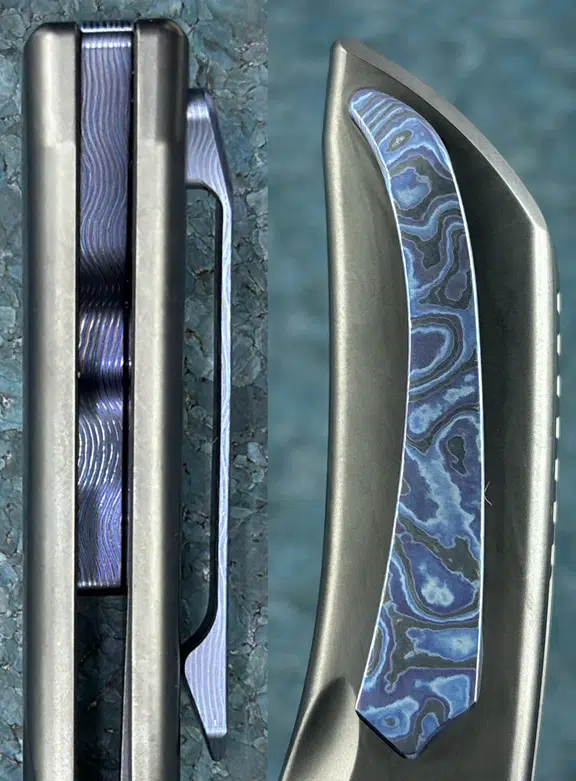
The backspacer on the Poikilo Tuna is one of the upgraded features on the Midtech edition. What we have is a stunning, 56.35 mm / 2.219” long, Zircu-Ti (aka black titanium Damascus) backspacer that features matte-finished, dark blue, black and magenta swirls. It’s gorgeous!
The backspace is held in place by a single fastener and 2 pins. It features a crenulated reflection of the design that also appears in the jimping style appearing on the blade spine (the PKB Orca did that as well). I love everything about it – with the notable exception of 1 thing. I’ll get to that later in the review. But you’ll see. Just wait.

Lanyard Mount
I’m shocked to say that this is my 2nd Poikilo Blade knife that includes a lanyard mount. I know the last 3 dudes in the world who care about lanyards, Jordan, Kent, and Owen, are overjoyed after hearing this news of this feature. Of course, you don’t typically earn a lot of income when you’re living in your mom’s basement, so it’s very likely that these 3 dudes won’t ever desecrate the beautiful Poikilo Tuna with a frayed piece of dirty string tied in a wonky knot and finished with the ubiquitous “skull” bead. Personally, I shudder at the thought.

That all said, the implementation design used by PKB to add this totally unnecessary feature is genuinely delightful. It’s subtle, hidden from view, and elegantly designed. Kudos to Poikilo, not only for the design, but for relentlessly teasing the lanyard boys like this!
Sticks, Rocks, Lashes and Play
Let’s talk about this. Please keep in mind, though, that I am talking about an elite Poikilo knife, not a Harbor Freight / Ozark Trail / M-Tech / Frost Cutlery / Opinel knife. The nitpicks mentioned here on such an ultra-premium knife are present in trivial proportions compared to the numerous, significant manufacturing and materials flaws so commonly found on ultra-cheap knives.
- Lock Stick. There was a small amount when the knife came to me as new, and it was largely resolved during this review period. Most knives equipped with a frame or linker lock, because they engage with the flat spot on the blade tang, show a bit of lock stick when new, so it’s not really unusual.
- Lock Rock. There is no lock bar movement or wiggle when pressure is applied to the blade spine.
- Blade Play (Up-or-Down, Side-to-Side). The blade is securely held in place with no movement whatsoever.
- Detent Double-Clutch. A small bit. The lack of enough usable access to the lockbar means that you have to push unnecessarily hard to completely release it from the blade tang. The condition is improving as the knife breaks in, but updating the handle design to improve lockbar access would significantly improve this matter as mentioned earlier.
- Detent Lash. Despite the Tuna’s lockbar detent ball resting in a blade tang detent hole, a design that can give some knives, especially on lower cost varieties, this problem, Poikilo didn’t allow this to occur. The stiffness of the Tuna’s lockbar securely holds the detent ball, and thus the closed blade, in place.
- Pivot Lash. Trace amount. Applying an admittedly heavy-handed wiggle, I detected extremely light, micro movement of the blade around the pivot barrel. The Orca, by comparison, had none.
- Blade Bounce. When the blade is disengaged, it doesn’t fall like a guillotine, but instead slowly glides down into the blade channel (thanks to that tight pressure of the detent ball on the blade tang from the lockbar spring). There’s no chance for blade bounce.

Ergonomics
Poikilo included a number of excellent ergonomic design features to the Tuna.
- Poikilo added blade jimping that actually works! The perpendicular spine cuts are usefully grippy, neither skin shreddingly sharp nor pure decorative nothingness. For a knife at this premium level, where other designers so often go for form over function here, this is great to see.
- Thumb studs. The studs used by PKB have a hemispherical They are smooth enough to be very comfortable, but long enough so that the smoothed ends don’t reduce the ability to open the blade. Very nice.
- Contoured scales. You can’t deny that contoured scales always make for a much more comfortable grip, which in this case, Poikilo’s design nicely fills the hand. Lovely!
- Radiused / chamfered scale edges. PKB took great care to ensure all exposed edges of the scales have been radiused (top and bottom) or chamfered (front and back). Even the interior edges were knocked down. I love that.
- Smooth scales. The surface texture of the scales is very smooth and feel so nice in the hand – perhaps to a fault.
- Pocket clip design and placement. When the knife is open and you are hammer-gripping the handle, the milled clip doesn’t dig into your palm. That’s a great thing.

Missed Opportunities
Well, everything can be improved, right? I have a few examples where an updated release of the Tuna could be improved.
- Blade spine edge sharpness. The edges of the spine feel unfinished, as they are needlessly sharp. I’d rather have a crowned spine every time.
- Pivot ring edges are sharp. I loved the visual design of the circles of unfinished steel bosses surrounding the pivot faces. Those ring bosses are raised above the pivot face surface and sport 90° edges of unfinished steel. In other words, they are abrasive to the pad of my thumb. The design looks nice, but it should be completed with a smoothed, even radiused, edges (interior and exterior).
- Slippery scales. While I love the tactile feel of the Tuna’s smooth, Grade 5 Ti scales in my hand, they are slippery and will likely be even more so when wet. I think the scales would be significantly improved by adding a micro-milled texture, as I suggested in the Handle section, to improve the grip. And if the texture was applied in a pattern that looks like the super-fine scales of the bluefin tuna, it would be fantastic!
- Insufficient lockbar access. The liner lockbar lock-up, when the blade is opened, is 100% engaged on the blade tang. That’s great – the open blade is super secure. But this lockup also means releasing such a tight lock will not be easy. You’ll need the right leverage to get your thumb into the blade channel to push on the end of the lockbar. But the access needed to do that is not available, which makes releasing the blade unnecessarily difficult. The lockbar access design needs to be updated, and it can be done with little-to-no impact to the visual lines of the handle of the Tuna, as I proposed in the Locking Mechanism
- Pocket clip issues. In terms of ergonomics (not beauty, in which it’s outstanding!), the clip flex is tight, which I assessed I had by the difficulty of slipping it over the edge seam of my pocket.
- I personally like a hefty boy (more cushion for the pushin’, right?), but not everyone shares my sentiment, especially with regard to pocketknives. The Tuna pushed down the scale by 151.26 g / 5.336 oz. That figure isn’t overly excessive by itself, but for a knife that’s only 200.64 mm / 7.899” long, which gives the knife a weight to blade length ratio of 1.64, it will likely surprise some people (but not me; I like beefy). For comparison, the Poikilo Blade Orca weighs 131.76 g / 4.648 oz. in the form of a 218.53 mm / 8.604” long knife with a weight to blade length ratio of 1.32.
Handle Dimensions
Hello. Are there any numbers out there? Just nod to get them from me. I took the measurements at home. Come on, now. I know you’ll write them down. Well, I can feel your pain, so I’ll provide it all again.
Is my email getting through to your Inbox?
- Weight:26 g / 5.336 oz.
- Weight to Blade Length Ratio (some prefer a 1.0 ratio):64
- Handle Length:57 mm / 4.55”
- Blade to Handle Length Ratio:80
- Closed Knife Handle Height:34 mm / 1.391”
- Open Knife Handle Height:43 mm / 0.962”
- Handle Thickness:58 mm / 0.574”
- Scale Thickness (includes liner if present):08 mm / 0.2”
- Pivot Center to Balance Point on Handle (0.0 is balanced at pivot): 12.62 mm / 0.497”
- Frame / Liner Lockbar on Blade Tang Lock-up Percentage:30%
- Frame / Liner Lockbar Lock-up Percentage:00%
- Thumb Stud to Pivot Center Distance (higher can mean less leverage for easy, fast opening):91 mm / 0.863”
- Thumb Stud Angle from Vertical Center when closed: 38 mm / 1.496”
- Thumb Stud Tip to Scale Edge Clearance:4 mm / 0.055”
- Backspacer Length:35 mm / 2.219”
Hardware
The Poikilo Blade Tuna shines in every category, but when we’re about to talk about Zircu-Ti (aka black titanium Damascus), things really get exciting!
One of the best features of the Poikilo Blade Tuna Midtech edition is the addition of those spectacular Zircu-Ti elements. PKB specifically uses the material name Zircu-Ti, which is the brand name for the premium titanium & zirconium layered composite material manufactured by Chad Nichols of Nichols Damascus.
Zircu-Ti is a Damascus-like product that incorporates stacked layers of metal plates and/or pieces of titanium (Ti) and zirconium (Zr) alloys. These stacked plates are subjected to a high-heat, pressure-forged process that transforms it into a pattern-welded composite. After that, Zircu-Ti, similar to Damascus steel, is acid etched to visually emphasize its high-contrasting, pattern-welded features. Finally, it’s then flame anodized, which renders the Zr element from dark grays to black, and Ti into beautiful hues of blue, purple, magenta and bronze. Zircu-Ti is commonly polished into a highly-reflective finish, but can have a matte finish, a brushed finish, or even left in the acid-etched texture.
Apparently, Zircu-Ti is not an easy material to CNC. Thanks to its Zr content, Zircu-Ti has an unfortunate tendency, when machined at too high RPM, to literally erupt into flames! That’s not a welcome thing for a machine shop.
BTW, don’t confuse zirconium with cubic zirconia, the manufactured, inexpensive jewelry gemstones you see at shopping mall kiosks. Cubic zirconia is technically the cubic crystalline form of zirconium dioxide (ZrO2). It ain’t the same stuff, okay?
Poikilo uses a matte finish version of mesmerizing Zircu-Ti in the Tuna Midtech edition’s pocket clip and backspacer. The extremely high polished version of Zircu-Ti is indeed beautiful, but it’s anything but subtle. The Zircu-Ti’s hues of blue, gray and black matte version give the Tuna a genuine pop of visual interest, but in an understated way that makes the Tuna Midtech genteel instead of garish.
The Tuna’s pocket clip is configured as medium deep, non-ambi (right-side-only), and tip-up. It features a gentle curve that follows the handle curve, a flat top with edges knocked down, and ends with a pointed, triangular tip reminiscent of a necktie. That tip, while somewhat pointy, is not sharp pointy, which is greatly appreciated. Underneath, the clip has a full-width ramped toe that only actually touches the centerline of the scale contour; the rest just sits above the sloping handle surface. There is no visible fastener for removing the pocket clip; that is managed on the underside of the scale. As I mentioned earlier, I found it a bit challenging to get the tight clip to jump over the edge seam of my pocket.
The length of the PKB Tuna pocket clip measures 61.33 mm / 2.415”, giving it a clip-length-to-handle percentage of 53.07% (slightly long for those who prefer a relatively shorter clip).
There are only 2 visible fasteners on the Tuna. Both are equipped with T10 sockets – hooray for Poikilo for that excellent design! One of the 2 fasteners is the pivot screw we discussed earlier.

The other fastener is for both securing the backspacer and attaching the rear of the scales together. That’s cool.
But wait! There’s more! That 1 body fastener is on the show side!

Yep, that beautiful, near flawless show side is defiled by a body screw! It gives me a tummy ache every time I see it (yeah, I’m going to the doctor for that next Tuesday).

So why? Why do this to a beautiful show side? I don’t know, so I can only speculate. My theory is that, due to the degree of the swooping curve of the pocket clip, and the fact that the design specified an unusually large T10 fastener, hosting that fastener on the clip side would put it very close, maybe too close, to the pocket clip. The key here is maybe. I’m no engineer, nor am I a knife designer, but I did stay at a Holiday Inn Express last night.
As such, I’ll say that it looks like there might have been room to apply the rear body fastener to the clip side scale. But on the other hand, I have zero reason not to assume the PKB guys are experts in their field. I have to believe the following is true:
- The placement of the rear body fastener to the show side was not an intentional visual design decision
- The fastener was placed on the show side was a forced compromise made to other conditions, such as accommodation to the shape of the expensive, already designed, potentially already manufactured, Zircu-Ti pocket clip and/or the backspacer.
If the above assumptions are true, I can understand the decision (although I’m still disappointed). If it was a forced compromise, that leads me to suspect an oversight was made early in the design process that wasn’t recognized until the engineering prototypes were made, when it was too late (or expensive) to change. But I have questions:
- If the required space for a T10 body fastener was not available on the clip side, would the use of a T8 or even a T6 fastener have changed the equation?
- Was there an opportunity to redesign the pocket slip shape?
- Was there an opportunity to redesign the backspacer, given it would also have been affected by a change in the fastener size or location?
Again, I assume all these questions (and dozens more) were addressed by the PKB guys, and they had to make the call. If I was to learn that putting the 1 body screw on the show side was an intentional design decision, well, my mind would be blown to smithereens. So in conclusion, that’s the likely reason!
Hardware Dimensions
There ain’t many to share, but here’s what I got:
- Clip Length:33 mm / 2.415”
- Clip Length to Handle Percentage (< 50% preferred):07%
- Fastener Sizes: All external fasteners are T10
Design Considerations
There’s a tuna, and then there’s a tuna. Sometimes it’s abstract. I mean, really abstract!

Other times it’s almost photorealistic. Almost. Sort of.

The Poikilo Tuna is somewhere in the middle, although it does lean in toward the abstract side. It’s tallest in the middle, like ole Charlie. It’s like, if it weren’t for the tanto blade, it would be a tuna! Well, if it weren’t for the blade and for the end of the handle, it would definitely be a tuna. At least if you squint.
Ha! I’m having a laugh, but I am also serious. We already discussed how the Tuna’s scales’ diagonal groove, next to the tip of the pocket clip below, looks like a pectoral fin. We’ve discussed how the smoothness of the handle scales recalls the sleek, hydrodynamic skin of a tuna. Even the downward slope of the blade spine, which largely matches the curve of the handle spine, adds to the fusiform-shaped spirit of the mighty bluefin. Curved, contoured surfaces are everywhere across the Tuna’s handle, making the knife very nice to hold. The use of hand-rubbed satin as a blade finish, with its very fine, horizontal-line orientation, actually gives the PKB Tuna a sense of swift, forward motion.

The use of high-end, blue-centric Zircu-Ti, a fantastic upgrade in materials in the Midtech edition, was left in a matte finish so it didn’t over-compete with the rest of the knife for your eye’s attention (even if it still does!). Indeed, the matte Zircu-Ti backspacer was milled to show its grain lines rather than its swirls (was that intentional?).
If you’re not paying attention, you may not even notice the backspacer is Zircu-Ti. I think it looked better when the knife was disassembled and you actually see how nice the blue-centric swirls look. Having such a rich, luxurious feature in such a muted form is kind of like owning a 2022 BMW M5 CS.

As the owner, you will never come close to testing that speedster’s outrageous 627-hp engine’s performance potential of running a 0–60 mph sprint in 2.6 seconds. But you still know it’s always there, and it’s yours (sadly, it’s not mine; I still drive an old beater car).

Poikilo creates a variety of knife designs, all of them remarkable. But call me a fan of their curvaceous, organic BIO series of knives. And yes, I know Poikilo decided that the Tuna is an EDC knife and not a BIO knife, but I am hereby reclassifying it back to its natural designation as BIO. Don’t challenge me on this! Nope!
Weight
Our chunky little monkey is not a long boy. It’s not even 8” in length (200.64 mm / 7.899” to be precise). But for being average length, it’s definitely a stout, little teapot, weighing in at a lusty 151.26 g / 5.336 oz. Is that bad? That’s your call. It’s not for me – I like a knife that has a substantive feel in my hand. I know I’m holding a beefy fistful of titanium and steel, and I‘m all for it!
Given the PKB Tuna has a 92.22 mm / 3.631” length blade, this gives the knife a weight to blade length ratio of 1.64. So, yeah, this is a buff beast. But I love it!

I’ve never been a fan of skinny, uber featherweight knives that have super-thin blades and cheesy, plasticky, garbage scales. However, if you’re used to carrying something like the Spyderco Para 3 Lightweight as an EDC, a 183 mm / 7.2” long knife that weighs down your pocket with a mere 68 g / 2.4 oz., our husky Tuna will feel like you’re carrying a pocketful of gold. To me, that’s just fine. To a few other people, though, it will force them to wear a belt!
So how much weight reduction milling was done? Well, I carefully disassembled the knife (remember that this is a loaner to me!) and took this photo. Poikilo attached internal liners to both sides of the handle, and I opted to not go any further into the exam. I’m not sure how much, if any, weight reduction milling was done. The knife is not a brick, but nor is it a Para 3 Lightweight. I hope that answers the question (I doubt it, but whatever).
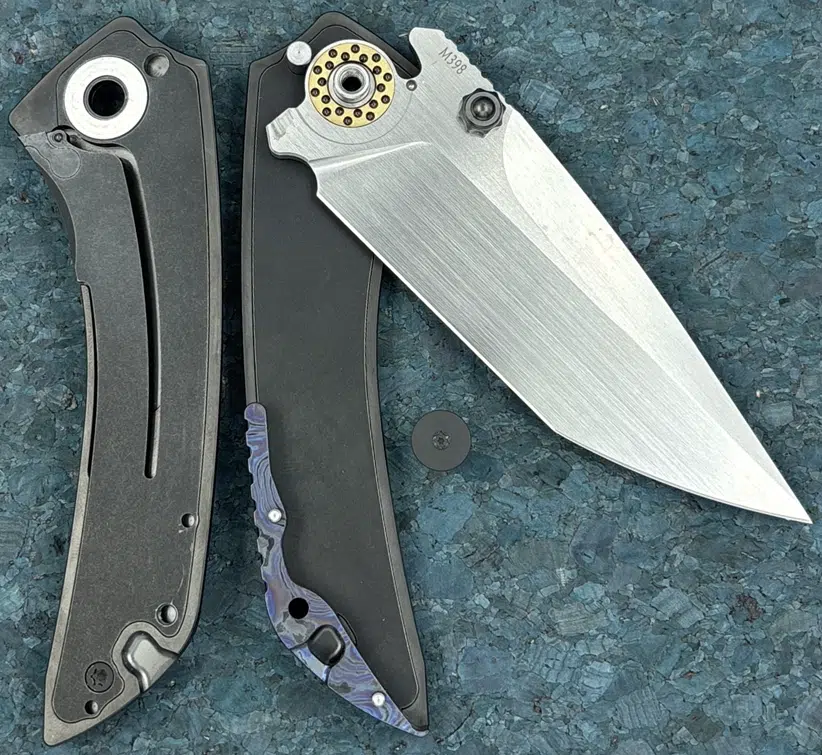
Original Packaging
I wrote about Poikilo knife packaging in my review of the Poikilo Blade Orca. The Tuna comes in the same folding leather envelope pouch, featuring the same neon green stitching, the same hook-and-loop strip with the same Poikilo patches. The big difference between the Orca and the Tuna pouches is that the Orca’s pouch came with a strip of leather fringe. Hey, man, that was groovy, man.

Inside the pouch is the same thick, soft, 8″ x 5″ black suede sheet, which Poikilo uses to wrap up their knives (no crappy, plastic zip-top baggie used here).

But wait! There’s more! Poikilo includes a solid knife identification card (it’s not labeled as a Certificate of Authenticity, but it’s basically what it is). The Orca’s card was (likely) made of titanium, whereas the Tuna’s card is a thick slab of carbon fiber. Interestingly, the card was labeled “Andy” after Andy Wang, the co-founder of Poikilo Blade. If I recall correctly (and my memory of what I had for lunch yesterday is already a bit foggy), he told me that he writes his name on the cards of knives sent out as loaners. Either that or it’s his personal knife. It’s either one or the other. Or not. Whatever.

Knife Karen Nitpicks
I have been really happy in creating this review. I explored this knife from head to toe, and it’s been great! There’s practically nothing to complain about. Yeah, there’s a little thing here, a minor issue there, but it’s all good. Well, I guess nothing’s perfect, right? And those problems, they’re not too bad, I guess. But I do wish there were some changes. In fact, some of those problems were really surprising to me. I mean really! Something should be done! We need to get this addressed! I need to speak to the manager – right now!
- For a knife with so many radiused and chamfered edges, the sharp-edged blade spine feels unfinished. It’s not crowned; it’s not chamfered; it’s not even knocked down. The spine edges are almost “Spyderco spine” sharp, and I was never consulted about approving of that design decision!
- The silvery ring boss design on the pivot faces has 90° sharp edges, which abrade the skin on your thumb. Not nice!
- The titanium handle scales are sleek and smooth, which looks really nice. Unfortunately, that also means the knife is somewhat slippery in dry hands. It’s likely to be dangerously slick in wet conditions. Whoops!
- The show side handle is beautiful until you notice it. Did you see it? The fastener, that is! The only non-pivot fastener on the knife, a backspacer-retaining screw, desecrates that otherwise perfect, showcase look! That screw should have been put on the clip side. Very disappointing!
- The ability to easily release the liner lockbar is, to my eyes (or my thumb), inadequate. We have a LOT to talk about here.
- Out of the box (aka the pouch), the liner lock had a moderate amount of lock stick. After struggling a bit and mentioning it to Poikilo, I performed a quick disassembly to take photos. After reassembly, much of the lock stick seemed to have smoothed out, although it didn’t completely resolve it.
- Accessing the Tuna’s lockbar is needlessly difficult, especially when it was new. I needed to aggressively press my thumb into the narrow blade channel and press hard against the lockbar to disengage it, which was uncomfortable. Since I’ve had it, the knife has been somewhat broken in so it’s become somewhat easier to release, but I was surprised by the initial difficulty I experienced.
- There is no external scale access cutout at all. There is a modest, internal scallop milled into the show side scale to widen access for your thumb, but it was placed too low on the scale. It should have been placed higher up toward the lockbar / blade tang interface. Interestingly, that same, internally milled liner lockbar access on the Poikilo Orca was milled in the correct, higher up position.
- The open blade detent is rather stiff. That’s good for giving the blade a smooth, controlled glide down into the closed position, but it also contributes to the challenges of releasing the lockbar, as the lockbar must be pushed very hard, all the way over for the ledge on the tang to clear the detent ball. The strong detent ball resistance effect almost feels like double-clutch. Adding a detent ball ramp would help with easing the release.
- Unlike the Orca, whose lockbar was, at best, barely 50% engaged on the blade tang (not a good thing, to be honest), the Tuna’s lockbar engagement is fully engaged upon the tang. Purely in terms of blade lock security, that’s a good thing, However, that reduced amount of lockbar access space within the blade channel also contributes to the difficulty of getting your thumb behind the lockbar.
- An external scale cutout would solve this whole thing. Where is that manager?
- The gorgeous Zircu-Ti pocket clip is very tight. I found it difficult to slip over the edge seam of my pocket.
- The weight is more than a bit chonky for a knife of this size. If you’re sensitive to carrying heavier knives, it could be an issue.
- Lastly, that sweet Zircu-Ti backspacer narrows to a thin, exposed bar, revealing an open space underneath that looks suspiciously like a lanyard mount. However, no one in their right mind should ever put a cheap, dirty, frayed lanyard on this knife! Don’t encourage them!
Price
While researching this topic, I learned that are 2 versions of the Poikilo Tuna Midtech. Kinda. The new one I found on NC Blade is the Poikilo Blade Tuna Mini Midtech. Note that it’s identified as a mini version of the Tuna. It’s absolutely lavished with stunning blue, gray and magenta Zircu-Ti accents, including not only those glorious pocket clip and backspacer pieces, but also magnificent bolsters!
The blade is identified as stonewash DLC M398, and the photo below shows a reflective shine that looks stunning. I’m not sure, but the titanium scales on the Mini Midtech appear to be flat rather than the contoured ones on the Midtech edition knife covered in this review (give me contouring every day of the week). The Mini Midtech also appears to be a slenderer and sleeker version of the Tuna, making it look a little bit more regular knife-y and a little bit less Tuna-y. The specs on Mini Midtech come in at:
- Blade length:9 mm / 3.5” (slightly shorter than the Midtech’s 92.22 mm / 3.631”)
- Overall length:2 mm / 7.25” (a fair bit shorter than the Midtech’s 200.64 mm / 7.899”)
- Weight:6 g / 3.3 oz. (significantly lighter than the Midtech’s 151.26 g / 5.336 oz.)
Why do I mention this? Because this Tuna Mini Midtech would have cost you $680, but it appears to be sold out everywhere.

The knife in this review, the PKB Tuna Midtech, is a tad bigger, a tad beefier, and yet, a tad less expensive at $550 – if you can find it. It appears that the price is the price – retail is the same as MSRP. Either way, you’re paying for a Poikilo, so you will be happy.
Verdict
The Poikilo Blade Tuna Midtech edition is a hands-down, gorgeous pocketknife. It’s built with ultra-premium materials:
- The blade is crafted of Böhler M398, a steel with phenomenal edge retention (9/10), excellent corrosion resistance (8/10), although fairly poor toughness (2.5/10) (all ratings data supplied by com). That said, if you’re silly enough to buy a knife using M398 for a work knife, well, let’s hope you have the money to buy another – and another after that.
- The blade sports a sumptuous, hand-rubbed satin finish with clearly defined grind regions defined by crisp grind lines. I especially like how the hand-rubbed finish lines on the swedge follow the angle of the swedge, just adding to the fine details that Poikilo always adds.
- The tanto shape is elegantly crafted with perfect ground, symmetrical edge bevels and blade angles which converge into a perfect, sharp point.
- The rear of the spine has genuinely functional jimping, a feature that is largely absent in so many pocketknives, especially premium level and higher, today!
- The blade hosts custom thumb studs with rounded dome heads on top of a radiused ring, then followed with a gear-like octofoil-shaped base, a design feature repeated in the pivot. This stacked stud provides enough height to make opening the blade super easy and comfortable.
- Unfortunately, the blade spine edges were left in almost what I call “Spyderco sharp”. With so many other ergonomic features added, this seems like a basic oversight.
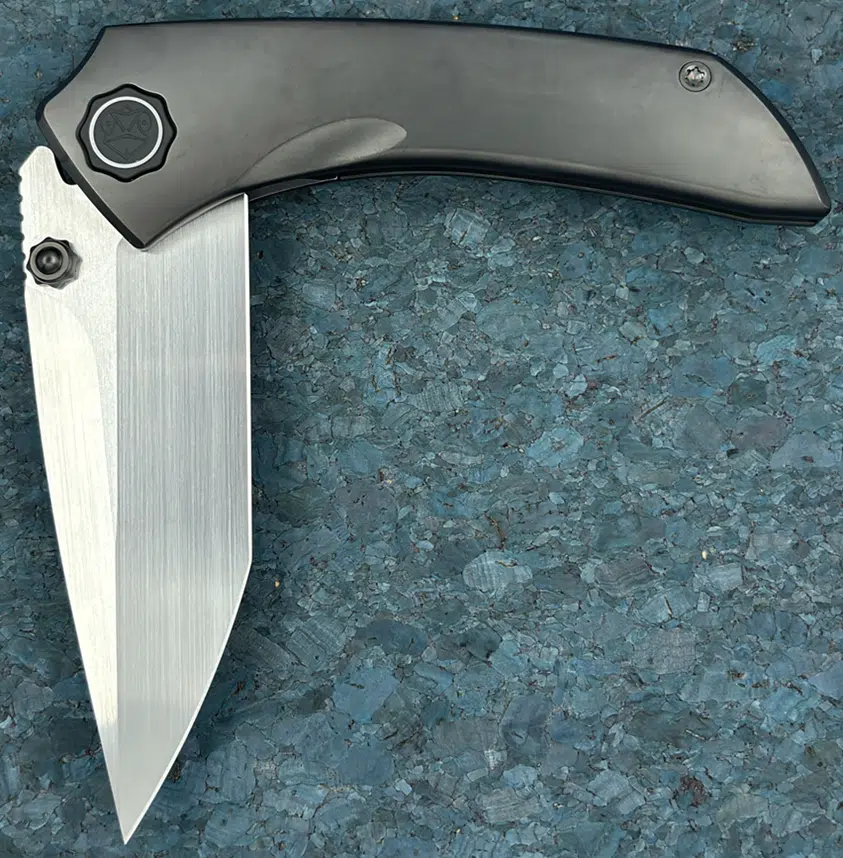
- The handle is made from 2 hefty slabs of titanium.
- The peak height of the handle is at the pivot, matched by the blade at the ricasso, the combination of which provides the foundation of the knife design echoing the form of a tuna (to me, it looks specifically like the robust Atlantic bluefin).
- Poikilo made the effort with the handle to contour the scales, coat them with durable, matte black DLC, and add milled, diagonal, concave carve-outs that harken to the appearance of a tuna’s pectoral fins – a really nice design touch.
- All external edges of the scales are softened, with excellent radiusing on the top and bottom and chamfering on the front and back, giving the PKB Tuna an excellent feel in the hand.
- Unfortunately, the handle design for accessing the liner lockbar is not up to the extremely high standards of Poikilo Blade. This issue is discussed thoroughly above in the Locking Mechanism section, but the gist of the matter is that there is no external cutout on the show side scale to aid lockbar access. A modest, shallow internal scallop was milled into the scale, but it’s positioned too low to be of optimal use. If the internal scallop had been placed higher on the scale so the user could more easily access the lockbar at its junction with the blade tang, that would have significantly improved the user’s ability to release the lock. But ultimately, the scale should have an external, milled cutout for lockbar access.

- The hardware accessories on the Poikilo Tuna are very special features that add so much value to the Tuna Midtech.
- The captured pivot design is a reflection of the gear-like octofoil-shape of the thumb studs (it’s probably the other way around, to be honest). The pivot appears at first glance to have an impossible-to-disassemble fastener, but the clever dudes at Poikilo engineered a surprise here. The inset octofoil perimeter element of the pivot faces doesn’t move. The pivot faces feature silvery ring boss design that reveals the pivot’s underlying steel for attention-grabbing appeal. The secret to the pivot fastener is that it resides inside that ring boss. Very cool!
- Both the pocket clip and the backspacer are made from generous amounts of Zircu-Ti, a beautiful, anodized blue, magenta and gray Damascus product made of zirconium and titanium and manufactured by Chad Nichols of Nichols Damascus. PKB employed a matte finish to these pieces, which to me, gives the knife an understated elegance rather than a shiny, if not gaudy, presentation.
- The Poikilo Tuna has only 2 visible fasteners, and both have T10 sockets.
- Unfortunately, the 1 non-pivot fastener, which secures the backspacer, was positioned on the show side, not the clip side! This unfortunate detail breaks what should have been a pristine show side scale. It baffles me why the Tuna was released with this surprising peculiarity. I certainly don’t know why, but I have to suspect there was a forced compromise made late in the development of this knife. I really wish the show side had been left as clean as the Poikilo Blade Orca I reviewed recently. But it wasn’t.
I must make this overall assessment abundantly clear, so don’t get me wrong: The Poikilo Tuna Midtech is a wonderful knife. The pivot action is stellar – a standard feature on all Poikilo knives. The DLC-finished titanium handle’s feel in hand is phenomenal. The M398 blade is nothing short of glorious! The blades on most top-tier knives will continue to strive to attain what the PKB Tuna Midtech has already achieved.
Is the knife perfect? No. But I have yet to see a perfect knife – have you? My honest feelings here are that I fell in love with the Poikilo Blade Orca – Standard edition! That meant I had sky-high expectations for the Tuna, the next Poikilo knife I’d have the privilege to handle and review. It’s an excellent knife, a mighty albacore in the ocean of pocketknives, but I still love the Poikilo Orca more. Enjoy! 