
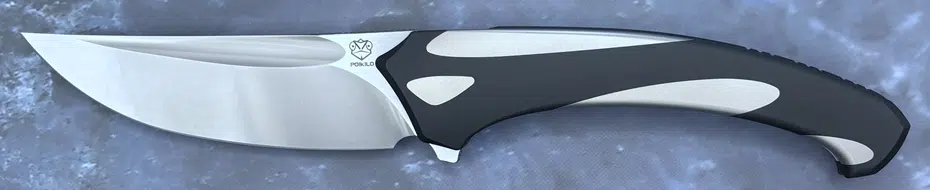
Author’s note: The knife used in this review was purchased by me at full retail price. I only call this out because – Spoiler Alert! – I really like this knife and the review is positive. Now on with the show.
Have you ever found The One? You know. The One! The One that, at very first glance, catches your attention, grabs your thoughts, piques your interest, draws you in, sparks your desire, fascinates your mind, tickles your curiosity, touches your soul, arouses your emotions, stimulates your brain, lives in your dreams, even tugs at your heart, and you know immediately that this is The One. You immediately know you have to see it. Stare at it close up. Hold it. Feel its weight in your hand. Touch the contours of its curves. Listen to its sounds. Deploy the blade. Manipulate the lock. Feel that blade edge against your nail. (Hey, you knew I was talking about a pocketknife, right?) You know this is the one you want because you know it’s right.
Yeah, that’s what happened to me when I first saw the Poikilo Blade Orca knife.
Of course, having such high expectations is dangerous. They say, “You should never meet your heroes” for a reason. You’ll have such a high bar of expectations that nothing could live up to that. But then the eternal optimist in your heart says, “But maybe, just maybe, it will.”
The Poikilo Blade Orca first came to my attention several months ago. I spent time on the Poikilo Orca’s webpage. But it was a pipedream, right? Certainly I can’t afford to do this – right? I would tune it out and try to forget about it. I have been very fortunate to have had opportunities to review, and occasionally even own, some beautifully designed pocketknives since starting this blog, SharperApex.com. The first review I wrote (now in retrospect a relatively short post!) was for the Italian-made Viper Knives Moon. What drew me to it was the curvaceous shape of both the modified sheepsfoot blade and the robust handle featuring those amazing sculpted, contoured green Fatcarbon scales. It even had a MagnaCut blade (although that was pretty early in MagnaCut’s release cycle, and back then, Italian knife manufacturers were earning reputations for under-heat-treat hardening Larrin Thomas’ new baby blade steel). Still, then and now, the Moon still captivates me.
But now there is a contender for my heart in the Poikilo Orca. I have a lot to say about this, so expect another long review (remember the post’s Table of Contents allows you to bypass my indulgences if you wish, but doing so would be a terrible decision, because, well, I rite goodly! So let’s get into it. This will be fun!
TL;DR
The Poikilo Blade Orca is a very special knife, and this isn’t just my opinion. Poikilo is very much a newcomer in the world of folding pocket cutlery. They only began to be recognized little over a year ago, when they attended their first major knife show, Blade Show West in Salt Lake City in early October 2024, where they brought with them the Orca. And what a start! As the show wrapped up, the Orca knife was awarded with not 1, but 2, major awards: Best Factory Folding Knife, followed by Factory Best in Show.

Since then, Poikilo released a limited number of their Standard) and upscale Midtech versions of the Orca. It’s an undeniably exquisite knife, both inside and out. It begins with the trailing point blade (Poikilo identifies it as a drop point blade, but that’s simply wrong, as there is no “drop” to the “point” at all. Indeed, the tip rises – slightly – above the spine line, thus without question, classifying it as a trailing point). That blade, made from ultra-premium Böhler M398 blade steel, is finished in what Poikilo calls Pearlescent Stonewash. But let me tell you, it’s so much nicer than it sounds. The blade surface sports an elegant, ultra-high-gloss polish so perfect that it looks as though it were dipped with a poured glass coating. The high, flat ground blade has a crowned spine, a lovely grooved swedge, and a needle-like tip. The blade edges are symmetrical, even, and sharp as you could ever want it to be.
Each handle scale is made from a 2 separately colored pieces of titanium that interconnect in a visual pattern that truly captures the living spirit of real-life orcas. Best of all, the seams between these pieces are utterly flawless. You can’t feel any of the seams with your fingertips. The show side shows no fasteners – not even the pivot face! The clip side only has 2 fasteners: a black-coated, titanium T8 screw securing the milled, black-coated, titanium pocket clip and a high-polished, titanium T10 screw in the pivot with faceted cuts along to top that gives it a genuine sparkle.
The pièce de resistance for what is already a spectacular knife is the pivot action. The jimped flipper tab easily bursts the blade through its ball detent with a very satisfying pop. And when you release the comfortably accessible liner lock, the blade lazily glides down the pivot toward the handle until that needle-sharp tip is just above the frame, when its detent suddenly snaps it into place. There was no break-in period needed to get this action – it was dazzling right out of the box (well, right out of its folded, leather pouch).
Is it perfect? Well, I have a few nitpicks (I have yet to hold the perfect knife), but I am admittedly smitten with the Orca. If you like what you see here, take a look at the details below. There’s a lot to go over, and have a lot to say. See you down there!
Pros
- Stunningly sensuous knife with curves all around
- Böhler M398 blade has an incredible, intensely polished, Pearlescent Stonewash finish
- A hollow swedge sports crisp lines and the same amazing, highly polished blade finish
- Blade spine is crowned, even along the swedge portion
- Handle features a glorious pair of bi-colored, contoured titanium scales designed to look like the white-on-black patches on an orca
- Scales are made from separate gray and blackened pieces – the gray pieces also serve as liner frames, to which the black pieces are fastened
- Separate Ti handle pieces interconnect with flawless fitment
- Handle has only 2 visible fasteners, both on the clip side (1 for pivot, 1 for pocket clip)
- Captured pivot has a polished Ti T10 fastener with a tri-faceted surface cut design, adding sparkle to the handle
- Handle sports a graceful convex curve along its spine
- A very long, black-coated Ti backspacer runs nearly the full length of the handle spine
- Blade spine jimping design is repeated along the butt end of the backspacer
- Pivot action, right out of the box, is stunningly smooth, thanks to double-row bearings and excellent detent. No break-in needed!
- The light-switch back flipper has effective jimping and drives the blade to burst past the firm detent to snap open
Cons
- Typically not a big fan of trailing point blades – meh
- Blade spine jimping far more decorative than functional (although it’s handsomely done)
- Liner lock-up on blade tang flat not fully engaged
- Handle has an exposed bar in the back that looks like a lanyard mount, but no one in their right mind should put a lanyard on this knife!
Tech Specs
Brand | Poikilo Blade |
Website | |
Manufacturer | Poikilo Blade |
Origin | China, but HQ is in Hayward, CA |
Model Reviewed | Bio Series Orca - Standard Edition |
Designer / Design | Vince Wang |
Model Launch Year | 2024 |
Style | Folding knife |
Lock Type | Liner lock with a titanium lockbar and a steel lockbar insert |
Opening Type | Manual |
Opening Mechanism(s) | Back flipper |
Pivot Type | Captured |
Pivot Mechanism | Double row ceramic bearings |
Length Closed | 128.69 mm / 5.067" |
Length Opened | 218.53 mm / 8.604" |
Weight | 131.76 g / 4.65 oz. |
Original Packaging | Double-stitched, tri-fold, soft-finished black leather storage pouch with 2 external, Poikilo-branded Velcro patches attached. Inside the suede-lined pouch is a credit-card-sized, titanium plate laser-etched with basic knife information. The knife is rolled up in a (roughly) 8" x 5" black suede sheet. The pouch is decorated with a knotted black leather fringe strip. |
MSRP & Retail Price | MSRP: $450 (sold out) |
Edge Type | Plain |
Shape | Trailing point (incorrectly advertised as drop point) |
Material | Böhler M398 |
Claimed Hardness HRc | ~62 |
Length (from lower half of handle scale) | 99.62 mm / 3.922" |
Weight-to-Blade-Length Ratio | 1.32 |
Cutting Edge Length | 101.24 mm / 3.99" |
Primary Bevel Half Angle | 5.0° |
Original Edge Half Angle | 15.8° |
Height | 29.37 mm / 1.157" |
Spine Thickness | 4.02 mm / 0.158" |
(Edge Bevel) Thickness Behind the Edge (TBE) | 0.36 mm / 0.014" |
Finish | Pearlescent Stonewash |
Features | Blade surface has an ultra-high gloss polish akin to a poured glass coating. The high, flat ground blade has a crowned spine, grooved swedge/fuller, and a needle-pointed tip. The blade edges are symmetrical, evenly ground, and extremely sharp. |
Grind | High flat grind with very short flat and grooved swedge/fuller |
Swedge | Yes, more like a combined sweller |
Fuller | Height: 7.16 mm / 0.282" |
Jimping | Blade spine jimping is made up of widely spaced, shallow, marginally useful cuts in a pattern of 3 cuts & 1 skipped cut, totaling 3 sets of 3 cuts. The back flipper has a set of 5 shallow but more useful jimping cuts aligned closely together. |
Blade Markings | Show side: Company logo and name etched on the flat in front of the ricasso just before the start of the grooved swedge/fuller cut. |
Sharpening Choil from Handle Scale | Length: 7.75 mm / 0.305" |
On-Blade Opening Assists | Back flipper tab rises 3.90 mm / 0.154" proud of handle |
Materials | Titanium |
Color | Two: Natural gray and matte black titanium coated, finish undefined (likely PVD) |
Scale Thickness (includes liner) | 4.74 mm / 0.187" |
Scale Texture | Smooth |
Handle / Scale Features | The mildly contoured handle scales are comprised of 2 pieces of titanium per side: 1 natural gray piece that serves as both frame and 4 exposed parts, and 1 black-coated piece that comprised the majority of the exposed scale. The black-finished pieces fit over the gray frame pieces, and the fitment seams between the pieces are extraordinarily tight and smooth. The finished design is powerfully reminiscent of the eponymous orca. |
Pivot Features | Captured, hidden within titanium design feature |
Liner Type | None |
Opening Stop Pin Type | Single, floating stop pin in top front corner of handle serves as both open and close stop pin. |
Closing Stop Pin Hits Sharpening Choil? | No |
Length | 128.69 mm / 5.067" |
Blade-to-Handle Ratio | 0.77 |
Closed Knife Handle Height | 30.26 mm / 1.192" |
Open Knife Handle Height | 18.86 mm / 0.743" |
Thickness | 13.97 mm / 0.550" |
Detent Type | Ceramic ball |
Frame / Liner-on-Blade-Tang-Lock-up % | 19.61% |
Pivot-Center-to-Fulcrum Distance | 19.49 mm / 0.767" |
Flipper Tab Action | Light switch |
Flipper-Tab-from-Pivot-Center Angle | 105° |
Integral? | No |
Backspacing Type | Backspacer |
Backspacing Material | Titanium |
Backspacing Color | Matte black |
Backspacer Length | 97.61 mm / 3.844" |
Backspacer Features | Long backspacer is pinned into place. Same jimping pattern as on blade spine |
Lanyard Mount | Rear standoff |
Pocket Clip | Milled |
Clip Material | Titanium |
Clip Color & Finish | Matte black |
Clip Placement | Right hand only, Tip-Up |
Clip Length | 60.17 mm / 2.369" |
Clip-Length-to-Handle % | 46.76% |
Clip Features | Milled, black-coated titanium clip, medium-deep, medium-firm retention |
Fasteners | No fasteners on show side. 2 titanium fasteners on clip side, including faceted T10 pivot screw and long, black T8 pocket clip screw. |
Who is Poikilo Blade?
Who are they? You mean you don’t know? Well, don’t feel too bad. I hadn’t heard of them until a few months into 2025. But what I heard and saw was incredibly compelling. Listen up!
Back in 2016, 2 knife enthusiasts, Andy Wang, who lives in California, and Vince Wang (unrelated), who (probably) lives in Yangjiang, Guangdong, China (where so many other Chinese knife manufacturers are located), became Internet friends. Many conversations ensued, discussing knives of all kinds, existing design ideas and origins, and brainstorming on modern knife design ideas. As a result of these fruitful interactions, in 2021, these 2 friends formed Poikilo Blade (aka PKB), where Andy would operate the company headquarters in Hayward, CA and Vince would manage the manufacturing side in China.

Per Andy, “The term ‘Poikilo’ is derived from the scientific term ‘Poikilotherm,’ which describes organisms, such as lizards, that possess a variable body temperature fluctuating in harmony with their environment … In a similar vein, we aspire for our products to adapt to the dynamic shifts within the knife community, bringing both satisfaction and joy to their owners.” I heard in a Poikilo video that they pronounce the company name as poi-KE-lo (middle syllable accent, folks!).
Poikilo has very quickly earned an excellent reputation for build quality, design originality and engineering excellence, so much so that they are already spoken of in the same breath as Reate, Bestech and WE.
Mundus Al Khem
In late 2022, Mundus Knives founder Andorise Hu designed the incomprehensively complex and luxurious Mundus Genesis (aka Al Khem) knife. It was released to the market in mid-2023, and Poikilo was publicly acknowledged as the manufacturer.
The Al Khem is a huge folding knife, measures 254 mm / 9.99” long with a 116 mm / 4.56” blade length, and weighs in at 396 g / 13.97 oz. This is a monster of a knife.

While the Al Khem is intended to be a collector’s art knife rather than a user or EDC, it’s definitely no low-quality, gas-station production build. To build the Mundus knife design, Poikilo had to create over 100 precision machined moving parts! The extraordinary, most breathtaking feature of the Al Khem is the expanding blade mechanism. A twist of the pivot ring either pushes the center portion of the 3-part, tri-blade forward, which collapses the 3 sections of the blade together into a tight unit, or it pulls the center section backward, which expands apart the tri-blade via 10 double-hinged linkage arms so it looks like a 3D schematic diagram.
I can assure you that the above description of the Al Khem is extremely reductive. However, this post is about another Poikilo knife. This bit here is to establish the technical creds of Poikilo as a knifemaker of unsurpassed technical skill.
When Poikilo was asked to build the Al Khem Full Dress model (shown above), that turned up the dial. The basic version (if anything like this could be considered basic!) used Böhler M390 steel in its tri-blade, and the handle was made of sculpted, contoured titanium. The Full Dress version plated the M390 tri-blade in gold, and the titanium handle was upgraded to full, multi-colored, titanium alloy Damascus.
In case you were interested, the Al Khem Full Dress only costs $5,000. But that was the Mundus budget model. There were 2 additional models sold by Mundus Knives called the Genesis Outline – Museum-Level Art Treasure, that were priced at $19,000. And every single Al Khem offered by Mundis sold out! Insane.
Blade Show West 2024
Poikilo took the momentum they earned with the Al Khem and started to build knives under their own brand name. Then in October 2024, the Poikilo team signed up for their first major knife show, Blade Show West in Salt Lake City, and brought along their exceptional knife, the Orca. They entered it into the various show competitions where judges would decide how their Orca compared to knives from other, more well-known and established brands. In a shock to no one who saw and held the Orca, it won awards for both Best Factory Folder Knife as well as Best Factory Knife in Show. Now that’s the way to introduce yourself to the world!
Product Lines
Poikilo currently offers 5 categories of knives:
- BIO Series: Nature-inspired knives (Komodo, Orca, Rhino)
- EDC Series: Practical everyday carry knives (Prism, Tuna)
- TACTICAL Series: Tactical-use knives (Anolis, Marlin, Salvator, Tero, Thorny Devil)
- BALISONG Series: Balisong-type knives (Halo, Hydra, Obsidian)
- FUTURISTIC Series: Bold futuristic knives (Al-Khem, Carmen)
There’s one more critically important thing to re-emphasize about Poikilo knives. As demonstrated with the Al-Khem, their quality of manufacturing craftsmanship is outstanding, if not unparalleled, in factory production knives. Every detail hits the mark. Blade finishes are flawless. Handle material seams are perfectly fit and smooth. And most noteworthy, the pivot action is incredible – right out of the box. Read on to get the deets!
Note: In the section below, I’ve added a detailed write-up about the majestic animal that inspired the development of this beautiful knife. But even for typical SharperApex posts, this post is a bit long, so I turned that section into a compressed sidebar. I do suggest you take a look, but in service to those folks who struggle with severe ADHD, you can leave it collapsed and move on to the knife details. But if you don’t like my technically detailed, wisecracking sidebar features, why are you here, browsing my post when you know this kind of thing is standard operating procedure for The Knife Karen? But hey, whatever floats your boat, right?
SIDEBAR: The Orca (Cetacean Edition)
SIDEBAR: The Orca (Cetacean Edition)
The orca is one of the most remarkable animals on earth. They are the top apex predator in the world’s oceans. They have no natural predators. Orca, which are technically not true whales, but instead are the largest member of the dolphin family, can swim as fast as 35 mph, hunt in highly coordinated efforts, and can live as long as 50 to 90 years (only in the wild; not in those insufferably confining amusement park tanks).
They are among the world’s most intelligent animals, equipped with very large, complex brains. Available, comparative neuroanatomy studies put orcas in the very top of all animals for the amount of brain gyrification (aka cortical convolution aka folds) in their cerebral cortex. Their brain gyrification index rating is at least that of the long-finned pilot whales, whose brains rate at 5.5. The orca’s gyrification index rating may go as high as 5.7, putting them at the highest degree of cortical folding within the entire animal kingdom. And in case you were wondering, homo sapiens (aka modern humans) have a cortical folding index rating of between 2.3 to 2.6, which is significantly lower than elephants (4.1 to 4.2), much less orcas (despite that lesser gyrification rating, we still won the global evolutionary contest by having hands equipped with opposable thumbs along with our gyrified brains. Tools are cool!).
Orca are also known by the names blackfish, grampus, even sometimes called the Wolf of the Sea (have you seen these critters hunt? Yeah, wolves of the sea is an apt moniker). Of course, they’re also commonly but erroneously called Killer Whales, a name originated by early sailors who saw orca successfully hunt much larger whales (the name should have been “Killer of Whales”).
Physical Descriptions
Orca are very large marine mammals. Adult males typically grow to between 6 to 8 meters (20 to 26’) and commonly weigh up to 6,000 kg (13,228 lbs.). The largest known orca was measured to be 9.8 m (32’+) in length with a weight of over 10,000 kg (22,400 lbs.). Adult females average a bit smaller in proportions with a typical length of between 5 to 7 m (16 to 23’) with a weight of up to 4,000 kg (8,818 lbs.). Newborn calves are typically just 2 to 3 m (7 to 8’) and commonly weigh 180 kg (400 lbs.).
Orca are easily identified due to their very distinctive coloring pattern. Orca are mostly black with white bellies, but also have white eyepatches, a distinct white flank patch, and a stretch of white flesh starting on the lower jaw and runs all the way to the underside of the tail fluke. On its back, immediately behind the dorsal fin, is a whiteish-gray saddle patch, the most unique element on each animal, which helps researchers to identify each animal in a given pod (family group).

There are several significant indicators of sexual dimorphism with orcas. The dorsal fins of males are quite tall, up to 6’, and are shaped like straight, isosceles triangles. Dorsal fins on female orca only grow up to 4’ and are falcate (the shape curves back like a sickle).

Additionally, the pectoral fins of orcas, which look like giant paddles, are much larger in males, as are their overall body mass.
Orca are found in every ocean around the globe, although they typically prefer cooler waters. In the Pacific Northwest of North America, there are 3 specific ecotypes of pod populations – resident, transient, and offshore – and members of those different pod types never interbreed or even interact. In fact, due to their pods’ segregated isolation, they’ve developed many differences between the pod populations, including morphological differences in appearance.

The various Pacific Northwest pod types live in specific areas and even have different diets. This includes:
- Resident pods, whose ranges are typically localized to their pod’s specific areas between southern Alaska and central California, live in smaller pods that generally do not migrate out of their home area (except to come together in related, regional superpods for mating). Resident pods contain between 6 and 35 animals that feed mostly on fish (they love Chinook salmon, as do I!)
- Transient pods, who live in very small pods of between 2 and 6, share a similar range as the resident pods, but do not remain in any one particular locale. Transient orca pods mostly eat marine mammals, such as harbor seals, harbor porpoises, Stellar sea lions, and whales. They are known to hunt marine mammals in extremely shallow waters. Transients do not interact or breed with resident orcas.
- Offshore pods, whose members live in very large pods, between 250 and 300, have a very long-distance range along continental shelf lines and largely feed on fish.
Familial Pods
Orcas live their entire lives in their matrilineally-led pods (that means the big, burly dude orcas are subordinate to the pod’s matriarch! Go lady orcas!).
Each individual orca pod has its own group culture, their own group language dialects, and use their innate intelligence to actively teach their young their pod’s social structure and communication practices. It’s a good thing that orca are such quick learners!
In fact, young orcas are also taught how to strategically hunt their pod’s preferred prey. Indeed, some pods have learned how to hunt and safely eat Great White sharks, but only for their nutrient-dense livers. Using their great speed, one orca from the pod will ram a large Great White from either the side or underneath, which physically stuns the dangerous fish. Then another pod member will grab the shark’s pectoral fin and flip it over so its belly up. The orca discovered on their own that sharks held in this upside-down position go into tonic immobility, an involuntary catatonic state in which they become rigid and unable to move, at which point the orca can safely bite out the sharks’ liver with near surgical precision. Once done, orca share their fatty, nutritious bounty with other members of their pod.
Most interestingly (and thankfully), the otherwise aggressive orca, when in their natural habitat, have never been recorded to have killed a human.
Bite Force
One very cool stat I found is that the orca is the global champion in bite force strength – by a huge margin! The orca beats out all other fierce, bitey animals that you (and admittedly me as well) probably thought were the mandibular monsters of the Midway. Take a look at this ranked list!

You have to admit this is pretty impressive. And in case letters and numbers don’t impress you, I have provided some cool pictures:

Significance of the Orca to Pacific Northwest Native Americans
Back in the mid-1980s, during my first visit to Seattle (at the start of rainy January, wouldn’t you know!), I blithely walked around the downtown area, dodging the innumerable, winter weather raindrops, and came across a storefront identifying itself as a Pacific Northwest Native American art gallery (whose actual name now escapes my ancient brain). Upon seeing inside their display windows countless examples of stunning artwork, the likes of which I had never seen before, I had to go in.

The local, Pacific Northwest indigenous peoples’ highly stylized artwork, called formline design, is an ancient, culturally traditional, visual language style of art produced by the coastal native communities spanning Alaska, British Columbia and Washington. Formline is composed of flowing lines of varying widths, ovoids (sometimes concentric), multiple S & U shapes, and various relief shapes, all which are contained within a specifically defined space.
The captivating formline designs of the coastal indigenous peoples typically focus on the abundant fauna found in this region’s original primeval forests, meadows, rivers and saltwater bays and inlets that comprise the peoples’ traditional homelands. The depictions of these native animals are highly spiritual representations of what are regarded as the founders of the world, the guardians of the lands, skies and seas, and the many spirits that provide the bounty that allowed the peoples to live and thrive in those lands for countless generations.
When I first saw the myriad images of these sacred animals in formline artwork back in 1986, I immediately felt a connection, a kinship, a sense of deep affinity with the artwork, and I fell in love. Four decades later, I still have that feeling, and it’s admittedly a likely contributor in my powerful attraction to the Poikilo Orca knife.
Q’ellhólmechen
The orca is one of the most revered creatures to so many of the cultures of the Pacific Northwest Native Americans. The peoples regard the orca as the guardian of the sea; as a symbol of family bonds (orcas stay with their birth pods for life); and represent traits of strength, longevity, family loyalty and hunting prowess. Some Pacific Northwest cultures see the orca as the spiritual embodiment of their hunter, fisher and tribal chief ancestors.
One First Nations Peoples, the Lummi Nation, consider orcas to be their family relations that live under the waves in their own societies parallel to human societies. By the way, the Lummi Nation, the Tulalip Tribes, and 40 or more other Coastal Salish Native America peoples all use the word “Q’ellhólmechen” for the orca. I’ll bet you didn’t know that!
Because of the respected and honored position of orca among all these indigenous First Nations peoples who live in the coastal areas of the Pacific Northwest, no native peoples hunt orca.

Be ready for this. I will be including additional examples of coastal peoples’ formline orca art in this post. I think it’s fascinatingly beautiful, and I want to share this with my dear readers. And for all our readers who skipped this section, they will scratch their head in confusion! Ha!!
Introducing the Poikilo Blade Orca
The knife model I am reviewing here is the Poikilo Blade Orca-S (Standard) – as if there was anything standard about this killer knife! However, Poikilo gilded the lily and also made the Orca-M (Midtech) version. That one offers a mirror-like blade finish and includes a ZircuTi backspacer and pocket clip – for a mere 50% price premium! SMH.
I am excited to have the opportunity to review the Poikilo Orca-S model. It’s hard to think of this knife as the budget version. I look at it as the highest value edition. After all, it’s an exquisite knife in design, in materials used, and in build quality. So let’s get down to brass tacks. Come with me.
Blade
The blade on the Orca is a beautiful asset that heavily contributes to the appeal of this knife. Let’s get into it.
Blade Features
Poikilo uses Böhler M398 MICROCLEAN (the steel’s actual name), an ultra-premium, powder metallurgy, high-alloy, martensitic stainless steel made in Austria by Böhler-Uddeholm. Introduced in 2019, M398 was designed as an upgraded evolution of M390. The improvements to M398 included a significant upgrade in edge retention (on a scale from 0 to 10, with data sourced from the authoritative KnifeSteelNerds, for edge retention , M390 is rated at 6.5 whereas M398 is rated as 9) as well as optimal HRc hardness (M390: 61.9; M398: 62.8). However, such improvements come with technical costs in the world of steel metallurgy. M398 has lower ratings in toughness (M390: 3.5; M398: 2.5) and corrosion resistance (M390: 9.1; M398: 8.0).

The gist of the difference between M390 and M398 is that the wear resistance, aka edge retention, or how long your blade will stay sharp, substantially increased, which is great! But that change comes at the expense of toughness, aka the ability to resist chipping, cracking and breaking. M390 was already low in toughness, and M398 is even lower. So while it’ll take much longer for the blade to dull, you need to be extremely careful that you don’t hit anything hard, like a staple, or a hard countertop, or drop the knife on the floor. M398 is very brittle.
Blade Shape
The blade shape referenced in the Orca page of the PoikiloBlade.com website calls the Orca a drop point. Say what? Excuse me. EXCUSE ME! Please tell the manager that The Knife Karen needs to speak to them. Right away!
Drop Point? Trailing Point?
Blade shapes have actual definitions. The spine of a drop point blade gradually drops down as it approaches the point of the tip. Easy, peasy, not too queasy. On the other hand, the spine of a trailing point blade starts out flat but begins to slope upward, making the point of the tip the highest point of the blade. Check it out!

The spine of the Orca does not drop down. No way, Pompeii. It doesn’t even run flat like a straight back. The blade spine of the Orca rises up. Not a lot, but it inarguably does rise. If you turn the Orca blade over and place the blade spine on a flat surface or against a straight edge, there’s plenty of light shining through underneath in-between the spine back and the tip. To demonstrate this, I oriented a photo of the Orca where the spine at the ricasso is a flat 90°, and then a horizontal line just above that part of the spine. It intersects the tip.

So to conclude, the point tip of a drop point blade drops down beneath the spine line. The point tip of a trailing point blade rises above the spine line. The Orca is a trailing point knife.
Your honor, I rest my case. I’m stepping down from the box now (or am I?).
My Preferences
Personally, I’m pretty finicky about blade shapes. And I’ve noticed that in some cases, my tastes have changed, but in other cases, they’ve remained steady. For example, I really like drop points. However, over the past 2 years, I’ve become really fond of sheepsfoots. I find that kukris are really cool, and cleavers are okay. I initially thought like DCA in not liking reverse tantos, but the Civivi Vision FG changed my ways on this (and besides, may folks conflate reverse tantos with sheepsfoots, which I do like, so there’s that!). However, to DCA’s credit, I now like Nessmuks. And if I was to ever buy a Spyderco, it would have to be a leaf shape blade, such as a Shaman or a Manix 2 (the standard, typical, Big-Bird styles are just too ugly for me to stomach).
As for shapes in which I’m not interested, Bowies have never been appealing, and clip points are too close to Bowies, so no thanks. American tantos (à la Cold Steel) have dropped down a notch or 2 for me over the years, and I’ve never been a fan of daggers (and WTF is the actual point of a tri-edged, spiraling dagger blade?). Extreme Wharnecliffes, with really long, very narrow tips, are a hard pass for me (I just see broken tips for me; nothing else). I don’t get the appeal of hawksbills / talons (I don’t equip myself for the imaginary, 1:8,000,000,000 chance that I will be attacked by ninja warriors (and even if I was, I doubt wielding a hawksbill would make much of a difference, unless I had a really top-class, ultra-premium knife and the ninjas became interested in swapping funny knife stories instead of killing me). Pen / Spey points are boring because I associate them with tiny, cheap Victorinox SAKs. And don’t get me started on recurves or Kris blades. I see them and think, “how in the hell am I not going to ruin that blade when it finally comes time to sharpen it?”. As for a dragon wing… why?
I also used to think that trailing point / upswept / Persian style blades had no appeal with me. But the Orca has a trailing point blade (see my watertight legal case made about that above). So I gave it a chance. I now know that, in the right circumstances, I can enjoy a knife blade shape that otherwise holds no appeal to me. See, I can learn things, too!

Finish
Poikilo uses a blade finish they call Pearlescent Stonewash. It sounds nice, although I’ve grown tired of the typical stonewash look. I know that stonewash finishes can help disguise small scratches and light wear on a blade, but the very reason why it can hide such evidence of use also means you can’t really see the beauty of well-finished blade steel. I’ve grown fond of hand-finished satin for this reason.
BUT… Poikilo does things differently. Apparently to them, a stonewash finish doesn’t have to be a matte, distressed look. Their Pearlescent Stonewash finish is more than the sum meaning of those words. What I see on this knife blade is phenomenal. It has a glorious, ultra-high gloss surface that looks like poured glass. So smooth. So reflective. So clean. So beautiful.
In addition, the high, flat ground blade rises up to a needle-sharp tip. The blade edges are symmetrically and evenly ground, and the knife’s factory edge is as sharp as you could ever want it to be.
Sweller?
One interesting feature on the blade is a grooved area that starts just in front of the flat / logo spot and runs ~69% down the length of the blade, right along the spine. What is this called? A swedge? A fuller? I know! Since it’s not really one or the other, but it’s similar to both, I’ll call it a sweller!
Interestingly, it seems these swellers have become popular in recent months among Chinese knifemakers. Some folks claim that with so many of the knifemakers centered in the area of Yangjiang, Guangdong, China, there’s a lot of sharing of ideas and technology between companies. Who knows if this is true, but take a gander at this:

From top to bottom:
- CIVIVI Voidflare with 14C28N blade and White Resin scales: $74 (courtesy of Civivi.com)
- Kunwu Excalibur with Vanax blade and Titanium integral handle: $405 (courtesy of KunwuKnives.com)
- Poikilo Orca Standard with M398 blade and Titanium scales: $450
I’ve not handled the Civivi, but I can say that between the Excalibur and the Orca, Poikilo did it better. The whole blade is done better. But then again, the Poikilo Orca is a higher-end knife, so it makes sense, I suppose.
Spine Features
The Orca’s blade spine is very well done. It starts out with an attractive crowned spine – a feature I always appreciate. The crowning runs all the way down the length of the spine as it slowly rises up, as trailing point blades do, running from the area above the ricasso through the narrowed sweller portion of the spine all the way down to the tip.

With regard to jimping, the Orca blade features jimping at the base of the spine, running in a pattern of 3 widely-spaced cuts followed by a blank spot where the 4th cut should be. This pattern is repeated 3 times. Very fancy looking! However, as for adding thumb traction against the blade spine, it’s not very useful. Yes, there is a very modest amount of traction, but the truth is that the cuts are not very deep, they are too widely spaced, and the edges of the cuts are not crisp. But for such a beautiful knife as the Orca, perhaps the visual design aesthetics were the bigger priority than absolute utility.

I still say that the best jimping I have ever come across is on the spine of the beautiful Viper Knives Moon. The jimping runs across both sides of the thumb ramp and is applied in a very tight pattern of shallow cross-cuts along the Moon’s gorgeous Italian crowned spine. The placement of the shallow jimping cuts so close together makes the jimping both very effective, and thanks to cross-cutting through the lovely spine crowning, very comfortable to use. Now that’s how you do it!
Choil
The Orca’s M398 sports a good-sized sharpening choil, running 7.75 mm / 0.305″ across and 2.05 mm / 0.081″ deep (note, however, that’s far too small to be a finger choil). However, the primary bevel half angle measures 5.0° (for this review and going forward, I’m using trigonometry, detailed below, instead of my crappy laser goniometer!), which means any level of meaningful material removal (via repeated sharpenings or reprofiling) will soon run the edge up into the much thickened blade stock. Luckily M398 is noted for its high edge retention. But it’s also known for being as brittle as a saltine cracker. I’m going to assume that knife designer Vince Wang was well aware of this fact, which explains the rapidly increasing blade stock thickness, giving solid material support to the blade edge.

If you seriously plan to use your Poikilo Orca, not just as an EDC, but as a work utility knife that’s used heavily on a daily basis, then: 1. You’re absolutely nutz!; 2. The blade edge is likely to badly chip; 3. Even if it doesn’t chip, the factory edge will wear out far more quickly, and that’s when the sharpening issue will become a problem.
Opening Mechanisms
The sweller feature doesn’t offer any sort of a top ledge to use for finger-flick opening leverage, so the only 1-handed opening method available is a nicely-jimped back flipper tab. It’s definitely a light-switch action flipper, although depending upon what you call a push-button action, the Orca’s flipper might accommodate that, too.

Luckily, the flipper action is extraordinary. It’s the precision machining and quality pivot parts that give Poikilo knives so much of their panache, their reputation for excellence, and the Orca is right there in the middle of it. For a rather long blade (99.62 mm / 3.922″), the icy smooth pivot converts essentially all the physical work your finger applies to the flipper into clean rotational motion, with very little lost to friction. So many other knives require a noticeably higher amount of input work to overcome pivot drag caused by lesser-grade materials and/or lower quality machining and fitment. But don’t get me wrong – the detent is strong. The excellence of this pivot is in how, after literally bursting through the detent, the blade instantly slides along glassy smooth, double-row bearings up to the stop pin! I’ll be honest (for once!) – the difference in the action between other knives I‘ve handled and the Poikilo, given their superb pivot engineering and materials, is substantial and truly impressive. I love it!
Geometry
Per my measurements, for the Poikilo Orca, the primary bevel half angle (the angle per side) is 5.0°. The edge bevel half angle, which is important to know when you sharpen a knife, is 15.8°.
As I’m sure you already know, the “geometry” employed in knife blade design is as important to a knife’s performance as the blade steel used and the heat treatment done to optimize the blade. It’s true, Lou! I always hear reviewers, when talking about the blade, drop the word “geometry” as being good (or not), but what “geometry” actually means in this context is left undefined. So what is this mysterious blade “geometry” thing that we keep hearing about? Why does it matter? If you’re interested, check out the sidebar below to learn what it is and how you can precisely calculate it with just a few caliper measurements.
SIDEBAR: How to Determine Blade Bevel Angles with Math!
SIDEBAR: How to Determine Blade Bevel Angles with Math!
Do you ever hear people talk about blade geometry? Yeah, me, too. Do you know what they mean? Do they? Unless you’re listening to Dr. Larrin Thomas of KnifeSteelNerds, it’s typically mentioned without defining what it is and why it’s important. Let’s talk about it for a moment.
Blade geometry is most often mentioned when referring to the angle of the blade bevel, although the geometric angle measurements (yes, plural; commonly, there are 2!) are almost never mentioned – or anything else about the subject.
The gist of the matter is that blade “geometry” is the geometric relationship between the primary bevel angle, the blade centerline (blade height), and blade thickness. Of course, that is overly simplistic, and caveats abound. But if you are a blade designer (or just a big, old nerd like me!), geometry is your tool to do the following calculations:
- Calculate what the blade height (centerline) will be when you have a predefined primary bevel angle and blade thickness
- Calculate what the primary bevel angle will be for a predefined blade height and blade thickness
- Calculate what the blade thickness will be for a predefined primary bevel angle and blade height
This is all based on a conceptual, scalene (unequal side length) right triangle. You need 2 triangular data points to get the 3rd. However, there’s a couple of caveats to this with regard to knife blades:
- Unless the blade has a scandi or chisel grind, there is also a secondary bevel angle used on the blade edge. Because blade edge bevels are always wider angles than the narrower angle of primary bevels, the wider secondary bevel shortens the whole blade centerline length a bit (how much depends on that edge bevel angle!), which must be accounted for.
- In cases where the top primary bevel line doesn’t begin at the blade spine, such as when swedges or flats come in-between or when primary bevel grinds, such as saber, puukko or scandi, begin much further down the blade face, both the blade thickness and the blade centerline length must always be measured from the top of the primary bevel line. The same thing goes when working with convex and hollow
- To properly calculate the primary bevel angle (between the centerline and the hypotenuse), you must divide the blade thickness (the shortest side) of that triangle by 2. This shows why:

Importance of Blade Geometry
So why is blade geometry important?
- The primary bevel angle determines the blade’s cutting resistance. A narrower angle will make it easier for the blade to cut, especially through thick, stiff materials, whereas even a slightly wider angle will act more like a wedge, causing the blade to bind up when cutting those same thick materials. This is why kitchen knives almost always have very narrow primary bevels and thin, sharp razor knives cut through cardboard so well.
- A narrow primary bevel angle will make low toughness blade steels far more vulnerable to chipping damage at the blade edge, ruining the effectiveness of the edge, whereas a slightly wider angles offer more additional blade material to support a fragile edge.
- A narrow primary bevel will likely cause the blade steel to wear away more quickly, requiring more frequent sharpening, which reduces the life of the blade.
OK, so hopefully it’s becoming clear. But if narrow primary bevel angle blades are better cutters, why don’t all pocketknives use a narrow primary bevel? Well, perhaps the blade requires a short centerline height to fit within a narrow-handle, such as with an executive knife. Or it could be that the intended blade steel has a low toughness rating, such as CPM Rex 121, 1.4116, CPM S110V, M398, even M390. Clearly there are a myriad of reasons. And it’s all related to the geometry!
As you might see, even if an ultra-premium blade steel is used, and the proper heat treatment process (austenitizing, quenching, cryo & tempering) was followed, if it’s ground to a too narrow primary bevel angle that the steel can’t support against chipping or curling over, or it’s ground to a too wider primary bevel angle that’ll bind when cutting thick, stiff materials (presuming the knife is meant to be a slicey, daily user rather than a safe queen), then the blade design is simply inadequate for its intended purpose.
So now that we have established why the geometry is important, how do you figure out the primary and secondary bevel angles for a knife?
Doing the Math
Do you remember your high school math classes? I don’t (that was far too many decades ago to remember any of that crap). But to do the type of math needed here to determine both the primary bevel and the secondary, edge bevel angles, we’ll need to dig up our old, dusty schoolbooks on trigonometry to resolve for the blade geometry! Nerdy fun, right?
To calculate this, I turned to my old, trusty friend, Excel. We’ll do the calculations using 4 measurements I collected from the Poikilo Orca via my cheap-but-good-enough digital calipers. Note that I am using millimeters in my calculations to get finer granularity. I only need 2 decimal places for millimeters to be as accurate as 5 decimal places in inches (and my calipers only provide 2 decimal places). I gathered these measurements from the Orca:
- Primary Bevel Maximum Thickness (measured at the flat on the ricasso): 02 mm
- Primary-Bevel-to-Blade-Edge Face Length: 55 mm
- Thickness Behind the Edge (TBE) Bevel: 36 mm
- Edge Bevel Face Length: 66 mm
If I want to be accurate (and you know I always want to be accurate), we have some complicated challenges to overcome with the above numbers:
- The swedge dominates the top of the Orca blade, but luckily, the flat just above the ricasso is the full thickness of the blade (A), so I can measure it there. But if there was a full-length swedge, then I’d need to begin my measurement at the top of the primary bevel line (A).
- When calculating the right angle’s narrowest angle, we must divide the blade thickness (A) by 2. The long side of the scalene right triangle (G) is the centerline, and the short side is half the blade thickness (E). We have to account for that.
- Because the Poikilo Orca’s blade is not a full flat grind, the primary bevel begins down the face of the blade. We have to begin the primary bevel height (J) measurement at that bevel line.
- When measuring the primary bevel height, it’s easier to measure between the primary bevel line and the blade edge, but that measurement is technically inaccurate. We should be measuring down only to the secondary bevel line (J). However, because setting up a caliper measurement on 2 shoulder grind lines (J) with calipers is too prone to errors, just subtract the edge bevel height (L) from the primary bevel height-to-blade edge length gathered in the previous step will result in what’s needed here, the primary bevel height (J).
- In terms of right triangles, the line measured is not the long side of the triangle (G – the primary bevel centerline “height”). Instead, it’s technically the right triangle’s hypotenuse (F – the diagonal side of the scalene right triangle). As such, we need to use the blade half-thickness (E) and the hypotenuse (F) measurements to calculate the primary bevel’s long side line centerline (G) length.
- For the secondary bevel, repeat the same right triangle calculation. Divide the TBE (C – aka the secondary bevel thickness) by 2 and use that figure and that bevel’s hypotenuse to calculate the edge bevel’s long side length.

How much nerdy fun can one gal have?
Calculate Both Bevel Angles
In Excel, I built a table that looks like this:

The formulas needed to do the last 2 calculations are as follows:
F2: =DEGREES(ASIN(((B2-D2)/2)/(C2-E2)))
G2: =DEGREES(ASIN((D2/2)/E2))
So why do this?
If you have a fixed angle knife sharpener, sure, you can use a Sharpie marker to color your knife’s shiny strip and eventually replicate the factory edge bevel angle (once you figure out which setting removes all the marker ink in one stroke). Some nicer fixed angle sharpeners even support digital angle finders (I use the TSPROF Axicube on my Kadet Pro). But those are all only relevant to the secondary blade edge bevel angle.
You can also use a laser goniometer. I have a crappy one I ordered from a dude in the Czech Republic. It was his low-end model, and we talked about upgrading mine to his nicer model. But he apparently wasn’t happy with my rather critical (and deservingly so) review of the Czech knife, the Mikov Kostka. I busted a lot of myths about Mikov’s claims about the knife. He then ghosted me. Unfortunately, my little goniometer seems to have become less and less reliable over time, so being able to use my digital calipers data to accurately calculate both the primary and secondary bevel angles is super cool to me, even if no one else thinks so!
To wrap up this sidebar, the next time you hear someone casually drop the word “geometry” when talking about a knife blade, but they don’t mention the angle measurements or anything else about the magic word, ask them what they mean. If they stumble and stammer, they don’t know. Since you now already know all about it, maybe you can help them understand what they are trying to say!
Stepping off the soapbox (for now)…
Edge Bevels
And for technical execution matters related to the geometry of blade edges, Poikilo did a stellar job in evenly grinding the edges of the Orca up and down the blade as well as symmetrically on both sides of the blade. Very nice work!

All these exquisite edge angles execution means the Orca has a fantastically sharp factory edge. Very nice!!! I like!!
Blade Markings
The blade markings used on the Orca are a combination of logos and text, laser-etched, not printed, onto the steel. The show side presents the Poikilo chameleon with the company name and takes up minimal space: 6.88 mm / 0.271” tall and 5.73 mm / 0.226” wide. The clip side shows the knife series logo (the Orca is in the BIO series, naturally), on top of the blade steel name. The clip side’s markings are ever so slightly larger, but not too bad, coming in at 8.22 mm / 0.324” tall and 5.63 mm / 0.222” wide. It’s certainly not as crazy as the Microtech SOCOM Elite, but nor is it as clean as the Kunwu Excalibur. It is what it is. Since I like the cute Poikilo logo, I’m fine with it.

Böhler M398 TECHE
When I can get the ratings data for the knife steels I review (I primarily gather the data from the authoritative KnifeSteelNerds.com as available), I include it here in a section I call TECHE. What does TECHE mean? Well, you could look at the table below and figure it out, but it stands for Toughness, Edge Retention, Corrosion Resistance, HRc Hardness Rating, & Ease of Sharpening. Clever, huh?
Note that all ratings but HRc Hardness Range are based on a scale from 0-10; Hardness is based on the Hardness Rockwell C scale, which technically is between 20 and 68.


** Ease of Sharpening data is not a rating produced on KSN.
HRc Rating
While the Poikilo webpage for the Orca doesn’t list its hardness rating, Andy Wang of Poikilo, in an interview with GearPatrol in October, 2024, stated that their M398 was “expertly heat-treated to approximately 62 HRC.” OK. But Poikilo, you really should include such important info on your website. People care about this stuff!
I hear that some people have complained that ~62 HRc is not where M398 should be. Apparently Poikilo has heard the feedback and has since stated that they will improve their heat treatments to raise their M398 hardness.
That said, the metallurgic properties of M398 already has relatively poor ratings in resisting chipping, cracking & breaking (aka toughness), this at normal hardness ratings. If Poikilo pushes the steel’s HRc ratings higher, toughness levels will drop even further, nudging the blade toward almost eggshell brittle, and who needs that?
Blade Dimensions
Who wants blade stats? You want blade stats!
The blade of the Poikilo Orca is 99.62 mm / 3.922” long with a cutting edge length of 101.24 mm / 3.99″. The blade height is 29.37 mm / 1.157″, with a top spine thickness of 4.02 mm / 0.158″ and a bottom main bevel edge thickness of 0.36 mm / 0.014″. The combined swedge & fuller (what I’ve decided to call a sweller) is 7.16 mm / 0.282″ in height and 71.98 mm / 2.834″ in length. The usable sharpening choil length is 7.75 mm / 0.305″ and goes 2.05 mm / 0.081″ deep. Lastly, the back flipper tab rises 4.00 mm / 0.158″ proud of the handle.

Knife Body & Scales
While the blade of the Poikilo Orca is beautiful, the handle is breathtaking. I just love it – what can I say?
Well, as it turns out, I have plenty to say (surprise!). Read on, Babycakes.
Handle
Poikilo designed the handle of the Orca knife to be an homage to the, well, can you guess? Yep, it’s the orca! Winner, winner, liver dinner!

I absolutely love what Vince Wang of Poikilo did with his knife design. The blend of the 2 colored pieces of titanium, natural gray and (an unidentified) black coating*, come together in swooping curves and integrated dichromatic shapes to represent the form and natural movement of this majestic, intelligent living creature, the sub-marine Empress of the Seven Seas.
* Note: The blackened handle coating is all but guaranteed to be some form of physical vapor deposition – PVD – coating. But given the dark level of black achieved, it’s most likely be one of the following:
- Titanium Aluminum Nitride (TiAlN)
- Diamond-Like Carbon (DLC)
Given how Poikilo identifies its use of DLC on other knives and models, the lack of any such identification here, at least to me, implies that it’s regular PVD, which usually is TiAlN. Too bad, really. A beautiful and extremely durable, polished DLC could have given the Orca knife an almost wet look, enhancing the allusion toward the orca in its natural habitat.
The handle is comprised of 2 thick slabs of titanium. Each slab is comprised of 2 individual pieces of separately-colored titanium. The natural gray piece serves as the frame of the scale, milled out in the back for weight reduction and on the front serves as the gray accent elements in what is mostly a black scale.

The black piece is perfectly fitted into the milled gray frame piece. Did I say perfectly? I meant superbly, magnificently, immaculately, exquisitely, impeccably fit together. Look at it! Just look at it!

Photos cannot do justice to the milling excellence done here. What may not come through is the extraordinary precision done by Poikilo in the matching of the seams on the 2 pieces – curved and contoured seams, no less! You brush your sensitive fingertips across this luscious piece of body work, and your heart will doubtless skip a beat. There’s no seam to be felt. Even your fingernail, with your eyes closed, will struggle to find the seams between these 2 pieces. It cannot be this nice, but it is.
Compare the handle work perfection of the Poikilo Orca to other, recent reviews I’ve written about our friends at Benchmade and their Shootout and Mini Crooked River pocket knives. The comparison is truly tragic – for Benchmade. Their fit and finish work as of late seems to be way below average, which makes their butterfly tax price premium all the more absurd. How humiliated they must feel. Too bad. So sad.
The beautiful Ti scales of the Orca are smooth, contoured and pleasing to the touch. Don’t get me wrong, now. The surface is softly smooth, not greasy smooth like what those blokes in the UK who choose to grasp, squeeze tightly and continuously slide up and down on a heavily lubed pole.

Oh, those silly-billy Europeans and the peculiar games they play.
Burnishing, Damn It!
One thing I wanted to call out. While the titanium scale’s black-coated finish appears to be durable, there is an issue that not everyone will know to be watchful for. This is the issue of burnishing. Below is the last photo I took while creating this review. After taking my regular photos, I carried this knife for a couple of days in an empty pocket. One time I mistakenly put another knife in the same pocket (my Vosteed Porcupine). I heard the 2 knives make contact in the pocket, and I quickly removed the Orca. Much to my deep chagrin, I discovered this visual marring of the handle’s finish.

This isn’t the scale’s black finish having been scraped off. In fact, if the lighting is right, you don’t even see it. But at different angles to the light, you see it as clear as day.
This “damage” to the handle’s black finish is sometimes known as “snail trails,”, but in this case, the actual name is burnishing. This is a result of the surface texture being “polished” smooth by friction from rubbing against another object, especially one hard or abrasive. That momentary action of the Vosteed knife’s steel blade spine making contact with the Orca’s softer titanium scale left behind a slightly shiny patch. My research revealed that this is a permanent change to the surface optics at the microscopic level despite not removing the coating. Note that the burnishing is along the centerline of the contoured scale, where the contact was focused.
Burnishing on a PVD / DLC surface can’t be removed by cleaning with soap and water, isopropyl alcohol, or any other cleanser or solvent, nor by rubbing on the scale using a microfiber cloth or an art gum eraser. If anything, these ideas, especially the ones involving surface abrasion, will only exacerbate the problem. It’s simply non-removable damage to the surface. And given how comparatively soft typical titanium runs compared to any form of steel (aside from annealed), our beautiful PVD / DLC coated titanium scales are highly vulnerable to this type of damage (not steel blades, just Ti scales). The only actual fix is to strip off the coating and then fully re-apply the PVD coating to the surface. That sounds spendy, right? Take care of your beloved knives if you want them to remain looking factory new!
Bottom line: While a Ti handle’s black PVD / DLC finish will likely be fairly durable from the daily wear and tear of mild scratches, because Ti is a much softer material than many other materials we carry in our pockets, it’s still highly vulnerable to being permanently marred via burnishing. I want to cry.
Liners
The Orca does not use traditional liners, as the slabs of titanium used as scales perform that role. That was quick!
Pivot
Take a look at it. Just look at it! It’s beautiful. The asymmetrical, captured pivot is placed within the cetacean design’s orca eyepatch. The show side is clean – you might not even realize it’s the pivot because of its integration into the orca visual design.

When you hold the knife in your hand, it’s hard to believe the gray, show side pivot face is a separate piece from the black body scale because the fitment is so good!

Amazing.
The pivot fastener is on the clip side, but even that is unusual. Poikilo took the opportunity to look after the tiny detail of the pivot fastener’s appearance by using a polished titanium screw, then added three small, fine beveled grinds, 120° apart, that, in good light, actually adds a hint of sparkle to this side of the knife.

At the heart of the knife’s pivot is a pair of ultra-smooth, multi-row, ceramic bearings that allow the blade, from the disengaged liner lock, to smoothly glide down to the closed position inside the handle’s blade channel.

Honestly, I’ve flicked this blade open hundreds of times now and it’s always a treat to experience how beautifully this pivot action works. It worked this way right out of the pouch (pouch? Yep. I’ll get to that later in the review) when brand new. Best of all, nothing has changed in its performance over this time. It literally brings a smile to The Knife Karen’s mug every time I unlock that long, sleek, gorgeous blade.
Detent
The detent system is perfectly executed on the Poikilo Orca. The ceramic ball embedded at the top end of the liner lockbar is placed about as close to the end as it can be, ensuring that the detent ball, immediately after the liner lock disengages the blade, will not immediately hit a wall on the blade tang and stop the blade from closing (the classic “double-clutch”). Additionally, unlike many other knifemakers, Poikilo didn’t add small detent holes or pits on the blade tang to serve as resting points for the detent ball when the blade is fully opened or closed. Often when this is done, these indentations are sized incorrectly. When the indents are too small, the detent feels too soft, as there is not enough depth to hold the detent ball in place. On the other hand, if the indent is too big, the detent feels loose and sloppy, as the detent ball can move within the larger indent.

Poikilo engineered their detent system to use the 90° cutouts in the blade tang to serve as ledges over which the detent ball falls and is held firmly in place.

This detent design gives the Orca several benefits:
- A firm hold on the closed blade
- A satisfying break when the back flipper is popped
- An excellent, automatic closure of the blade once it comes close to the handle.
Stop Pins
The story of the Poikilo Orca stop pin is pretty simple. It’s in the typical place – the northwest part of the show side handle. The pin serves double duty, providing overtravel stop services for both the open and close positions of the knife. Any questions?

As you can surmise, there’s plenty of blade shouldering in the open position, and because the same pin works for the close position, there’s no worries about the stop pin hitting the blade choil (a serious flaw you sometimes see on poorly designed, cheap knives).
Locking Mechanism
I will start off by saying that I have never been a fan of frame locks. When I wrote my review of the Reate-made Arcane Design The Creature knife, I complained quite a bit about needless difficulty of how the rather wide frame lockbar on a rather narrow handle causes the user to have to actively think about her hand position to open the knife. It was way too easy to inadvertently press your fingertips into the lockbar. Worst of all, just a little bit of pressure there made The Creature nearly impossible to open.
Another knife that presented a similar frame lock opening difficulty challenge was the Metal Complex-designed Kunwu Excalibur. However, I found the Kunwu knife’s frame lock to be slightly easier to use, although it’s not clear to me if the cause for that was the physical difference of the way Kunwu built the lock or my growing experience with strong-detent, heavy-sprung, frame lock knives. Early on, I also hated my Ruike P801 as I found it nearly impossible to open. (And yes, I now have developed the muscle memory of using the pocket clip as a stand-off for my fingers to allow me to securely hold a frame lock knife handle so I can open it without needing to overcome my self-inflicted, unintentional frame lockbar pressure. SMH.)
If you look at the portfolio of knives at Poikilo, it seems they are also big fans of the long-in-the-tooth, non-finger-safe, at times needlessly difficult to use, frame locks. I counted that 7 of the 12 models they are selling are frame locks. That said, I am very pleased to report that the Poikilo Orca is a very nice Liner lock!
Now it’s true that the liner lock mechanism is far longer-in-the-tooth (it was invented 81 years before the Reeve Integral Lock, aka the frame lock). It’s also non-finger-safe, requiring that you put your thumb across the path of the about-to-fall blade to disengage the lock.
However, the joy of a liner lock is that the problem of inadvertently applying compression pressure on the lockbar, thereby putting the brakes on opening the knife, never happens. It can’t. And that, to me, is a very big deal. Yeah, nested frame locks or bolster locks offer very similar solutions for resolving the design failure of the standard frame lock, and I don’t disagree. But those are not “frame locks”. Those are “nested frame locks” or “bolster locks”. To me, a well-executed liner lock is always superior and will always work (unless it’s on a knife like the $10 Harbor Freight Gordon knife, whose liner lock was the text book definition of both lock stick and double-clutch).
The liner lockbar of the Orca is made of titanium, connected by a couple of fasteners to the gray frame slab of handle titanium that peeks through the black-coated Ti handle scale material. The lockbar is topped by an embedded steel lockbar insert, sitting beside the high-mounted, ceramic detent ball.

My only complaint with the Orca liner lock is that the lock up is not deep at all on the blade tang. I measured it – the lockbar face has exactly 19.61% engagement on the blade tang. While I don’t plan on batoning green firewood with the Orca, I’d still prefer to see a higher percentage of lock up. Heck, the liner lockbar contact itself is barely 50% of its thickness! <sigh>

Sticks, Rocks, Lashes and Play
This part is good news! As mentioned above, the Poikilo Orca does not suffer from blade play in any direction. Let’s run through all the standard checks:
- Lock Stick. Most new knives using either a frame or liner lock that engages with the rear spot on the blade tang show a bit of lock stick. Not the Poikilo Orca, though. It’s like it came pre-broken-in. I really like that!
- Lock Rock. There is no lockbar movement or wiggle when pressure is applied to the blade spine.
- Blade Play (Up-or-Down, Side-to-Side). The blade is securely held in place with no movement whatsoever.
- Detent Double-Clutch. The very high placement of the detent ball on the lockbar means that lock disengagement is immediately followed by the detent ball contacting the blade tang, so there’s no space for double-clutch to occur.
- Detent Lash. The Orca’s lockbar detent ball doesn’t sit in a dinky detent hole on the blade tang. Instead, the detent ball perfectly falls over a ledge of a cutout on the blade tang, securely holding the blade in place.
- Pivot Lash. I detected no movement of the blade around the pivot barrel, indicating precision milling work.
- Blade Bounce. When the blade is disengaged, it doesn’t fall like a guillotine and bounce out; instead, it slowly glides down into place within the blade channel. There’s no chance for blade bounce.
Blade Centering
What can I say? A picture is worth a thousand words, right? (Can you imagine how long my posts would be without pictures?!! Yeowza!)

Backspacer
The Orca is equipped with an unusually long, beautifully radiused titanium backspacer that has the same unidentified black coating as the handle (I still believe it’s PVD). It also hosts a similar, decorative cross-cut pattern that’s used on the blade spine as jimping.

Not only is the backspacer crowned like the blade spine, but it’s also curved! Now that’s some very elegant milling! Lastly, it’s pinned in place, only held together by the pocket clip screw, which spans the width of the knife handle. It’s a lovely, polished detail to an already gorgeous knife.

Lanyard Mount
The last 3 dudes in the world who care about lanyards, Jordan, Kent, and Owen, were over the moon when I mentioned that the ultra-premium Poikilo Orca came with a small, rounded pocket milled into the rear of the handle, in which a polished steel, subtle diabolo-shaped crossbar rested. Of course, I told them that a lanyard has no place on such a handsome knife, but I could already see they were going to defy me on this. But then I told them the price of this ultra-premium knife. That popped their anarchic dreams of knife desecration, and they slinked back to their moms’ basements, working on how to add a lanyard to a crummy Opinel No. 9.

You know, when you think about it, tying a crappy, fuzzy-frayed paracord lanyard onto such a beautiful knife as this is like installing naked lady mudflaps and a big, ole pair of red truck nuts on a Bentley. Oh, the humanity!

Ergonomics
The handle on the Orca is surprisingly comfortable to hold. I say surprisingly because the handle looks, at first glance, to be quite narrow. But I found that the handle is thick enough to offer a good, comfortable grip.

Thankfully, Poikilo designed the tip of the pocket clip to be blunt, not uncomfortably pointy, which is great. Finally, the rear of the handle has a rear quillon to help lock in your closed hand in place, a feature many people seem to hate because oftentimes the available grip space can be uncomfortably constrictive. On the Orca, the distance between the finger guard and the rear quillon is quite spacious at 93.92 mm / 3.70”.
Yes, it’s true; I do have smaller Knife Karen hands, but even the big, burly boys who consider a visit to Home Depot to be an exciting day out will likely comfortably fit within this space. That is, unless you are Jeff Dabe.

The multi-piece titanium handle is a panoply of excellent, ergonomic design features. All handle edges are wonderfully radiused or chamfered, the scales are gently contoured, and the handle gently curves like the arched spine of a majestic orca.


Do you see it? Of course you do. It’s part of the design!
The Orca blade has a sharpening choil, but it’s much too small to serve as a finger choil. Luckily, you can choke right up to the fingerguard and have excellent blade control.
Lastly, while there is only 1 method of blade deployment offered, it works perfectly. The back flipper is crowned, has radiused vertical edges, and sports actually useful jimping. The closed blade is held in place by a firm detent, but thanks to the help of the pivot’s excellent, double-row bearings, a firm light switch press makes the detent break and snappy blade lock engagement a sheer joy. The pivot action was outstandingly smooth out-of-the-box and remains excellent today. The Poikilo Orca is a genuine delight to hold, deploy and fidget with!

Handle Dimensions
Do you dream about numbers? Hmmm, you know there’s strong meds for that nowadays, right?
The handle length of the Orca is 128.69 mm / 5.067″ and the handle thickness is 13.97 mm / 0.550″. The height of the open knife handle is 18.86 mm / 0.743″ whereas when measured when the handle is closed is 30.26 mm / 1.192″. The thickness of the titanium scales is 4.74 mm / 0.187″, and the length of the backspacer is 97.61 mm / 3.844″. The blade-to-handle length ratio works out to 0.77, and the amount of the liner lockbar lock-up on the blade tang was a mere 19.61% (not as much as I would like to see).
Lastly, the open knife balance point is 19.49 mm / 0.767″ behind the center of the pivot fastener, and the angle of the top of the flipper tab from vertical center as measured from the pivot center is 105°. Now that’s detail nerd stuff right there!
Hardware
I’m starting with the fasteners, but you need to look hard to find them. You won’t find any on the show side. It’s a lovely presentation.

The only visible, external fasteners are on the clip side, which include the polished and faceted T10 pivot screw and the long, black-coated T8 pocket clip screw. Both are made of titanium.
That long black-coated screw not only holds the right-hand only, tip-up pocket clip in place, but fastens the entire rear of the handle together.

The milled titanium pocket clip uses the same black-coating as used on the titanium knife scales. The design of the medium-deep carry, right-side only (sorry Mollydookers!) clip uses a level top face that curves slightly with the curve of the knife body, widening as it flows downward. It ends with a blunted tip that features a full-width ramp toe. The clip retention is medium-tight, but the toe and the height of the clip make it easy to insert onto your pocket.
The length of the Orca pocket clip is 60.17 mm / 2.369″, which results in the pocket clip running 46.76% down the length of the handle.
Design Considerations
I’ll tell you straight – I believe the Poikilo Orca is one of, if not the most beautiful knife that I, The Knife Karen, have reviewed in this blog’s history. Don’t just take my word for it – I’ll explain why. (Actually, do take my word for it, because it’s factually true – period.)
The knife design starts by paying loving tribute the ocean’s most sublime cetacean, the mighty “blackfish” – aka, the orca. Poikilo’s use of a bi-color form, sumptuous shapes, sensual curves, and soft, contoured, sculpted radiusing of the knife body come together to create an organic incarnation that is both beautiful to see and to hold. The seams of the shapes are milled so perfectly smooth as to look – and feel – like a singular, solid piece of titanium.

Once you finally take your eyes off that gorgeous handle, you flip open that perfectly polished, glassy smooth-finished, groovy sweller (swedge & fuller for those of you who didn’t read everything above – and shame on you!), and sharp as a scalpel M398 trailing point slicer. Like the handle, it has its own smoothness, grooves and curves, and isn’t afraid to show them off. I think this is a great look (and this coming from someone who heretofore was never a fan of trailing point blades!).

In addition to the natural, swooping curves that move through the blade, the handle, and even the pocket clip, I like the fact that Vince Wang of Poikilo also replicated the jimping pattern of the crowned blade spine down the crowned backspacer. The attention to precise details in both engineering and aesthetics in the Orca is stellar.

Suffice it to say, I like this knife. And I’m not alone in this opinion.

Weight
For a knife whose full, open length is 8.597” and whose blade length runs 3.953” with a spine thickness of 0.153”, not to mention a pair of hefty titanium slab scales that each measure 5.058” x 0.745” x 0.171”, it’s noteworthy that the Orca knife’s weight comes in at a mere 131.76 g / 4.65 oz. A big contributor to that slimmed down weight is the amount of titanium Poikilo mills out of the back of the scales. Those pockets are surprisingly deep! While the show side scale, which hosts the titanium lockbar, has a modest amount of weight reduction, the clip side scale is practically skeletonized.

For those who are interested, the weight-to-blade-length-ratio comes in at 1.32. And in case you’re interested, that’s much lower than the weight-to-length ratio of a male orca. That comes in at 757.10. Zoinks!

Original Packaging
For the cost of this ultra-premium knife, Poikilo’s packaging is not extravagant. And thank goodness for that! It bothers me more than a little when some knife companies believe they must dazzle their customers with first impressions – over-the-top, ostentatious packaging. It seems that there are now innumerable knife industry disciples of Apple’s former Chief of Design, Jony Ive, who created Apple’s iconically elaborate, first impression packaging. He regarded it as product theater!
But these days, it seems to have gotten out-of-control. Now it’s not uncommon to see knives shipped in packages within packages, the use of costly materials and/or actual display boxes, proprietary tools, controlled friction boxes whose mild vacuum resists being opened, laser-engraved Certificate of Authenticity titanium plates, silly swag, and more. And, of course, that elaborate, expensive packaging will never be used or seen again after retrieving the knife (although saving it in case you might resell it later on is a good idea).
You realize, of course, that you paid extra for that one-and-done expensive controlled friction-slide box when you bought that knife. That bugs me. This is not to say that first impressions don’t matter at all. Some expensive knives still ship in cheap paperboard boxes, which gives off an impression of low value. Worse of all was when I bought an Opinel No. 9 Carbone, and the original packaging was a zip-top baggie! Talk about zero value! A reasonable compromise can be found that conveys quality and value simultaneously. I think Poikilo found that nice compromise.
The Orca knife is delivered in a double-stitched, tri-fold, soft-finished black leather storage pouch, decorated with a pair of Poikilo-branded Velcro patches attached and a knotted black leather fringe strip. Groovy, man!

Inside the suede-lined pouch, the knife is rolled up in a thick, soft (roughly) 8″ x 5″ black suede sheet. The only other thing of note in the pouch is a credit-card-sized, titanium plate laser-etched with basic information about the knife (yep, they went there!). The knife itself is rolled up in what feels like a soft sheet of suede.

This leather pouch package is a step up from the now ubiquitous black nylon zipper pouch. It’s not an over-the-top Herman Knives-level, engraved wooden display box (not that I would turn down a Herman Knife if Polish Custom Knives offered me a chance to review one! Honestly, I wouldn’t!), nor is it an utter crap Opinel plastic baggie. The Poikilo packaging works for me.
Knife Karen Nitpicks
I’m feeling down in the dumps. How can The Knife Karen be so cowed by a knife as to offer so little meaningful complaints and criticisms? Maybe I’m in the holiday blues. I’m sure a worse knife will come along soon and brighten my spirits! In the meantime, this is all I got.
- I’ve never considered myself a fan of trailing point blades. Hmmm. I know, I’m being too harsh, but it’s the holidays. I have to celebrate somehow!
- The jimping on the blade is only marginally functional. But it is really pretty to look at, so I guess it’s just more decorative than functional. Not that I plan to take it camping in the woods and skinning a crushed rabbit or anything. Whatever.
- OK, I do have one gripe. The liner lockbar lock-up on the blade tang flat does not fully engage. I mean, only half of the steel lockbar insert even gets onto the blade tang. And from the other perspective, only 19.61% of the blade tang is engaged with the lockbar. Does it hold? Well, I’m not going to go full Neandertal on the thing. It’s not The Knife Karen way. But it hasn’t failed me yet. But the fact that the blade is locked in place by a mere 0.788 mm / 0.031” (that’s 31 thousandths of an inch, folks) isn’t a comforting, warm and fuzzy feeling. Maybe I need to talk to the manager of Poikilo about this. See, I’m feeling better already!
- At the back of the knife handle is an exposed, polished steel standoff pin, shaped like a skinny hourglass, placed at the radius of a quarter circle cutout. OMG, Poikilo, you can’t be serious!? Is this… a… lanyard bar? This cannot be! Why? After all, who in their right mind would ever want to desecrate such a beautiful knife with a repugnant, frizzy-shredded string of crummy paracord? This really needs a second conversation with the manager. Right now!

Price
The Poikilo knife reviewed here is the Orca Standard Edition. I mention this because there are 2 other versions, and as you may surmise, the standard edition is the low-end version. In any case, the MSRP of the Orca Standard Edition was $450. I say “was” because it’s sold out from Poikilo and everywhere else I looked. I may have picked up the last one out there. Sorry about that!
Note that the Orca Midtech Edition offered a few upgrades. Instead of a Pearlescent Stonewash blade finish, the Midtech had a Mirror Stonewash. Oh, and both the backspacer and the pocket clip were made of ZircuTi. But that’s all the documented differences I could find on the Poikilo website. Given they call it a midtech, I have to believe there could be other upgrades, but that’s all I could find. The price premium to get the mirror finish and the ZurcuTi accents boosted the retail price by more than 50%, an additional $230, making the price of the Orca Midtech Edition $680.
FWIW, I checked through the Poikilo dealers and found a 3rd version of the Poikilo Orca. It’s a full blackout mode version, identified as an all DLC (matte?) finished blade and an all-black Ti handle (all pieces are blackened). Also for $680. Hmmm. To me, that color pattern doesn’t make any sense. The distinctive, bi-color Orca handle design so similar to the orca is visually eliminated by the black-on-black titanium finish. It’s no longer an orca Orca! Blah. No thanks. Not interested.
Regarding the Midtech, please don’t get me wrong. I love me some ZircuTi and a blade finished as a “mirror” stonewash (but why ruin a mirror finish by stonewashing it, Poikilo? C’mon, man!), but just those feature upgrades are not worth a 50% premium. Either the good folks at Poikilo have to learn how to do more effective online marketing for their upscale versions (call me for advice!) or they need to check with their supplier of ZircuTi. Poikilo is getting ripped off if that’s why the Midtech costs so much!
But the bottom line is this: the Poikilo Orca Standard Edition is a gorgeous knife, exceptionally engineered, beautifully designed, and an absolute joy to have in hand. There’s no wonder why this version of the knife won Best In Show at Blade Show West 2024 when it debuted. I’m in love!
Verdict
The Poikilo Orca begins with the Wolf of the Seas, the Killer (of) Whales, the mighty blackfish, the sacred “Q’ellhólmechen” of the Pacific Northwest Coastal Salish peoples, the majestic orca. It’s a spirit animal for many Native American indigenous cultures, as it represents strength, hunting prowess, strong family connections, high intelligence, and it generously shares its waters with the coastal peoples. I fully understand why Vince Wang of Poikilo chose to design their first major release as an homage to this magnificent being.

The Poikilo Orca is a knife with its own magnificent qualities. First and foremost, the design is organic in its shapes, fluid in motion, and majestic in its curves. Where do you go with a start like that? Well, Poikilo knows.
They started with excellent materials: an abundance of titanium for their handle, backspacer, pocket clip, even the fasteners. Poikilo paired that titanium with the ultra-premium Böhler M398 blade steel, a steel rarely available in folding knives. Once the materials were set, Poikilo took advantage of their advanced engineering skills to create the knife Vince Wang designed using those exclusive raw materials.

The knife is a marvel of craftsmanship with scales made of 2 separate, exceptionally milled pieces of titanium that fit so perfectly as to look and feel as if it were 1 piece. The handle’s edges are very radiused to contribute to the soft, organic feel of the knife.
Then they took their M398 bar stock and milled it into a very slight trailing point grind, adding a grooved swedge / fuller (a sweller?), and then exquisitely finishing the steel with what looks like poured glass because of its glossy smooth and polished surface.
Once that was done, the last part was the addition of a pair of double-row ceramic bearings in the pivot, a strong titanium liner lockbar with a steel lockbar insert, and a perfectly positioned ceramic detent ball that works by dropping over a pair of blade tang ledges when fully opened and closed. This blade design provides the knife with exquisite action, from bursting thorough the strong closing detent using a nicely jimped and comfortable flipper tab, leading to a smooth, quick and firm lock engagement. When closing, the liner lockbar disengages and the buttery smoothness of those bearings, along with the constant pressure of the lockbar’s detent ball pressing on the blade tang, cause the long blade to slowly glide down in the silkiest of movements back into its blade channel home.
If the magnificent orca could understand the honor bestowed upon it via this magnificent Orca knife, it would be proud. The Poikilo Orca is a victory to be savored. I have, and I sincerely hope to get a chance to experience more knives from Poikilo. Enjoy! 