
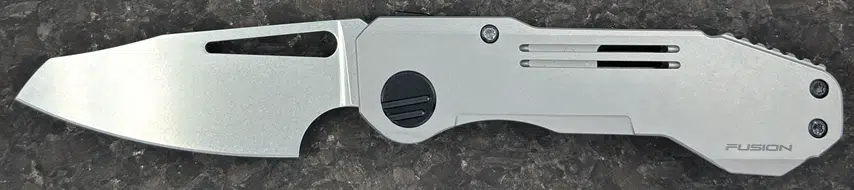
Bryan Winters, whom I, with tremendous respect and admiration, affectionately call Dr. Magnet, has done it again. The acclaimed founder of Winterblade, whose innovative knife designs have become fan favorites across the pocketknife community, has been on a hot streak over the past year (last several years, to be accurate). Over the past year or so, he’s released such bangers as the Severn, the Factor B4, the Darkfire, the X Folder, and now, coming in May 2026, the Fusion. Bryan sent me a prototype version of the Fusion, not the final release version, so I could do a pre-drop review. And while it’s different from previous releases, one truth still comes through – it’s a Winterblade knife through and through. Stay with me as we explore the specs, the details, a design review, and have a little along the way.
TL;DR
The Winterblade Fusion is the latest release by Bryan Winters of Winterblade. He describes the Fusion as a fun, easy-to-carry EDC knife, and indeed it is. He’s updated the overall design of the Fusion relative to many of his earlier releases. The knife is comparatively a bit less geometric (at least in terms of the blade, as it’s a bit less cleaver-y), the opening hole is a bit less angular, and the internals of the handle are a bit less exposed (I’ll explain more about that in a minute). But have no fear, my sibling Winterbladers. The classic, familiar Bryan Winters design language has not been abandoned; the dialect has just slightly evolved. It’s still distinctly a Winterblade knife.
So many of the classic design elements that define Winterblade knives were faithfully retained:
- The huge finger/sharpening choil
- The use of a narrow slot as an opening hole
- The double-grooved, show side pivot face
- The slight upsweep of the blade edge
- The model’s name laser-etched on the rear, low right corner of the show side handle
- The shape, wide and flat, and ambidextrousness of the milled, titanium pocket clip
- The distinct top and bottom beveled edges on the handle
- The micro-beveling around the full perimeter of the handle edges
- The availability of titanium handle scales
- The beveled cutout on the handle for improved opening hole access
But as I said above, there are some specific, noteworthy changes as well. There is 1 less screw in the handle above the pivot (nice!). The handle scales show no visible indications of the locking mechanism, the sleek Stealth Lock PLUS. The handle is adorned with a pair of decorative, horizontal, parallel groove slots (still gotta have that geometry thing going!). And this pocket clip is slightly, almost teasingly, off parallel, skewing slightly upward by what I measure as 1°.
And most curiously, the knife comes out-of-the-box with no magnets! WHAT? Yes, it’s true! Dr. Magnet omitted the magnets in the stock model of the Winterblade Fusion. But there is good news for all you dipole fanatics. Magnets can still pay a role in the Fusion. Bryan milled an inset cup on each internal side of the steel liners into which you can place a pair of disc magnets. So why would you do this? The magnet mounting cups enable you to significantly upgrade the detent strength of the Fusion knife. (Pro Tip: I tried this installation and I absolutely LOVE the difference they make!)
The design of the Fusion is largely an evolution of the original Winterblade Severn, albeit a smidge shorter. But to be honest, it’s more of a fusion (see what I did there!) of many design elements found on several Winterblade knives, including the flagship Winterblade Factor knife, with a few new ideas added for kicks and giggles.
The Winterblade Fusion is a genuine user’s knife. Its sculpted titanium handle is comfortable to hold, the stonewashed M390 blade, which comes hardened to 61-63 HRc (excellent numbers for M390), is easy and satisfying to deploy, and the milled titanium pocket clip has medium-firm retention but remains easy to slip over your pocket seam. The new Stealth Lock PLUS is a beautiful thing to use, although, in my case with the prototype, fresh out of the box, I add a bit of high-quality lube to speed up the break-in process to knife Shangri-La (I discuss this in detail below in the review).
The Fusion is a chunky little monkey at just under 4.5 oz. for a 7.5″ knife, but it feels satisfyingly substantial in the hand, which I really like. The Winterblade Fusion is a perfect EDC knife – if you enjoy stepping up above the otherwise perfectly fine budget category (<$100), carrying a knife that possesses far more premium materials, design, engineering, and a visual style that blows away everything in that budget category. The Fusion knife is expected to drop in early May 2026.
Pros
- Visually stunning design
- Excellently hardened M390 blade
- Radiused internal edges of the opening hole slot that are very comfortable to use
- Perfect blade centering
- Blade spine edges micro-radiused
- Captured D-pivot with custom Winterblade show side pivot face
- Smooth, caged ceramic bearings
- Sculpted titanium scales with beveled handle edges make the knife very comfortable to grip
- Excellent handle access to the opening hole slot
- Exceptional reverse flickability provides a lot of fun
- Stealth Lock PLUS with roomy finger lever tab access due to liner cutout
- Attractive, polished edges on stacked steel liners
- Detent can be dramatically upgraded by adding a pair of disc magnets into pre-milled cups in the steel liners
- Ambidextrous, milled, low profile, tip-up titanium pocket clip
- We have a titanium backspacer!
- T8 all the way
Cons
- Flat scales are so smooth that some may find them to be slippery
- It’s a hefty gal, despite ample milling in the liners and scales for weight reduction
- Clip side pivot face is near Spyderco-level plain
- When the optional detent magnets are added, you lose the ability to use the lock to open the blade
- The large, rear quillon squeezes your fingers into a narrow space
- A fair bit of lock stick out-of-the-box
- No blade spine jimping (but Winterblade knives seem to never have jimping)
Tech Specs
Brand | Winterblade |
Website | |
Manufacturer | Bestech |
Origin | Yangjiang, Guangdong, China |
Model Reviewed | Fusion |
Designer | Bryan Winters |
Model Launch Year | 2026 |
Style | Locking-blade folding knife |
Length Closed | 109.29 mm / 4.303″ |
Length Opened | 190.95 mm / 7.518″ |
Weight | 125.19 g / 4.416 oz. |
Lock Type | Stealth Lock PLUS |
Opening Type | Manual |
Opening Mechanism(s) | Long, asymmetric, obround opening hole slot |
Pivot Mechanism | Caged ceramic bearings |
Pivot Type | Captive, decoratively engraved, flat, PVD-coated, milled stainless steel, captured D pivot with a T8 fastener |
Original Packaging | This prototype knife came in a black, lined zippered pouch with Winterblade embroidered across one side. A 177.80 mm / 7.000″ x 178.96 mm / 7.045″ black, microfiber cleaning cloth is included. |
MSRP & Retail Price | MSRP (estimated): $375-ish |
Edge Type | Plain |
Shape | Angular, modified sheepsfoot (aka Rev-Clipto) |
Material | Böhler M390 |
Finish | Stonewashed |
Claimed Hardness HRc | 61-63 |
Length (from lower half of handle scale) | 82.38 mm / 3.243″ |
Cutting Edge Length | 69.13 mm / 2.722″ |
Height | 31.10 mm / 1.224″ |
Primary Bevel Thickness | 3.16 mm / 0.124″ |
Thickness Behind the Edge (TBE) Bevel | 0.38 mm / 0.015″ |
Primary Bevel Half Angle | 2.64° |
Edge Bevel Half Angle | 12.05° |
Cutting Geometry Coefficient (0.100 and lower will provide excellent cutting performance) | 0.051 |
Sharpening Choil (from handle scale to blade heel) | Length: 20 mm / 0.787″ |
Blade Features | The blade comes in a heavily modified, angular sheepsfoot shape and has an asymmetric, obround opening hole slot that’s 31.48 mm / 1.239″ long and 6.04 mm / 0.238″ tall with a stonewashed finish. The blade has perfectly symmetrical, evenly ground, edge bevel that comes extremely sharp. A large finger choil makes a choke-up grip comfortable but diminishes the cutting edge length. |
Grind | Full, flat grind |
Flat | None |
Swedge | None |
Fuller | None |
Jimping | None |
Blade Markings | Show side: None |
On-Blade Opening Features | Very long, asymmetric obround, opening hole slot |
Flipper | None |
Opening Hole | Height: 6.04 mm / 0.238″ |
Weight | 125.19 g / 4.416 oz. |
Weight to Blade Length Ratio (some prefer a 1.0 ratio) | 1.52 |
Materials | Titanium (either Chinese TC4 or American 6Al-4V aka Grade 5 titanium) |
Finish | Light stonewash |
Length | 109.29 mm / 4.303″ |
Blade to Handle Length Ratio | 0.75 |
Closed Knife Handle Height | 37.64 mm / 1.482″ |
Open Knife Handle Height | 23.34 mm / 0.919″ |
Handle Thickness | 10.95 mm / 0.431″ |
Scale Thickness (includes liner if present) | 3.43 mm / 0.135″ |
Liner Type | Stacked steel with mirror-polished edges |
Scale Texture | Smooth |
Integral? | No |
Handle / Scale Features | Smooth, flat scales with angular, sculpted and matching, lightly-beveled edge cuts on both sides with chamfered edges. Features dual, internal magnet cups for enhancing the detent strength and a pair of long parallel slots at the top edge of the scales that appear to be purely decorative. The scales are internally milled for weight reduction. |
Pivot Type | Captured |
Pivot Mechanism | Caged ceramic bearings |
Pivot Features | Captured, flat, black-coated (PVD?) round, show-side pivot face featuring the standard Winterblade, dual parallel grooves of different lengths. The clip-side pivot face is a smaller, shall-domed, black-coated (PVD?) fastener with a T8 socket. |
Opening Stop Pin Type | The floating, opening stop pin is in the typical location at the top corner of the handle. |
Closing Stop Pin Hits Sharpening Choil? | Technically yes, but far back at the plunge grind |
Lock Type | Stealth Lock |
Lock Features | The Stealth Lock is a coil-spring-based, sliding cartridge system that features a lightly jimped, auto-retractable finger pull tab on the handle spine. The lock design cut away the liners in front of the pull tab, making it easy to access when needed, but virtually disappears when it’s not. |
Detent Type | Detent is supplied by the Stealth Lock’s coil spring, but can be substantially beefed up via the installation of 2 flat magnets inside the scales |
Pivot Center to Balance Point on Handle (0.0 is balanced at pivot) | 21.16 mm / 0.833″ |
Backspacing Type | Backspacer |
Backspacing Material | Titanium |
Backspacing Color | Light stonewash |
Backspacer Length | 35.95 mm / 1.415″ |
Backspacer Features | Short, matte-finished, raised surface with 6 medium-spaced, rounded jimping cuts resulting in 7 elevated crenulations, whose edges have been nicely beveled. |
Lanyard Mount | None |
Pocket Clip | Milled |
Clip Material | Titanium |
Clip Color & Finish | Light stonewash |
Clip Placement on Handle | Ambidextrous, tip-up |
Clip Height in Pocket | Medium-deep carry |
Clip Length | 53.13 mm / 2.092″ |
Clip Length to Handle Percentage (< 50% preferred) | 48.61% |
Clip Features | Low profile, medium deep-carry, wide, flat, full-width ramp-toe with blunt tip and fully beveled edges |
Fastener Sizes | All external fasteners are T8 |
Fastener Features | 3 PVD-coated titanium fasteners per side: 1 at the top edge of the scale to retain the Stealth Lock and 2 used with the pocket clip (the longer, top edge side used to secure the backspacer). These fasteners, as well as the shallow-domed, black-coated, pivot fastener, all have T8 sockets. |
The Origin of the Winterblade Fusion
Bryan Winters, aka Dr. Magnet, wears a number of hats at Winterblade. He is simultaneously the:
- Company Founder
- Chief Engineer
- Head Designer
- Principal Machinist
- Lead Marketer
- Primary Photographer
- Social Media Maven
- Mischievous Mailroom Manager
- Supreme Inventor / Tinkerer

Like all the other knives he’s engineered, his new Winterblade Fusion is a special knife. It uses the now well-established, Winterblade visual design language, but is still unique in its own right. We’re going to be talking about this in detail as we get deeper into this review.
The inventive processes Bryan uses to develop his engineering requirements and knife designs have never before been disclosed to the public. However, thanks to your trusty investigative reporter, The Knife Karen at SharperApex, I have uncovered, for the very first time, the heretofore secret details of the Winterblade product creation and the specific development process used to make the latest knife, the Winterblade Fusion. The following is my report to you, my dear reader (in graphic narrative form, naturally):


What an amazing documentary, right? Of course, there’s a small possibility that I might have gotten a minor detail or 2 slightly wrong, but I feel confident that the story is pretty accurate as portrayed. Sort of. Especially the lab coat. And the nuts and bolts and tools. Yeah. That’s real.
Introducing the Winterblade Fusion
What can I say about the Fusion? Quite a lot, actually. It’s a perfectly sized, comfortable to hold, easy to operate EDC knife. The Fusion is a new variant of the well-recognized Winterblade design style, which makes it simultaneously fresh and familiar. Let’s dive into the deets.

Blade
Winterblade knives are easily distinguishable from other knives just by the designs of their blades. There’s a look, a style, that instantly tells you there’s a Winterblade knife in the house. That’s a truly impressive achievement for what is essentially a one-man shop.

Blade Features
Well known for its high-performing edge retention and excellent corrosion resistance, the popular Böhler M390 blade steel is used in the Winterblade Fusion.
Blade Shape
Previously released Winterblade knives, such as the Severn and the flagship model, the Factor, were identified as having sheepsfoot blades. To my squinty little eye, a sheepsfoot blade has a specific shape and design, and the earlier Winterblade blades, while distinctively beautiful in their own way, were more like modified cleavers than a sheepsfoot. But the Fusion blade design pushes the blade shape closer toward the sheepsfoot national border. It’s not quite at the border checkpoint just yet, but it’s definitely headed in that direction. In my opinion, the blade shape should be called a Rev-Clipto (a fusion of a clip point that morphs into a reverse tanto). Hey, I think we have a new blade shape name here! I like it!
In typical Winterblade fashion, the blade is a stylish, full-flat grind slicer with minimal ornamentation: there’s no swedge, no fuller, and no flat (the ricasso notwithstanding). That leaves us with no multiple grind regions, and no region grind lines to discuss! Easy, peasy, lemonhead candy! That said, the triple segment shape of the Fusion blade spine is a bit of a departure from the more familiar 2-segment, cleaver form of the extremely popular Factor and Severn series of knives.
The Fusion’s blade edge curves upward from the heel at 11°, and the tip of the blade rises from the edge at a sturdy 70°. Even with that blunted point, the spine’s last segment does go down to a very thin edge at the tip, and the blade overall will serve you as a super-slicey cutter.

I have a question, though, about the Fusion blade shape that Winterblade calls a sheepsfoot. Why is a knife blade canned a sheepsfoot? How can this be? What’s the connection? Do these 2 things look even remotely similar?

Oops! My bad! I made a mistake here. I should have said we’re dealing with a “modified” sheepsfoot here. But does that really help? Has anything really changed?

Well, I think not so much.
Now if you want to see a genuine, authentic sheepsfoot pocketknife, all you need to do is take a gander at this model:

Unfortunately, it doesn’t really cut cleanly (at best, it’s more like tearing, if not simply folding over), and it has pretty low edge retention (cloven hoof horns are not high on the HRc scale), not to mention its pathetic toughness ratings (there’s just no logical way to call this thing, as built, “tough”). The actual resistance to corrosion isn’t so good, either (it’ll start to turn black and stink within a month or so), and it’s a nightmare to sharpen (see the reference to cloven hoof horn’s edge retention above).
However, you can’t deny it’s pretty cool because, aside from other blade materials like ceramic, Terravantium (dendritic cobalt) and Tungsten Carbide, an authentic sheepsfoot blade is one of the extremely rare, non-steel-based knives, which makes it a genuine collector’s showpiece, even if it’s kind of gross!
Blade Finish
The Fusion blade comes with a stonewash finish, a nice thing if you want to hide new, minor scratches from daily wear and tear on an EDC knife. I personally prefer a hand-rubbed satin, but will always take a stonewashed blade to blackwash or, really, any form of blade coating with the specific exception of true DLC, especially a near-mirror DLC. Oh, be still my beating heart. However, if someone was to offer me a near-mirror-finished Balinit Mayura with a rainbow spectrum finish (an even harder finish than DLC), I’d happily give that a go!
After discussing this topic, I’m left with the same kind of question again. How did this become associated with pocketknife blades? I’m baffled.

Opening Mechanisms
The Fusion sports 2 blade opening methods out of the box:
- A long, pyriform-shaped opening hole slot
- Stealth Lock PLUS unlock
You can also do a Spydie Drop if you are so inclined, but that’s not an officially sanctioned opening methodology. You do so at your own risk. Read the fine print, man!
The vast majority of Fusion owners will use the opening hole slot the vast majority of time. And luckily for them, Winterblade made it really easy to do so. First of all, there’s plenty of access room, due to generous space on both scales, to engage with that slot. Second, the opening hole slot has very nicely radiused interior edges. They are “soft” to the touch (which my delicate Knife Karen fingers really appreciate!) while retaining a useful grippiness that enables a strong, satisfying as hell opening SLAM! Winner, winner, tuna fish dinner!
The knife can be opened via your thumb with either a sharp flick or a slow roll, but the Winterblade Fusion was built to be reverse flicked. In fact, every Winterblade knife I’ve had the great good fortune to handle has been a reverse flicker first and foremost. And I send my eternal thanks Dr. Magnet for that!

The blade can also be opened by pulling back the Stealth Lock PLUS’s recessed finger tab on the handle spine, similar opening action to crossbar locks, button locks, pivot locks, and more. There’s a big caveat here, however. If you opt to enhance the opening blade detent system with disc magnets (yay!), you’ll be unable to open the knife using the lock tab (boo!). But truth be told, this is a very small sacrifice for a much firmer opening detent! I’ll discuss that in detail in the Locking Mechanism section below.
Lastly, enough of the blade spine sits proud of the handle that a tight pinch and a downward flick will give you the infamous Spydie Drop. While it’s kind of fun, it’ll give you nothing close to the incredibly satisfying, opening BAM of the reverse flick, but hey, it’s your knife. Do what you want, even if it’s silly. Who am I to judge?
Swedge
There’s none. Moving on.
Fuller
There’s none. Moving on.
Spine Features
I’ve made mention of some of the features, or to be more accurate, the omission of features, but let’s continue. The Winterblade Fusion has no jimping. In fact, I think it’s standard practice to omit any jimping on any Winterblade designs, as I can’t remember any that included that feature.
I don’t know why this is. It could be that Dr. Magnet hates the abrasive feel of jimping on his digits. He might believe that jimping is merely a fad and no one really needs it or will miss it. It could be that having blade spine jimping would violate the design aesthetics that the good doctor has established. It could be that adding jimping cuts will increase the potential for establishing points of stress concentrations, a knife design issue that Dr. Larrin Thomas of Knife Steel Nerds said may have been a contributing factor in the broken MagnaCut blade made by the now controversial Bark River Knives. Such stresses could cause blade cracks, even breaks, in knife blades, and generate warranty claims because, you know, some “savvy” knife users actually believe every pocketknife is a batoning tool, regardless of the size. Who knows? Well, Dr. Magnet knows.

The Fusion blade spine doesn’t have crowning. In fact, I think it’s standard practice to omit any crowning on any Winterblade designs, as I can’t recall any that included that feature. While crowning is a feature of both beauty and comfort. Unfortunately, the beauty of soft, curvaceous crowning is likely incongruent with the geometric, angular aesthetic designs of Winterblade knives. But the news here is not all bad. Unlike many other knifemakers, who leave the edges of their blade spines as extremely sharp, unfinished 90° thumbprint shavers (cough, cough, Spyderco, cough), Winterblade applies a radiused edge finish to its blade spines. I really appreciate that wonderful, little touch.
Choil
Do you like a big choil? I’ll get you the biggest choil you’ve ever seen!
All seriousness aside, the Winterblade visual design seems to always features a bloody huge finger/sharpening choil. In the case of the Fusion knife, given the choil length of 20 mm / 0.787″ and choil depth of 8.74 mm / 0.344″, there’s plenty of room for the user to get a comfortable, choke-up grip on the knife. And equally important, thanks to the Fusion’s tall, full flat grind, the blade can be resharpened for years without a significantly negative affect on the very narrow blade edge angle (especially compared to most other pocketknives on the market). Lastly, the perfect placement of the plunge grind in the far back of the choil just adds a bit more good to all the choil goodness here.

The only negative about the Fusion’s bloody huge finger/sharpening choil is the resulting reduction of its cutting edge length (69.13 mm / 2.722″) relative to the blade length (82.38 mm / 3.243″), which means only a mere 83.9% is usable. That said, it still has 2 ¾″ of very slicey cutting edge mounted in a very comfortable, 4-finger handle. Plus, perhaps the most important feature in Winterblade’s knife design with the giant choil is that it looks really damn cool.

Geometry
Many knife reviewers love to talk about the importance of blade “geometry” but never explain what they mean. I’ve covered what geometry actually means when discussing knife blades, so I explained it for them! I recently created a method for calculating primary and edge bevel angles using Excel (and a few key caliper measurements). Using this methodology, you see those measurements and the results below. Cool, huh?

In addition to the blade geometry data up above, I also included a calculated insight score into the blade’s cutting performance potential using a methodology developed by Piratech that they call Cutting Geometry Coefficient. If you know me, you already know I am not smart enough to recall my high school trigonometry (heck, I’ve even forgotten my basic multiplication tables!). Instead, I let Excel calculate this metric for me! Who needs high school after all?
A CGC score of 0.100 and lower is the target. It means the blade is designed to provide excellent cutting performance (assuming it’s sharp!).
Note: The CGC was developed for assessing flat grinds. Hollow grinds with the same score will feel like they cut better than a flat grinds in shallow-to-moderate depth cuts but will become more problematic on deeper cuts (such as across cardboard). In those circumstances, since the CGC score is the same as flat grinds, the performance levels out.
Beyond pure, mathematical geometry, the edge bevels must be sharp. And if you ask me, for any knife above the ultra-budget level, the edge bevel grinds must be even along the whole edge as well as symmetrically ground on both sides of the blade.
The edge bevels of the Fusion are perfectly ground, evenly done on both sides, and the factory edge was very sharp.

Please pardon the non-symmetrical view of these blade sides. Sometimes getting the edge bevel to become illuminated is a bit tricky!
Blade Markings
As is typical for Winterblade knives, where the use of blade markings is limited in use and quite consistent in style, the Fusion pocketknife follows this style. Let’s explore this:
- Show side: It’s blank. It’s always blank. Winterblade show side knife blades are clean, sterile, and beautiful. There’re no distractions.
- Clip side: Minor and consistent. The Winterblade name, with its stylish font, is the company logo, and is always placed under the opening hole slot. The laser etching is done in a way to be quite unobtrusive. Indeed, in some light, held at the right angle, the logo all but disappears completely. I know because it was hard to get a clean, properly contrasted photo!
- Hidden marks. Sometimes Winterblade etches the name of the blade steel under the opening hole slot when, on the slot’s bottom side, it’s angled and comes to a point mid-way through. But the Fusion knife follows the more common Winterblade style of hiding the blade steel name when the blade is fully open or closed. It’s temporarily visible only when the blade is partially open, during which time the Fusion reveals the M390 name etched deep on the ricasso.

I know there are some people who loudly advocate for the elimination of any and all blade markings, heck, even all markings on the handle, from our favorite pocketknives. While I will never be an advocate for applying the equivalent of your credit card’s exhaustive Terms and Conditions statement on the side of a blade (looking at you, Microtech!), I do think showing the manufacturer’s branding is a damn smart idea.
Unlike you and me, the vast majority of pocketknife purchasers and users reflexively buy cheap, low-end-to-utter-crap knife brands like Gordon of Harbor Freight, Ozark Trail, MTech, Frost Cutlery, Tac-Force, Master USA, Snake Eye Tactical, Rite-Edge, Frost Cutlery, Wild Turkey Handmade, Grand Way, Opinel, and so many others (and BTW, you knew that Victorinox, the maker of so many inexpensive Swiss Army Knives, half of which on KnifeCenter are < $25, is by far the world’s largest pocketknife manufacturer, right?).
But once these cheap knife folks get to handle a premium-level knife, in most cases, their hearts melt, their mouths drool (kinda gross), and they get a very bad case of knife lust. And you can bet your sweet bippy, they will want to know the brand name of the knife that has made their heart swoon.
Out in the wild, these beautiful knives are ambassadors for their brands. They should give the besotted knife luster a hint about its brand name. Knife brands that fail to understand that this is minimum baseline marketing are a quart low of brain juice in the noggin.
That said, this isn’t license to go full SOCOM Elite, of course. No one wants to see their knives covered with unsightly crap such as:
- The company’s name and a logo
- Duplicated info on both the blade and handle
- Pointless info, such as a patent number or an inventory code
- Overly large text fonts
- and for the love of all that’s good in life, a URL or a QR code!
Do I really need to say this stuff out loud?

• Right column: Benchmade Mini Barrage (patent number version), KH Blade P12
Blade marking abuse is bad enough. But some knife designers decide to go in whole hog with knife marking abuse, much to the regret of any knife customer with an eye for aesthetics.

• Middle: SOG Gambit
• Bottom: Kershaw Scallion
If the evolution of this visual knife blade marking abuse is allowed to continue unabated, the future is clear. Pocketknives will end up looking like NASCAR.

All I see is blade marker vomit. Who wants that? Decent shape, though.
Böhler M390 TECHE
When I can get the ratings data for the knife steels I review (I primarily gather the data from the authoritative KnifeSteelNerds.com as available), I include it here in a section I call TECHE. What does TECHE mean? Well, you could look at the table below and figure it out, but it stands for Toughness, Edge Retention, Corrosion Resistance, HRc Hardness Rating, & Ease of Sharpening. Clever, huh?
Note that all ratings but HRc Hardness Range are based on a scale from 0-10; Hardness is based on the Hardness Rockwell C scale, which technically is between 20 and 68.


** Ease of Sharpening data is not a rating produced on KSN.
HRc Rating
Bestech reported to Bryan, aka Dr. Magnet, that the hardness of the M390 blade on the Winterblade Fusion is ~62 HRc. If this is true, that is excellent. So many knife makers, including some well-known makers, cheap out and only harden their M390 blade steel to the upper 50s HRc, which is unequivocally unacceptable. 60 HRc should be the minimum for M390, even for coated blades.
So why does this happen? Proper hardening of blade steel takes time, and time is money. However, we, the knife buying public, are paying that money, so we should get what we pay for – properly hardened knife blades!
On the other hand, given the inherent brittle nature of Böhler M390 steel, heat treating it up to and beyond 63 HRc will make the blade far more liable to chip, crack, and break. Given the likelihood of carbide chip out at the edge bevel, you can easily end up with a “serrated” blade, even if you didn’t want one, if you use your knife for anything other than cutting straight lines on thin, lightweight materials. If you torque the blade while cutting, cut into staples or other hard materials, or heaven forbid, do some knucklehead move like using it as a prybar or even dropping the knife while open, you’ll be crying a river over your damaged, expensive knife. Don’t do it, people‼
Note: While generic, steel-type hardness ratings from manufacturer data sheets are a helpful start, knowing how a specific knifemaker hardens their blade steels gets you closer to how well your knife was made. You can get that info by checking out the ever-growing Steel Hardness Lab database to see how specific knife blades made by specific knife brands fared in professionally performed hardness tests. It’s great information, and it’s free to access!
Blade Dimensions
Do you like numbers? I’ll get you the best numbers you’ve ever seen!
- Blade Length (from tip to 75% down the front of handle scale):38 mm / 3.243″
- Cutting Edge Length:13 mm / 2.722″
- Blade Height:1 mm / 1.224″
- Primary Bevel Thickness:16 mm / 0.124″
- Blade Thickness Behind the Edge (TBE) Bevel:38 mm / 0.015″
- Primary Bevel Half Angle:6°
- Edge Bevel Half Angle:1°
- Cutting Geometry Coefficient (0.100 and lower will provide excellent cutting performance):051″
- Sharpening Choil from Handle Scale
- Length: 20 mm / 0.787″
- Depth:74 mm / 0.344″
- Opening Hole
- Height:04 mm / 0.238″
- Length:48 mm / 1.239″
Size Comparisons
I’ve been getting a lot of requests to show size comparisons to the knife reviewed in my post, even though I’m already providing so many exact measurements for every element of the knife. But so be it. I hope this visual size comparison is helpful in determining whether this knife is for you.

• Top: Philip Kubicki Ex Factor Bass Guitar, Wikipedia.org
• Middle: Winterblade Fusion
• Bottom: Wiha T8 Torx bit, TME.com
Knife Body & Scales
As iconic as the blades are with Winterblade knives, the handles are equally important to the knife’s design language and appeal. Let’s explore this.

Handle
The handle of the Winterblade Fusion is made from beautiful Ti-6Al-4V (Grade 5) titanium. This prototype version comes in a natural, light stonewash finish (there are many other models that include color-anodized Ti and even, I believe, gorgeous, anodized Crystal Ti). The handle scales feature dual, parallel grooves that allow you to partially see through to the closed blade’s edge – a new design element for Winterblade knives, in which none of the previous designs had see-through handle elements. Except the top and bottom between the scale standoffs. I guess. Does that count?
The handle has very nice milling features, including multiple areas of broad, edge section beveling as well as fine chamfering along the entire perimeter. The broad, primary surface of the scales are flat and very smooth. But thanks to the sculpted handle shape, my grip on the knife felt secure, but the flat surface was a bit slippery. The addition of some micro-texturing would go a long way here in my humble opinion.
I currently carry a QSP Vault with CPM S90V and a bolster handle sporting gold foil carbon fiber. That knife’s CF finish is so ridiculously smooth and slick that I have already dropped it twice (while opened!). Despite that S90V is considered rather brittle, so far there’s been no damage to the blade (or my foot!). I’ll be writing a review of this knife soon (it’s on my calendar for later this year), and I’ll be discussing this “feature” in critical detail.
The reason I mention my current EDC is because the Fusion, while sporting smooth scales, the handle shape is its saving grace. It mitigates the smoothness concern by making the grip secure while remaining very comfortable. I will reiterate that the version of the Fusion I have is a prototype, so I’m not clear whether the final production models will have changes to the scales. I will say that the version of the Fusion shown on the Winterblade account in Instagram is quite different than this model shown in this review. Clearly, it’s gone through an evolution in style and design. We’ll see what the final version looks like when it drops in May of 2026.

Locking Mechanism
This is the section I’ve been waiting to write. I have interesting news, unfortunate news, and final redemption news to share. Let’s start with the interesting news.
Interesting
If you’ve read my review of the Winterblade Severn, you’ll recall the locking mechanism section where I introduce the original Winterblade Stealth Lock. As I said there, it was as if the Snecx Superlock had a mechanical knife baby with both the Benchmade Axis lock and the Demko Shark Lock (okay, a 3-way, knife-based, mechanical baby is a really weird thought). I showed this image of the internals of the Severn, which included the early Stealth Lock mechanism.

The Severn had both a jimped, handle spine finger tab and a connected crossbar cassette mechanism to release the lock. The cassette used a compressed coil spring that pushes against a pin to move itself forward, where it engages a flat on the blade tang to secure the blade open. The cassette is set in place by a pair of protruding pins that ride in slots cut into the scales. It’s a strong, secure system.
Dr. Magnet has made some improvements to his original design for the Fusion and has dubbed the new version (at least for the prototype I have) the Stealth Lock PLUS. I like it!


• Bottom: Winterblade Fusion with the new Stealth Lock PLUS
These lock improvements include:
- The Fusion Stealth Lock PLUS finger tab, which lies nearly flat when not in use but can be hinged up 24° when needed, is now 65% wider than the Stealth Lock tab on the Severn, improving the ergonomics of the lock interface.
- The Fusion’s finger access area in front of the lock’s finger tab was widened by removing part of the steel liners.
- Removal of the crossbar part of the lock mechanism. I don’t know why this was done, to be honest. There are folks, such as Metal Complex, who regularly asserts that people are “bored with crossbar locks.” I don’t feel that way, myself, especially when compared to frame locks, invented in 1987, and liner locks, first appearing on modern pocketknives in 1981. Given the Benchmade AXIS Lock patent only expired back in 2018, the crossbar lock is still relatively new. When pressed, he’ll say he’s more annoyed with the omega springs, although he admits he’s never had one break. Neither have I, but others apparently have. Perhaps this regular anti-crossbar lock commentary had an influence on Bryan’s decision to omit that feature in the latest version of the Stealth Lock PLUS. To be honest, I miss that element.
- The cassette is much shorter, as is the coil spring, while the lock’s coil spring pin is more robust. As a result, the lock cassette on the Fusion doesn’t sink below the handle spine as it does on the Severn. Instead, it remains flat and level on the spine. Additionally, the heel of the blade no longer intersects with the closed cassette position, which was split on the Severn to accommodate the blade.
- The closed blade stop, which used the lock cassette in the Severn, was reconfigured for the Fusion. The new lock has an actual closed blade stop pin. The cassette was also modified to have much deeper engagement with the blade tang to give the knife both a better baseline detent, and a more robust, secure lockout.
- The blade tang on the Severn merely rested against the open stop pin. In the new Fusion design, the open stop is shouldered inside a slot cut into the blade tang, adding more blade security to the design.
- Lastly, the lock’s finger tab on the Fusion was repositioned forward on the handle by 6.03 mm / 0.238″, further improving what was already good access with the Severn.


Overall, the entire internal structure of the Stealth Lock was reconsidered and optimized in the Stealth Lock PLUS for better performance. Very nice work, Dr. Magnet‼

Unfortunate
In the case of the new prototype I received for review, the knife came with pretty significant lock stick as well as some grinding with the pivot action. I reported this to Bryan, and he said he really likes dry PTFE (Polytetrafluoroethylene, aka Teflon) as a lubricant. He immediately offered to send some out to me and offered his sage advice on how to resolve this.
Well, your little, old trusty investigative reporter here was impatient. I found some PTFE silicone grease (food grade, if you can believe that!) in the back of a long-untouched tool drawer (you know the one; it has rubber bands, unused screws, carpet pads for furniture, dried out pens, tons of various kinds of packaging, duct and electrical tape, and so much more) in my house. I wanted to give this a shot.
Redemption
Per Bryan’s instructions, I disassembled the knife, soaked the bearings, the lock cassette and the spring in pure acetone for several minutes. I completely removed the black grease that Bestech had applied to the Stealth Lock PLUS cassette pin slots in the scales (through the liners). Once all the components were squeaky clean, I applied a layer of the PTFE grease in the handles’ cassette pin slots, on the edges of and inside the cassette’s coil spring housing, and along the blade tang. I also added some KPL 15 wt knife oil to the bearing races and bearing blade interfaces. I then reassembled the knife.
The change was immediate and revolutionary! I had a brand new knife! The lock stick was 100% gone. The pivot grind was vastly improved, too. I still can just barely feel the bearings when the blade is between approximately 60° and 90° open, but the feel I detect is at least 95% reduced. I will apply just a bit more of the PTFE, along with some active break-in work, and I have no reason to believe that this will disappear as well. Bryan also sent me some new bearings, but I’ve installed these yet, as I am satisfied enough to finish this review.
This house is clean.
Liners
Unlike the Severn, the Winterblade Fusion incorporates stacked steel liners in its design. The edges of the liners are nicely polished, giving the handle a nice look. I have to assume the liners were added as a cost savings measure. The Severn’s Ti scales measure 3.45 mm / 0.136″ thick, whereas on the Fusion, the Ti portion of the scales (excluding the liners) measure 1.96 mm / 0.077″ thick. Steel is significantly less expensive. While we still get the look and feel of titanium on the handle, we get a lower end price for a Winterblade knife. I see this as a clever win for the good doctor as well as us, his customers!

Pivot
The Fusion, like all other Winterblade knives I have encountered, comes equipped with a D-style captured pivot running on caged, single row, ceramic bearings.

The show side pivot face features the familiar Winterblade design of 2 parallel grooves (hey, that’s in the handle scales, too! Yeah, no ship, Sherlock!) that start at the front-pointing edge of the face and stop before they reach the other side. The pivot faces are unadorned with pivot collars – they’re just the pivot faces. I’ve noticed that these lines are never level to the knife’s centerline, which I think is a whimsical design feature. It shows Bryan incorporates a clever sense of humor in his designs, which I appreciate!

There is a popular old saying of criticism about the design of the typical Spyderco pivot faces: “To retain a pivot plain is in the domain of the insane.” Why do I mention this famous quote? Well, perhaps Dr. Magnet was fiddling with his Spyderco Shaman a bit too long when designing the Fusion. The clip side pivot face is very plain, especially compared to the flagship Factor. However, the basic, shallow dome hosting a T8 socket, is largely the same design used on the Severn, so perhaps not?
Detent
The default, out-of-the-box knife opening detent comes from the Stealth Lock PLUS coil spring. It’s okay, and is certainly better than the even lighter, soft detent of the Severn. Many people will be happy with the Fusion’s default, moderate detent. However, I do enjoy a bit of stiff resistance to my hand (if you know what I mean. And if you do, let me know what I mean, because I don’t know what I mean). Luckily, Dr. Magnet has us detent hounds covered.

In the steel liners, Bryan added a pair of recessed cups. These cups are there to hold a pair of disc magnets. On Dr. Magnet’s specifications, I bought a pair of 3/8″ x 3/32″ neodymium rare earth disc magnets at grade N42.
Nerd Notes:
- In the grade N42, N designates the material type, which in this case is neodymium (aka NdFeB). The number identifies the material’s strength. Magnet geeks will know the magnet’s strength ratings are the maximum energy product (aka the BHmax), represented in units of measure increments called MGOe (aka Mega Gauss Oersteds). The higher the MGOes, the stronger the magnet. I’m not a magnet geek, so I have no clue what I just wrote. Do you?
- I’m not sure if you can buy even stronger N52 disc magnets in this size (I didn’t see any), but if you find some, I highly advise against it. N42 is an excellent choice. You may discover that N52s will cause the knife to be unopenable!

With the addition of a pair of N42 magnets, the increase in detent strength is friggin’ fantastic! We don’t get a lockbar detent ball on Winterblade knives, so if you want a former flipper for your finger, follow the gauss groupies and add a pair of these magnets to your Fusion knife. It’s so much more satisfying to snap open the knife with a strong detent. And, of course, the closing detent practically sucks the blade back into the handle once it gets close enough. I love this upgrade!
Pro Tips:
- Have you noticed the Sharpie marks on the magnets in the disassembled knife photos? This is how I ensured my magnets were installed correctly. Both north and south sides of the disc magnets, which are not identified on the magnet, will be attracted to the steel liners. You must apply the magnets relative to each other’s polarities so that they are installed north-to-north or south-to-south, opposing one another. I carefully detected which sides of the pair repulsed one another and Sharpied them up (the ink wears off easily, so really mark them up!). Trust me on this, if you don’t match up the opposing polarities correctly, you ain’t poppin’ your blade out of that handle. The magnets will work in unison to keep it in place.
- If you aren’t careful in your polarity checks, the fragile neodymium N42 magnets can smash each other to pieces if they slam together. Order more than 2. Trust me on this.
- You need to have 2 magnets. Trust me on this, too. Using just 1, once the knife is reassembled, the magnet will abandon the steel liner and hop onto your Fusion’s M390 blade. You ain’t poppin’ your blade out of that handle in this case, too.
- If you really only want the relative strength of 1 magnet, I understand that some super glue or epoxy will help, although that’s a permanent change (normally with 2 magnets set up in opposition, no adhesive is needed; magnetic repulsion holds each other in place).To get a lower power magnetic detent, I advise you try a pair of thinner (1/16″ or 1/32″) magnets instead. It’s cleaner, more balanced, and the magnets are easily removable as well (but they will be more fragile, too).
- If you do decide to add magnets to the knife, you’ll lose 1 feature. Out-of-the-box, you can pull back on the Stealth Lock PLUS’s finger tab to release the closed blade for opening. But once the magnets are installed, the blade will be firmly held in place – that’s the detent! You’ll need a more forceful means to open it, such as a fantastic reverse flick! To me, that is a good trade!
Stop Pins
The Fusion comes with a pair of floating stop pins: A beast-mode, open stop pin and a dainty, skinny little thang for the closing stop pin. Note that technically speaking, the closing stop pin does impact the blade choil. However, as already mentioned, the Fusion has a bloody huge choil, and the impact zone is just barely ahead of the plunge grind.

If you kept sharpening your Winterblade Fusion all the way down to where that actually matters, you will have removed 28.1% of your blade height, leaving you with a friggin’ freaky lookin’ knife. Seriously, at that point, just buy another Winterblade, OK? Don’t torture your knife like the fool who owned this knife did.

Blade Centering
Good news! The Winterblade Fusion came centered. Did you expect anything else?

In case you need glasses or are crazy and trying to read this whole knife review on your phone, here’s a close-up.

Backspacer
When I reviewed the Winterblade Severn, I groused that beautiful knife not having a proper backspacer. Not that I can take credit for this, but check it out now, sistuh! The Fusion has a proper backspacer‼ Woot! Woot! This makes me happy!

The backspacer is made of titanium and comes in the same light stonewash finish as the handle scales. Even more interesting, this is the only place on the Fusion pocketknife where a semblance of jimping appears. The backspacer comes with 6 medium-spaced, rounded jimping cuts resulting in 7 elevated crenulations, whose edges have been nicely beveled. It’s comfortable, elegant, and looks refined. Very cool, Dr. Magnet‼
Lanyard Mount
This is a very dark day for the last 3 dudes in the world, Jordan, Kent, and Owen, who give a rat’s patootie about lanyards. I told them that the Winterblade Fusion was specifically designed to not have a lanyard attached, as any proper premium folding should. They cried rivers of tears until they realized this knife costs more than their standard MTech. At that point, they crawled back into their respective mommies’ basements and went back online to complain and ruminate with their ilk on BladeForums. Too bad, so sad.
Sticks, Rocks, Lashes and Play
Sticks and stones may break my bones, but knives will always be more awesome than crappy sticks and stones. I mean, c’mon!
- Lock Stick. Some lock stick was detected when out-of-the-box new. However, after speaking Dr. Magnet and understanding the strategy he uses in cases like this, I cleaned the Stealth Lock PLUS locking cassette, the coil spring, and the bearings (why not?) in pure acetone. I also thoroughly cleaned the handle scales where it meets with the lock cassette pins and blade bearings. I then applied a thin layer of PTFE-enhanced silicone grease to the lock, the blade tang edge, and a few drops KPL 15 wt knife oil to the bearings. The lock stick was completely resolved!
- Lock Rock. N/A. The Fusion has no lockbar.
- Blade Play (Up-or-Down, Side-to-Side). The blade is securely held in place with no movement whatsoever.
- Detent Double-Clutch. When the lock releases the blade, it falls free.
- Detent Lash. The detent is based out-of-the-box on the Stealth Lock PLUS coil spring, and I’ve upgraded this knife’s detent with a pair of N42 disc magnets. That closed blade’s not going anywhere.
- Pivot Lash. Extremely slight. I detected a tiny amount of blade wiggle around the pivot barrel. Keep in mind, though, that the knife I am reviewing is a prototype.
- Blade Bounce. It’s impossible, anyway. There’s no chance for blade bounce when the blade is firmly held by a pair of disc magnets!
Ergonomics
The Winterblade Fusion is infused with ergonomic design elements in its pocketknife DNA. Let’s take a quick look.
- Blade:
- The spine edge angle has been micro-chamfered, which keeps that part of the knife comfortable to the hand.
- The perimeter of the opening hole slot has also been micro-chamfered, making the blade deployment a total joy.
- The default opening detent, based on the spring tension of the Stealth Lock PLUS cassette, is comfortable and perfectly workable for most people. But if you enjoy breaking through a firmer detent, take advantage of the pre-milled magnet cups inside the liners. Adding a pair of 3/8″ x 3/32″ N42 disc magnets significantly increases the detent by adding magnetic attraction upon the blade. The increase is not overly powerful – not at all! I experienced much harder detent ball pressure on the recently reviewed Poikilo Tuna and Kunwu Excalibur What the magnets add to the Fusion is an initial, firm blade retention within the handle. That extra level of retention is exactly what you want to experience when opening a premium knife.
- The massive finger/sharpening choil on the blade enables a very comfortable choke-up hold spot for your index finger, offering a secure, agile grip on the handle.
- Handle:
- The handle has broad, beveled regions along the edges, and there is micro-chamfering around the entirety of the handle perimeter.
- Access to the opening hole slot is excellent due to a scalloped cutout along the bottom edge of both sides of the handle scales.
- Despite having very smooth, flat scales, the shape of the handle provides a comfortable and secure grip feel in hand.
- The wide and flat milled Ti pocket clip placement is medium-high carry, and its clip-length-to-handle-length-percentage is 48.61%. This means the clip generates no hotspots in the palm, offers medium-firm pocket retention, and is straightforward, simple for getting the clip over your pocket seam.
- The Stealth Lock PLUS finger tab, when not in use, is all but fully retracted into the handle spine, ensuring there are no hotspots in your palm.
- The Fusion’s Stealth Lock update offers a 60% widened finger tab (compared to the original lock on the Severn). It sits in front of a widened access space.
- The lock’s finger tab has been moved forward, 03 mm / 0.238″ closer to the front on the knife (compared to the Severn), making the lock easier and more comfortable to use.
- While the weight of the knife, 125.19 g / 4.416 oz., is a bit on the high side given its overall length of 190.95 mm / 7.518″. But I personally find ultralight knives to feel less substantial, less secure, and make me feel less confident when using them. The Fusion is a solid-feeling knife that is a joy to hold.
- Comments and Wishes:
- If you have normal-sized hands, and you grasp your knives with a tight-fisted hammer grip fully on the handle, the Fusion will not be as comfortable as with some other knife handles. The end of the handle’s bottom side, opposite of the backspacer and underneath the pocket clip, the area called the rear quillon, features a prominent bulge. The front of the handle just under the pivot, known as the front quillon, also has a prominent bulge. The region between the front quillon and the rear quillon is not very wide. At a modest 71.54 mm / 2.817″, the narrow-ish width between the quillon peaks will cause your lil’ dinky pinky finger to rest on top of the rear quillon. If you’re just slicing open delivery packages, you likely won’t notice or care. But if you go full gorilla, hammer-time fist grip, it won’t be long before your hand starts screaming, “You can’t touch this – without discomfort”.
- Note: if you have very small hands, then lucky for you, as the accessible handle length is not an issue.
- If you have normal-sized hands, and you grasp your knives with a tight-fisted hammer grip fully on the handle, the Fusion will not be as comfortable as with some other knife handles. The end of the handle’s bottom side, opposite of the backspacer and underneath the pocket clip, the area called the rear quillon, features a prominent bulge. The front of the handle just under the pivot, known as the front quillon, also has a prominent bulge. The region between the front quillon and the rear quillon is not very wide. At a modest 71.54 mm / 2.817″, the narrow-ish width between the quillon peaks will cause your lil’ dinky pinky finger to rest on top of the rear quillon. If you’re just slicing open delivery packages, you likely won’t notice or care. But if you go full gorilla, hammer-time fist grip, it won’t be long before your hand starts screaming, “You can’t touch this – without discomfort”.

- I’d love to one day see a Winterblade knife that would include:
- Contoured handles
- Crowned blade spine
- Blade Jimping
- I’d love to one day see a Winterblade knife that would include:

I understand the above wishes are probably not really in the Winterblade design language, but Bryan has been stretching that language with each new release. I believe the blade jimping could potentially happen first, given the crenulated backspacer used in the Fusion. It could be seen as a call and response in the design. In that spirit, a crowned blade spine could also be a call and response with a slightly angular, “crowned”/contoured handle body. But then again, I am a curvy, old gal myself. Curves are good!

Handle Dimensions
Sometimes, when you are feeling down, unsure about what is going on in this crazy life, you can find solace in knowing that I have the numbers!
- Weight:19 g / 4.416 oz.
- Weight to Blade Length Ratio (some prefer a 1.0 ratio):52
- Handle Length:29 mm / 4.303″
- Blade to Handle Length Ratio:75
- Closed Knife Handle Height:64 mm / 1.482″
- Open Knife Handle Height:34 mm / 0.919″
- Handle Thickness: 95 mm / 0.431″
- Scale Thickness (includes liner if present):43 mm / 0.135″
- Pivot Center to Balance Point on Handle (0.0 is balanced at pivot): 21.16 mm / 0.833″
- Backspacer Length:95 mm / 1.415″
Hardware
The Winterblade Fusion is well-equipped with solid quality accessory hardware. Let’s take a look at the deets.
Pocket Clip
Dr. Magnet loves his titanium (so do I!), so when I saw the Winterblade standard, milled, straight, wide, flat-topped, relatively shallow, medium-deep pocket clip with a full width ramp toe added to the Fusion, I was pleased. This knife comes with a light stonewash Ti clip, and I trust there will be the gorgeous Timascus pocket clips on higher end models as well.
Interestingly, the clip is ever so slightly canted toward the handle spine. I’ve never seen this in previous Winterblade knives. I don’t believe this was a requirement based on the rear handle shape. The clip could have been straight-mounted like on the Severn and the Factor; the ramp toe would have been right on the beveled cutout, but it could have been done. Because it wasn’t, I see this as another touch of Bryan’s design whimsy like what we see on the show side pivot face.
The pocket clip length is 53.13 mm / 2.092″ long, which given the handle length of 109.29 mm / 4.303″, the clip-length-to-handle-percentage is 48.61% (just under the 50% that many people use as the threshold for proper clip length). It’s an excellently designed, functionally perfect pocket clip, one of the iconic features I really appreciate on Winterblade knives.

Fasteners
Consistent with the Winterblade design style, all the fasteners used:
- The clip side pivot face
- The single knife body screw (on both sides) which supports the Stealth Lock PLUS cassette and spring
- The 2 screws at the back (on each side) that retain the pocket clip, and the higher screw (relative to the handle spine) also retains the backspacer – and secures the rear handle
are all T8! With the captured pivot and the universal T8 fasteners, you’ll never need anything more than a single T8 bit driver to do knife maintenance. I love this customer-oriented thinking from Winterblade.

Hardware Dimensions
There’s not many metrics to talk about here, but it’s still important data. And this is what I got:
- Clip Length:13 mm / 2.092″
- Clip Length to Handle Percentage (< 50% preferred):61%
- Fastener Sizes: All T8
Design Considerations
Winterblade design is visually clear. When you see the pocket clip, or the blade style, the opening hole slot, the handle shape, or the beveled sections of the scale edges, you immediately know you’re looking at a Winterblade knife vs. any other brand. Does this design language box in what Winterblade can do? I say no.
I have clearly seen Winterblade knife design stretch its boundaries with each release. Check out the photos below.

2nd: Winterblade Factor B3
3rd: Winterblade Factor B4
Bottom: Winterblade Fusion
From the Severn through the Factor knives to the Fusion, there were significant refinements made to the Winterblade knives. The locking systems were continuously improved (the Factor series uses the Winterblade M-Lock, while the Severn/Fusion knives use the Winterblade Stealth Lock, all which were custom-engineered designs from our engineering genius, Dr. Magnet (aka Bryan Winters, of course).

Aside from the locking system improvements, Dr. Magnet was always striving to find new and innovative ways to incorporate magnets into his Winterblade designs (naturally). The Severn used a strong ring magnet to retain the single thumb stud, and the Factor uses a magnet as part of its default detent system. Surprisingly, the default Fusion doesn’t actually have any magnets out-of-the-box, so I resolved to fix that by adding detent-enhancing dual disc magnets to the knife’s liners. Magnets should always find their way into Winterblade knives!

The use of opening hole slots as both a functional opening mechanism as well as a strong aesthetic design statement are always a part of the Winterblade visual composition. The same goes with the blades themselves. Common elements are the blunted nose on the angular, modified sheepsfoot (or mini cleaver) blade shape, backed up by a very large finger/sharpening choil.

The body shapes always have an angular element to them as well.
However, in the case of the Fusion, there are subtle but new design changes that are noteworthy:
- The steeply angular nature of previous Winterblade blade shapes was slightly morphed into some sort of new variant shape that might be called a Rev-Clipto (a clip point that morphs into a reverse tanto). Hey, I think we have a new term here! I like it!
- We also have the shortest, as well as the simplest, opening hole slot used to date.
- We also have the steepest blade belly rise seen to date, where previous models were either nearly straight edge or had a very modest blade edge rise. (The Factor B3 looks steep as well, but its orientation in the photo doesn’t start at 0° like the Fusion.)
- Did you notice the V notch between the top of the ricasso and the top front edge angle of the handle? All previous knives had similar top front handle edge angles, but the blade ran straight through it. The Fusion, well, shows a bit of ankle, if you know what I mean. (Yeah, you do.)
The body of the Fusion adds several entirely new elements:
- The bottom of the handle is not a shallow-angled, singular curve, but instead now it has multiple levels on which the user’s fingers can add grip onto the handle.
- The bottom of the handle has large, bulbous quillons on each end.
- There’s also a backspacer, which is new to the Winterblade line of knives, and it features jimping-like crenulations (might blade spine jimping come next?).
- There are a pair of parallel grooves milled into the handle scales. Their purpose? Near as I can tell, it’s purely a style element. It isn’t a pair of drain hole if the knife gets wet (the Fusion is not an integral, which means it’s open on the top and bottom of the scales! It’s also not easy access for maintenance and lubrication (duh!). The best thing I can think of is that it’s a design call and response to the 2 parallel grooves found on the show side pivot face. Is that it? Does it have to be?
- The Fusion finally comes equipped with an extra pocket clip screw to fill the previously empty hole on the opposite side of the handle! Very cool!
- And speaking of screws, there’s 1 less screw along the topline of the handle. Hurrah!
I realize I am missing comparisons to other Winterblade knives, such as the X-Folder, the Factor 8ight, the Veyron, the M-Fire, the Darkfire, the Greywalker, and more. And taking a quick browse at the official Winterblade page on Instagram, where so many images of Dr. Magnet’s designs exist, there’s countless caveats and yabbuts. I can only do so much comparison work, my friends, so I am sticking to the knives I’ve handled. And that’s all I have to say about that.
I do hope that one day, a beautiful day, sometime in the not-so-distant future, we might see a Winterblade knife with one or more (may all) of these features:
- A fastener-free handle
- An integral handle
- A contoured handle
- Magnetic, replaceable scales
- A jimped blade
- A MagnaMax blade
- A mirror-polished DLC blade
- Maybe even a Balinit Mayura blade finish!
- A Giga-style, full-dress Winterblade
As the repertoire of Winterblade releases continue to build, the design style lexicon of Winterblade will continue to evolve and grow. I love what I see, and I can’t wait to see what’s next!
Weight
I poke fun of the Winterblade Fusion’s weight, but it’s not really a serious issue for anyone who can lift more than a Twinkie. But if a Twinkie is all you can manage to lift, then the weight of the Fusion pocketknife is the least of your problems.
The Fusion, whose handle consists of titanium scales stacked over stainless steel liners, is seriously milled for weight reduction. The weight of the Fusion comes in at 125.19 g / 4.416 oz. This, along with the blade length of 82.38 mm / 3.243″, gives the Fusion knife a weight-to-blade-length-ratio of 1.52. Some folks might call that a chubby little monkey, but I really appreciate the feel of something substantial in my hand (if you know what I mean), and the Fusion has it in spades.

Original Packaging
I’ve always handled prototype Winterblade knives, so I don’t really know what the full retail packaging looks like. What I received wrapping the Winterblade Fusion is a black, nylon folding pouch that zippers closed. The Winterblade name is embroidered on the front. Is this it, or is there more?

The pouch did include a nice, large, black microfiber cleaning cloth that measures 179.51 mm / 7.067″ x 178.75 mm / 7.037″ you can use to keep your Fusion looking like the bomb.

Knife Karen Nitpicks
I am really impressed by my experience in handling the Fusion pocketknife! I mean, it was great! Really great. Yeah, sure it wasn’t perfect, but it was close, right? Sure, if it weren’t for a thing or two, it would be totally perfect, right? These are little nitpick things, so they don’t matter that much, really. They would be easier to get over if they weren’t annoying. Hmmm, I’m not sure if I should say something. You know, the dude will never know if I don’t speak up! Hey, I need to speak to the manager‼
- The main body portion of the scales are flat. Not contoured – they are just flat and smooth – no added texture whatsoever. In fact, they are so smooth that they are slippery. It’s a good thing that the bottom of the handle has sculpted regions for finger grips, or you might drop it or something!
- This knife is a hefty homunculus, despite milling for weight reduction. If you’re an indolent sloth, so consumed by lassitude and enervation that you can’t lift anything heavier than a Twinkie to your overused gob, you’ll find the Fusion really heavy.
- The plainness of the clip side pivot face is the stylistic antithesis of the fancier show side pivot face. I mean, it’s not a Spyderco plain pivot (which I believe is just a Home Depot machine screw), but it’s closer than it should be.
- When a couple of disc magnets are added to the steel liners to enhance the action of breaking the detent, you lose access to using the lock to open the blade. Technically, that problem’s on me, because the knife doesn’t come with magnets, it’s my choice to install them, and it’s not a design flaw, as the magnets will naturally retain the blade, but still, I wanted to complain…
- I was surprised to experience a fair bit of lock stick when the knife came to me brand new. Admittedly, the knife is a prototype version, so this issue could easily be an anomaly. And, well, I did completely resolve it by cleaning the lock parts and inside the scales with acetone, then relubricating the entire locking mechanism with a PTFE-based silicone grease. Sure, it was like a whole new knife, and I love it and everything. But why can’t Bestech do a better job of lubing a new knife with something better than booger glue? Sheesh!
- The handle space length between the bulbous front and rear quillons on the handle doesn’t leave enough room for a glorified gorilla grip! It’s like when you went to the doctor, raised your arm above your head and said, “Doc, it hurts when I do this”, and the doctor says, “Then don’t do that.” So don’t do a glorified gorilla grip, and you’ll be fine.
- The blade spine has no jimping. Technically, I don’t think any Winterblade knife has ever had jimping. And heck, it could induce stress concentrations. Still, I’m just sayin…
Price
I have been working with the prototype version of the Winterblade Fusion during this review. The knife is due to drop sometime in May, and Bryan told me that, while final prices had not been finalized, he said a ballpark price of maybe $375-ish or so would likely be accurate. Hopefully. Do you have a better guess? If you read this after it’s been released, then you know better than me.
Verdict
First of all, I will repeat one again that the knife I’m reviewing is a prototype version of the Winterblade Fusion pocketknife, a model that is slated, at the time of this writing, to be dropped in May 2026. If the final release version is slightly different than the knife in this review, I apologize for any inconvenience. My personal time machine is down at the moment, waiting for another carbonic rectangularium crystal to arrive from Temu. As such, I wasn’t able to grab the knife on release day and then bring it back to now to write my review. (Don’t you hate when that happens?)
The Winterblade Fusion is the latest evolution of the Bryan Winters (aka Dr. Magnet) Winterblade knife design language. You immediately know a Winterblade knife when you see it, even if you’ve never seen the particular model before. This is true for the Fusion. This new knife sort of looks like it’s a smaller, younger cousin of the original Severn, but it’s not a Severn. However, it’s clearly still a Winterblade knife. The updated design iteration proudly has some new features to show off.
First of all, instead of the very familiar, cleaver-like, sheepsfoot-ishy (is that a word?) blade shape of the Severn and the Winterblade flagship pocketknife, the Factor, we have a newly designed blade shape, what I call the Rev-Clipto (a clip point that morphs into a reverse tanto; I’ll be trademarking that name very soon now). Despite the blade shape being new, it’s still very clearly a design of Doctor Magnet (aka the founder of Winterblade, Bryan Winters). The familiar opening hole slot, the position of the plunge grind, the huge finger/sharpening choil, the logo placement, and the well-ground cutting edge reveal its Winterblade heritage in a mere glance.
The handle of the Fusion has a few design changes that are great, but don’t sacrifice the brand identification. For example, there are 2 parallel groove cuts milled into the top portion of the handle scales. There are unusually prominent front and rear quillons (compared to the Severn, whose quillons were short and small, and the Factor had none at all). There is 1 less body screw on the handle body, which is a step in the right direction (I want to see a version of the Winterblade design that has no visible fasteners!). We even have a titanium backspacer installed! I’m not taking credit or anything, but I did mention the missing backspacer in my review of the Severn.

The Fusion is a 190.95 mm / 7.518″ long knife when open, comes equipped with an 82.38 mm / 3.243″ long, stonewashed Böhler M390 blade and sports a pair of 109.29 mm / 4.303″ long, light stonewash-finished titanium handle scales stacked on top of polished-edged stainless steel liners. One of the most intriguing features is the proprietary, Dr. Magnet-engineered Winterblade Stealth Lock PLUS blade lock. It works by retracting a hinged, recessed finger tab attached to an in-handle lock cassette, which is, by default, pushed forward by a coil spring. When the blade is fully extended, the cassette body sides onto a flat, milled section of the blade tang to lock in, and the pressure of the same cassette spring keeps the blade held in place within the blade channel when closed.
While the Stealth Lock PLUS’s coil spring detent is decent, Dr. Magnet thoughtfully added a pair of milled, shallow cups into the steel liners into which a pair of small disc magnets can be installed. Doing so will significantly enhance the detent feel. I immediately jumped on this suggestion and purchased the pair of small magnets. If you enjoy breaking through stronger closed blade detent pressure when opening your knife, you need to try this tiny addition. It’s like having a virtual, strong detent ball to overcome.
The last recommendation I have is to disassemble and clean the lock parts and the lock cassette pin slots in the handle scales with pure acetone. Then add new lube. I tried a silicone grease fortified with PTFE. The minor lock stick the prototype initially had was immediately resolved. To me, between the detent magnets and the PTFE grease, the changes were revolutionary. The knife is yours to enjoy, so do what you like. But the above upgrades offer very impressive benefits!
The knife was described to me by Bryan Winters to be a fun-to-use, everyday EDC knife, albeit one with very high design features, sculpted titanium handle scales, a full-flat grind M390 blade hardened to between 61 – 63 HRc, a titanium backspacer and pocket clip, and T8-only fasteners. A $375-ish EDC is an oxymoron to some. But if you yearn to try the Winterblade experience, the Fusion is an excellent choice. Enjoy! 